



Let’s start with the bottom line: We are going to win.
That was far from clear in January. An autocrat had just been re-elected with what he viewed as a mandate to dismantle American democracy. His shock-and-awe-filled first few months were maximally destructive and sowed fear — intentionally — across the land.
But he was met with a counterforce: millions of Americans and organizations like Protect Democracy and our peers, determined to activate our system of checks and balances. He has repeatedly tried to override those checks, and has damaged them materially. But just as our flag was still there after the British bombing of Fort McHenry — as Francis Scott Key memorialized in our national anthem — so too is our democracy still there.
And what’s more, he is losing the race against time and has failed to sufficiently consolidate power before becoming deeply unpopular, which was the recipe we knew would be necessary to prevent a full-on collapse into autocracy.
So while extreme danger still exists for our democracy, and many communities in our country still live in daily terror from the regime’s abuses, we can now see a path to defeating the autocratic assault and turning this crisis into opportunity.
That is only possible because of communities like this one. Because of what we’ve all shown ourselves capable of doing, we are confident that democracy and freedom will prevail.
The race against time — and why 2025 was so pivotal
Donald Trump still has three years left in office. But it is possible that none of them will be as dangerous as 2025. If that turns out to be true, it will be because of a fundamental feature of authoritarian consolidation: Extinguishing democracy is a race against time, a sprint to seize enough power before political discontent and backlash constrain the autocrat from entrenching power.
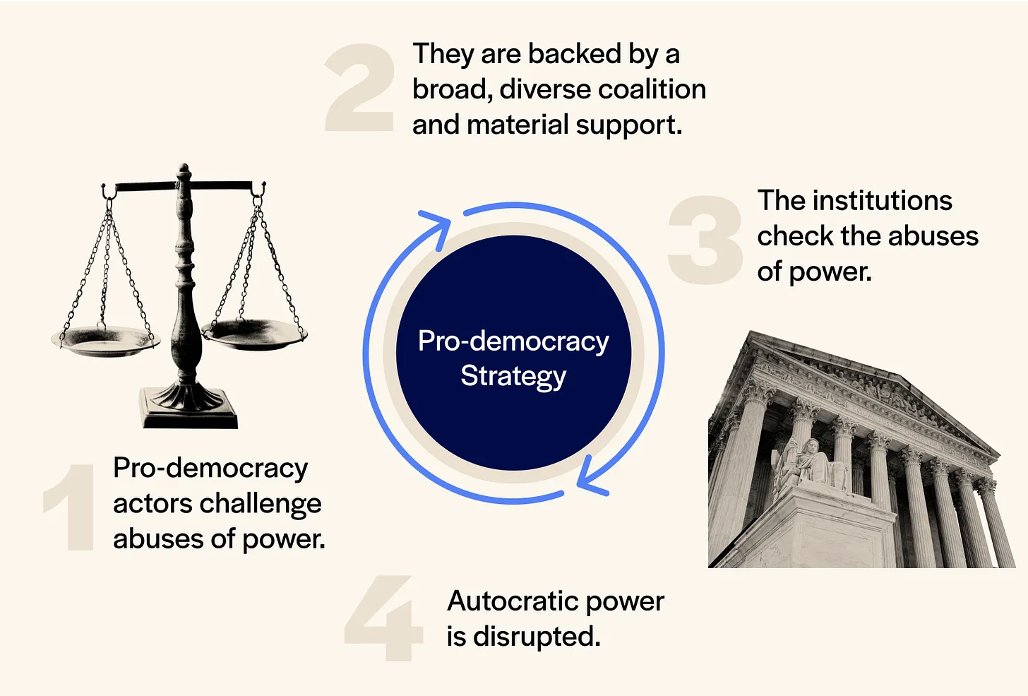
In practice, this struggle tends to play out between two countervailing cycles: the authoritarian strategy and a pro-democracy response.
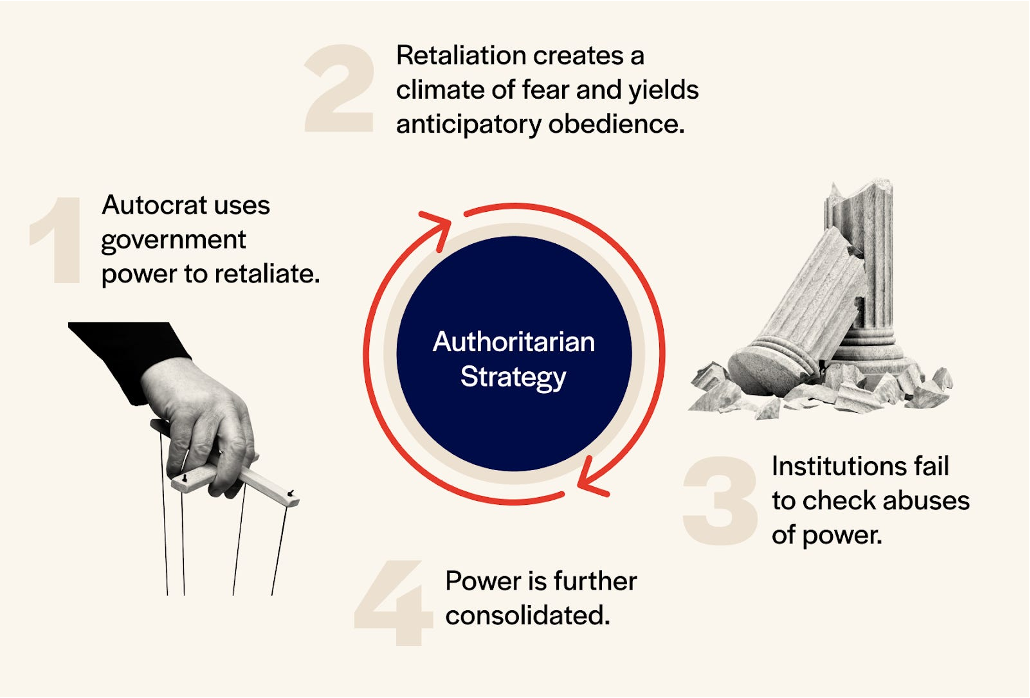
We saw this cycle clearly in the first part of this year. The administration’s attacks on perceived opponents or vulnerable groups created a climate of fear, leading those who populate institutions designed to check executive abuses (legislatures, courts, media, other civic institutions) to step back. With checking institutions frozen or in retreat, abuses grew and power was further consolidated.
To respond, our strategy has always been to reverse that cycle by challenging abuses of power. Courage, in a word, is contagious.
Here are some of the things we accomplished together this year to check abuses of power:
We won an injunction in Chicago severely limiting federal agents from using violent force to suppress peaceful First Amendment activity. (Here are some lessons we learned about how we can all effectively resist the next waves of federal deployment.)
We forced the Office of Management and Budget to stop hiding information about how the executive branch is using congressionally appropriated funding. (More here about why public — and congressional — access to this information is so vital.)
We blunted some of the worst attacks on the federal workforce through litigation that temporarily blocked efforts to dismantle 20+ federal agencies, which bought enough time for the administration to lose interest. (Read Erica Newland, Jules Torti, and Ellinor Heywood on why this dismantling of the federal bureaucracy is so alarming: What the RIF just happened?)
We filed suit on behalf of the Federal Trade Commissioners the president attempted to fire and we argued the case before the Supreme Court this week. (Read an explainer here about why it’s essential to have independent federal agencies.)
We pressured USDA into backtracking on efforts to seize sensitive SNAP data from state agencies and remain in court to stop their renewed efforts. (Learn more: DOGE’s data “panopticon” pales compared to what’s next.)
We helped prevent a North Carolina election from being subverted after the fact by a losing candidate who tried to disenfranchise thousands of voters. This is a key precedent we can use to defend elections in 2026 and beyond. (More about this election: Stealing an election by disenfranchising service members? And more about the danger of “zombie lawsuits”: How to steal an election in America.)
We’ve drafted and/or testified on behalf of a raft of bills that are moving through legislatures in Wisconsin, California, Georgia, Oregon, New York and elsewhere to shore up election vulnerabilities and protect constitutional rights from federal overreach. (Read more: One quiet bipartisan way state legislatures are making election administration stronger.)
We are on the brink of restoring voting rights to thousands of people in our litigation against Virginia’s racially-motivated felony disenfranchisement law. (Read a summary of why the legal strategy here is promising — and more importantly, of the real human costs that make this case important.)
And we launched the AI for Democracy Action Lab to ensure that we limit the risk that AI poses to democracy — and seize its potential for self-government. (Some more thoughts here: Democracy in the time of artificial intelligence.)
These interventions are just a tiny fraction of the millions of acts of courage, defiance, and patriotism that have slowed the authoritarian cycle and accelerated the pro-democracy one.
Almost every day now, authoritarianism is losing momentum while democracy and accountability are picking up steam.
If given the opportunity, the American people are poised to decisively reject autocracy
As Lakshya Jain writes in The Argument this week, all electoral signs increasingly point to a historic political rebuke that, to many, seemed almost implausible earlier this year: The unraveling of Trump’s 2024 coalition.
“Every data point we’ve seen in 2025,” Jain writes, “consistently points to one reality: A blue wave is coming. In fact, there’s good reason to believe that 2026 may be the best year for Democrats since 2018.”
Another data point from just yesterday: A new AP-NORC poll found record lows, with 31 percent approving of Trump’s handling of the economy (down from 40 percent in March) and 38 percent on immigration (down from 49 percent in March).
As our strategy predicted, once the autocrat becomes politically unpopular, it is hard for them to get others to help consolidate power and tilt the playing field. Institutions tend to lean into performing their checking functions. To wit, just this week:
Indiana Republicans rejected Trump’s attempts to coerce them into redistricting, bravely weathering even violent threats against their homes to do so. (Read the incredibly inspiring words of democratic patriotism from Indiana State Sen. Greg Walker in doing so here.)
After a truly Kafka-esque maze of legal persecution by the regime, Kilmar Abrego García was released from custody.
Alina Habba, Trump’s personal lawyer who the White House unlawfully installed as U.S. Attorney in New Jersey, resigned.
Another grand jury refused to indict one of Trump’s political adversaries.
After almost unanimously bucking the President on the release of the Epstein files, Republicans in Congress this week held oversight hearings on the president’s unlawful boat strikes in the Caribbean and on his deployment of military forces to American cities. Republicans also crossed the president in the House in voting to overturn the president’s executive order stripping bargaining rights from public sector unions.
For more on the signs that Trump’s efforts at authoritarian consolidation are failing, read this summary from Garrett Graff.
This sort of broad political rebuke of an authoritarian before they have successfully entrenched themselves in power is rare. Nothing like this happened in Russia or Hungary or Turkey or Venezuela. It looks more like what happened in South Korea, where president Yoon Suk Yeol found out that it’s very hard to consolidate power when less than 20% of the population approves of the job you’re doing.
Which is to say, what we’re seeing here is what you tend to see in countries that survive attempted authoritarian takeovers.
Protect Democracy’s strategy for 2026
But the danger has far from passed. To consolidate our gains against an autocratic takeover and set us on a path of democratic renewal is going to mean stepping on the gas in 2026. Our strategy for doing so reflects the trends above: that the majority of the people don’t want what the authoritarians in power are offering.
Which means that, at root, our task is simply to protect the people’s ability and freedom to choose their leaders and then to render a verdict on the performance of those leaders in regular elections. That process is not a given. We know that modern authoritarianism consolidates power not by eliminating elections, but by holding them on a playing field that is tilted in myriad ways to prevent true self-government.
We are therefore focused on two core pillars of work:
One, protecting the electoral process. The American people must have the ability to have their voices heard next November. We must protect electoral infrastructure and processes from interference in 2026 and look ahead toward protecting those processes for 2028. We are working to ensure that voters can cast their ballots, that the votes will be counted according to the rules, and that the outcomes will be respected and the rightful winners — regardless of who they are — will take power in a peaceful process.
Read our colleagues Alexandra Chandler and Emily Rodriguez on some of what we expect to see next year: What the 2025 election means for 2026.
Two, protecting electoral competition. At the same time, we are working to ensure that the 2026 and 2028 elections are open to meaningful competition. It’s not enough to just protect the voting process and transfer of power; we also have to uphold all of the predicate steps in the lead up to an election that make it a genuine and fair contest for power. Our focus is on protecting an open civic landscape in which all Americans can dissent, organize, share and receive accurate information, make arguments for and against political platforms, express and provide support for political candidates, and compete for power free of intimidation and censorship.
Read about some of the key dynamics: weaponization of the justice system, abuses by DHS agents, censorship by the FCC, abuse of the pardon power, the Insurrection Act, corruption, and violence.
In addition to this “north star” focus on protecting the integrity of future elections and electoral competition, we are also advancing a vision for democratic transformation and renewal. We will never truly escape the autocratic threat if our democracy remains so fragile that every election is an existential battle between democracy and authoritarianism. We must therefore advance an additional set of work to build a more resilient democracy for the future. This stems from a recognition that, as we saw in 2024, people around the country and around the world are hungry for seismic changes to the status quo, changes that recognize and respond to an era of enormous disruption.
Read about why proportional representation could come sooner than you think, how fusion voting offers a practical path to multipartyism, how Congress can fix itself by embracing internal divisions, and our new AI for Democracy Action Lab.
Again, none of this is cause for complacency. This is ambitious, challenging, and high-stakes work. Our republic remains in significant danger, as are so many of our neighbors who are being actively terrorized by this administration.
For the first time in years, however, the pro-democracy side is the one with momentum. All of us have worked to make that happen. All of us should feel confident and empowered going into next year.
We — the forces of freedom and democracy — are going to win.

I'm pleased to read your cautiously optimistic view of things. And that seems about right to me, as my own pessimism has declined over the past few months.
Your two "core pillars" for 2026 also make sense to me.
Thank you for your work for a TRULY patriotic America, not the faux version put out by Trump and crew.
I think the tire is turning Trump is losing support lost Indiana looking more incoherent and bitter resentment man so I think we’re on a track to having a major sweep in 2026 and then we can seek justice against those who perpetuated this misery!!