



The Trump administration is in the middle of a massive, unprecedented, and unlawful effort to accumulate your private voter data in advance of the midterms. Since last May, the Justice Department has demanded access to nearly every state’s full, unredacted voter file in an effort to create a central federal database of voter information.
Why does the DOJ want this mountain of data on virtually every voter in the country? It has all the markings of a deliberate effort to manipulate, misconstrue, and even manufacture evidence of supposed election “fraud” — the same playbook President Trump and his allies used to sow doubt about election results in 2016 and 2020.
There’s a common phrase1 in the research world: “If you torture the data long enough, it will confess to anything.” In short, with enough manipulation, you can make a dataset say whatever you like.
This is exactly what the Trump administration wants to do: accumulate enough voter data that it can torture this data into confessing the predetermined conclusion that, should the president’s preferred candidates lose, it will have been because of fraudulent votes from ineligible voters.
So what would this look like in practice? Reports indicate that the administration is planning to review states’ voter files using a Department of Homeland Security citizenship verification tool: the Systematic Alien Verification for Entitlements or “SAVE” system. The goal is to match voting records with lists of non-citizens to “prove” the repeatedly debunked claim that widespread non-citizen voting is threatening the integrity of American elections.
But there are inherent challenges in matching datasets that were collected at different points in time for different purposes. And while it is extremely unlikely that this method will produce legitimate evidence of widespread fraud, it very well could result in false matches that disenfranchise eligible voters and create unwarranted doubt about the integrity of American elections ahead of the midterms.
It ultimately does not matter to the administration what the data actually says — Trump and his allies have shown time and time again that no amount of evidence will convince them to drop their election denying conspiracies. With enough data “torture,” they will almost certainly find the “confession” they’re after.
With election deniers now in top roles at the Justice Department, the same people who tried to overturn the results of the 2020 election now have far more tools at their disposal to fuel their efforts to access and manipulate state voter data, making it all the more important that states continue to protect their voters’ personal information from being used as a tool for election subversion.
Your voter registration data could fuel election subversion
If you’re registered to vote in the United States, your sensitive information is likely implicated in the Trump administration’s plans to sow doubt about the integrity of future elections.
Election officials in every state collect and maintain a trove of information on their registered voters. This could include your full name, home address, date of birth, social security number, driver’s license number, and a record of your participation in previous elections. You likely shared this information to register to vote, and election officials rely on it to verify your eligibility and determine your polling place.
Some of this information is available to members of the public, including political candidates, campaigns, and get-out-the-vote initiatives. But states go to great lengths to keep the most sensitive information (such as social security numbers and driver’s license numbers) private — and for good reason. Given this administration’s track record of poor cybersecurity practices, the federal government’s effort to access and centralize this data raises serious privacy and security concerns. Just last week, the DOJ admitted in a court filing that DOGE staffers at the Social Security Administration illegally accessed and shared sensitive social security data with an outside advocacy group trying to “overturn election results” as part of an effort to match that data to state voter data.
States, rather than the federal government, have long maintained the highly personal information contained in voter rolls as part of their constitutional authority to administer elections. As our colleagues Emily Rodriguez and Justin Florence explained last week:
In our federal system, elections are decentralized. They are run at the state and local level, which makes them much harder for an authoritarian president to corrupt.
Centralizing voter data at the federal level not only makes it easier for authoritarians to manipulate this information to deny election results, but it also leaves the data vulnerable to hackers and cybersecurity threats, making our elections less secure and our personal information less private.
The DOJ claims that it needs access to this data to make sure states are complying with federal voting laws like the Civil Rights Act of 1960, but this logic doesn’t add up. The agency doesn’t need the sensitive information in the full, unredacted voter files to evaluate states’ compliance with voter roll maintenance requirements. The information supplied in states’ publicly available voter files is more than enough — in fact, our colleagues at VoteShield have used this public information to track voter database changes since 2017. So what else could be going on?
The DOJ is likely planning to use the sensitive personally identifiable information in states’ full, unredacted voter files to match these records with federal data sources, a process that sounds innocuous enough but is almost certain to result in false accusations of fraud in voter rolls and spread doubt about the integrity of American elections.
Here’s an example: Someone may register to vote in their state after becoming a naturalized citizen, but federal datasets that were collected prior to that person’s naturalization may not capture the change. If the federal datasets are matched and relied on to identify purportedly ineligible voters, this naturalized citizen would be flagged and potentially disenfranchised.
Read more: How Federal Efforts to Access Voter Data Affect Our Privacy, Civil Liberties, and Democracy.
To be clear, despite the administration’s bluster, there is no evidence of widespread non-citizen voting in American elections. Experts consistently find that voting by non-citizens is exceedingly rare. Trump and his allies are looking for patterns in voter data that they know don’t exist to repeat their playbook for election subversion.
The SAVE system is supercharging an old narrative
The DOJ’s efforts to access state voter files and investigate widely disproven fraud narratives will likely be supercharged by a newly expanded DHS tool for verifying voter eligibility: the SAVE system.
Last year, DHS unveiled the first ever searchable national citizenship data system, a massive expansion of the SAVE system, an existing DHS tool previously used to verify the eligibility of non-citizens for certain government benefits. DHS worked with DOGE to rapidly integrate personal data held by the Social Security Administration into the SAVE system, transforming it from a modest tool for looking up immigration status of foreign-born citizens and non-citizens into a system that can comb through entire voter lists.
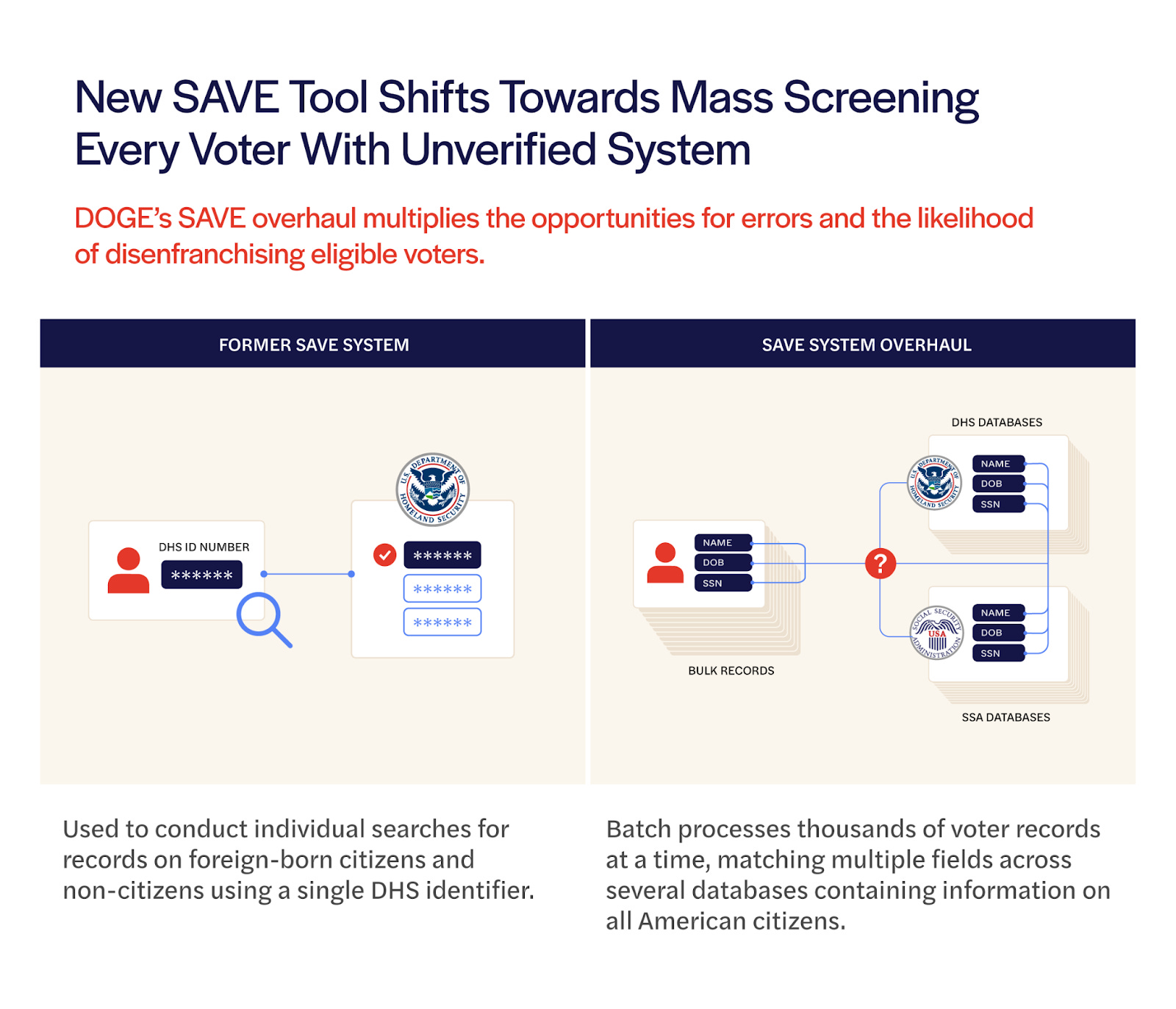
The result is a tool that effectively functions as a national citizenship database, which has never previously existed or been sanctioned by Congress. In fact, Congress passed the Privacy Act of 1974 in part to prevent the creation of an official or de facto national data bank, recognizing that such a database would erode Americans’ privacy rights.
While ensuring that only American citizens can vote is important, the Trump administration’s expansion of the SAVE system as a voter verification tool is unnecessary, unreliable, and dangerous. State election officials already have reliable processes to verify the citizenship of voter registrants. (Like we mentioned earlier, broadly speaking, non-citizens aren’t voting in American elections.)
Then there are the system’s significant flaws. Experts, including our VoteShield colleagues, have raised serious concerns about the accuracy and reliability of the data the SAVE system relies on and potential data matching issues created during the rapid expansion of the system. These underlying data issues could lead to false accusations of voter fraud, potentially disenfranchising eligible voters and perpetuating misleading claims about widespread non-citizen voting and unreliable election results.
Read more: The ‘SAVE’ Tool Could Disenfranchise U.S. Citizens.
Despite these concerns, the Trump administration has encouraged states to use the SAVE system to verify the eligibility of every voter on their voter rolls. And there is already evidence that the SAVE system is returning errors.
In October, election officials in Texas, one of 26 states that have reportedly signed on to use the SAVE system for voter verification, sent notices to thousands of voters who have been flagged by the SAVE system as “potential” non-citizen registered voters. Early reports indicate a high error rate, with numerous eligible voters being wrongfully identified as non-citizens and given thirty days to re-prove their citizenship status or face cancellation of their registrations.
This is about election subversion
Taken together, the two efforts set the stage for those in power to throw out the results of the midterm elections — torturing the data until they can use it to overturn the will of the voters and pick a winner of their choosing.
As the nation’s top law enforcement arm, the DOJ (which, again, is run by election deniers) can exert massive pressure on states when it is conducting investigations, regardless of their merit, and has broad powers that come with its obligations to ensure that states are not violating civil rights and voting rights statutes. However, the current DOJ is now seeking to use those civil rights authorities to commandeer sensitive voter data and make it harder for eligible voters to vote — the exact opposite of the laws’ intended purpose. Without any meaningful way for the public to check their work, the Trump administration could claim that running this data through the SAVE system has produced evidence of widespread non-citizen voting that casts doubt on the integrity of the midterms, paving the way for it to question and overturn unfavorable results.
The DOJ’s quest for voter data will likely only intensify in 2026. Just last month, the DOJ escalated its demands, pressuring more than a dozen states to sign a memorandum of understanding that would give the agency the power to hand-pick voters to be removed from the rolls without any clear criteria for doing so. This interference undermines states’ constitutional authority to run their own elections and could allow for hyper-targeted election subversion down to individual races of interest.
States are fighting back
States can and should continue to push back against these egregious and unconstitutional attempts to interfere with their authority over elections processes.
Since the DOJ began its campaign to access state voter registration data last May, state officials from across the political spectrum have challenged the legality of these requests and taken steps to keep their voters’ sensitive personal information out of the DOJ’s hands.
Of the 44 states that have received demands for copies of their statewide voter registration files, only 11 have provided or said they will provide their full, unredacted statewide voter registration data. Instead, most states have only provided the publicly available version of their voter file or not provided the file at all.
All evidence points to the administration gearing up to contest midterm results it doesn’t like, so it remains more important than ever that state leaders, election officials, and advocates stand up to protect their voters’ data from weaponization and approach allegations of widespread voter fraud with skepticism. Because if the administration succeeds in its quest, there’s little doubt it will find a way to “torture” your data into a false confession and use it as a pretext to overturn your vote.
Free elections require free speech, including for veterans
Yesterday, our colleague Amanda Carpenter wrote about another election threat on the horizon:
We are witnessing the Trump administration attempt to force dissenters into a repressive spiral, a dynamic where the state treats dissent not as a signal for dialogue but as a security threat that justifies even more aggressive force. Those who wish to protect our elections must be firm: Free speech is the prerequisite for a free election.
One group currently being targeted by the administration for exercising their freedom of speech is the cohort of veterans and former intelligence officers currently serving in Congress who have been vocal with their concerns around the administration’s national security policies. One of them, Senator Mark Kelly, has sued Secretary Pete Hegseth for illegally retaliating against him with a formal Department of Defense punishment.
We filed an amicus brief on behalf of more than 40 former defense and military leaders in support of Kelly. The stakes here are clear: “To chill the speech of retired military service members would not only infringe on their individual First Amendment rights, but also impoverish public debate on critical issues relating to our military and its role in domestic and foreign affairs.”
Read the whole brief here. It’s worth your time.
What else we’re tracking
This week marked one year since President Trump was sworn in for his second term. Protect Democracy’s Genevieve Nadeau and Ellinor Heywood kicked off our new civic column at Nonprofit Quarterly with a retrospective of the first year of the administration’s attempts to constrain civil society and the lessons we’ll carry into year two.
For more perspectives on where we stand a year in, we recommend Quinta Jurecic for The Atlantic, Jacob Grier for The UnPopulist, and The New York Times editorial board on how much money Trump has made off the presidency.
Cameron Kistler and Ben Raderstorf wrote for the San Francisco Chronicle about the need for California to pass a universal constitutional remedies law to counter federal overreach: California can use these three words in the Constitution to push back against Trump. More on these kinds of laws and how your state can push back against unlawful abuses here and here.
“Fixing the rules so no one can abuse power again”: The Renovator’s Danielle Allen is thinking about how laws like the one in California and the No Political Enemies Act introduced in Congress last week represent one part of a larger movement, which she calls the loyal opposition.
In Minnesota today, the faith and labor communities are leading a day of action and general strike to call attention to the brutality of DHS agents there. Per The New Republic’s Grace Segars, The Minneapolis faith community is showing how to fight ICE.
Frequently attributed to Nobel Prize-winning economist Ronald Coase.


I’m wondering about all of this. I’m pretty sure out state was one of the first to send voter rolls to the Feds. That doesn’t capture live data if they’re asking for it to be sent from Blue states. Live data continually updates - how do they plan to capture updates?
Has Iowa given this data to the feds?