


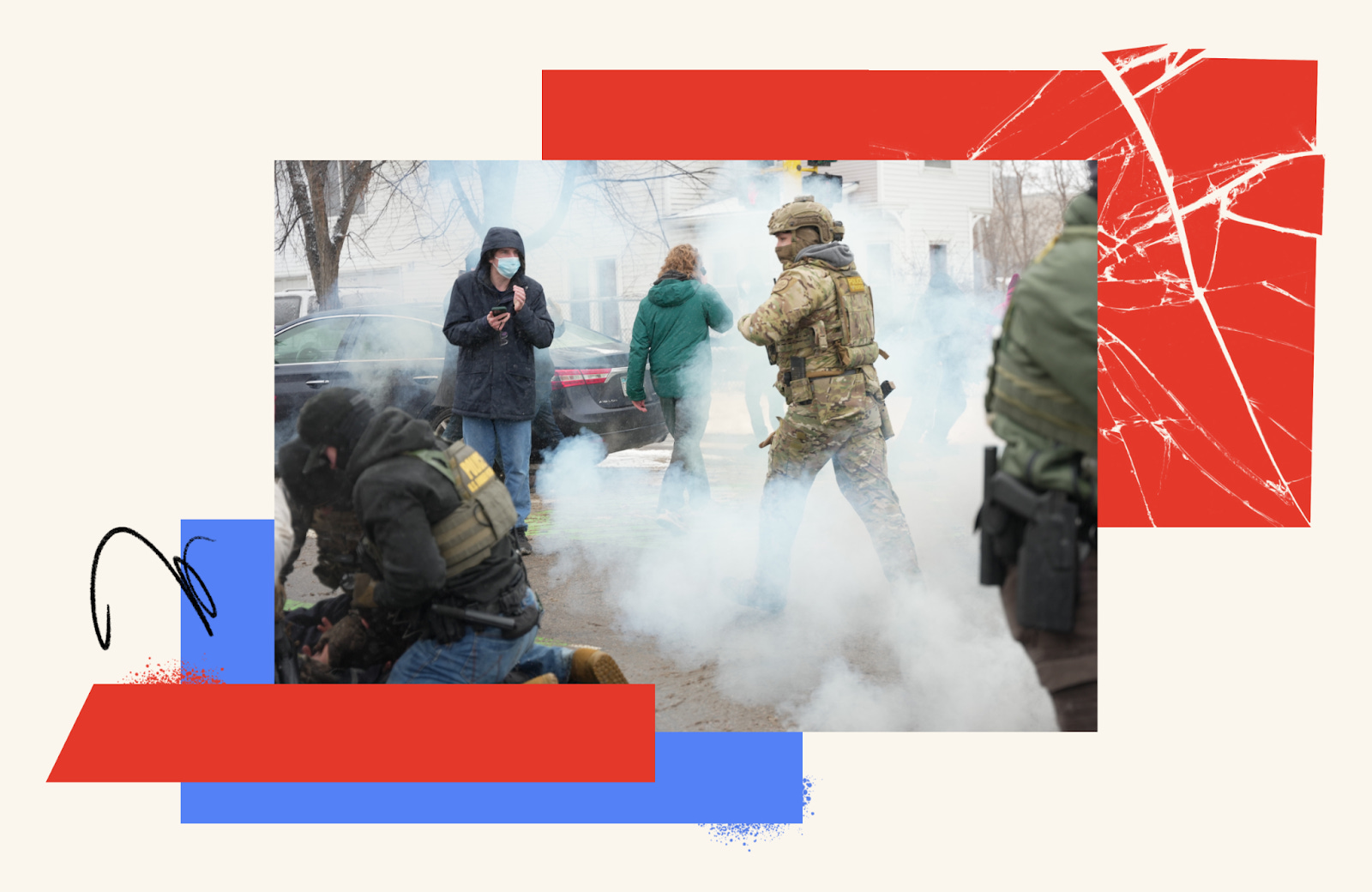
President Trump has told us what he sees when he sees millions of Americans rising up in our cities and towns to protest his ICE overreaches: The enemy within. Rebellion. Reasons to use Democratic-run “cities as training grounds for the U.S. military.”
In response to the protests over ICE’s killing of Renee Good, Trump threatened to invoke the Insurrection Act to stop “agitators and insurrectionists from attacking the Patriots of I.C.E.” Over the weekend, Trump put 1,500 soldiers on standby for deployment.
Read more: What Trump can and can’t do with the Insurrection Act.
The ease with which the Trump administration now activates federal troops signals a dangerous new reality: the normalization of state force as a first response to political dissent. Since taking office in 2025, Trump has deployed troops to 10 American cities, exaggerating and blurring concerns over crime and protests to assert control and tamp down his critics.
This is happening as heavily armed, masked federal immigration agents, in numbers that often dwarf state and local law enforcement, conduct raids with alarming levels of aggression and violence across the country. This surge in force is backed by a clear message from the top: By pardoning violent January 6 rioters, Trump has already signaled that political violence is acceptable so long as it serves his agenda.
These are the conditions shaping our midterm elections. And as a historic number of Americans are rising up to oppose the Trump administration’s abuses of power, the White House, in return, is labeling them the “enemy” and sending federal agents to police them.
More than protest suppression
The impulse to intimidate those who challenge the administration’s actions extends well beyond protesters in the streets. The Trump administration began laying a foundation last year to exploit horrific acts of unrelated violence to target opponents at scale.
Read more: How autocrats use episodes of violence to justify crackdowns.
After the assassination of MAGA activist Charlie Kirk, the president issued an executive order designating “antifa,” which is not an actual organization and is shorthand for anti-fascist, as “a terrorist organization.” He then followed the order with a presidential memorandum that called for a national strategy to combat domestic terrorism. The memo linked the assassination attempts on Trump and Supreme Court Justice Brett Kavanaugh to the assassination of healthcare executive Brian Thompson, to anti-ICE protests, and more broadly, to “anti-Americanism, anti-capitalism, and anti-Christianity; support for the overthrow of the United States Government; extremism on migration, race, and gender; and hostility towards those who hold traditional American views on family, religion, and morality. “
The memo lumps these different political beliefs together as “anti-fascism,” labels it “domestic terrorism,” and then frames lawful acts of political dissent, such as tracking the movement of federal agents, as “sophisticated, organized campaigns” of unlawful conspiracy. Then, the memo directs the National Joint Terrorism Task Force, an interagency effort led by the FBI, to investigate suspected participants, funders, and organizers.
In response, more than 3,700 nonprofit organizations across the ideological spectrum issued an open letter that condemned Trump’s order, calling it “unchecked power to silence opposition and voices he disagrees with. That is un-American and flies in the face of the Constitution, including the First Amendment bar on targeting organizations for their advocacy.”
Read more: Two ways to read the “antifa” executive order.
In November, Protect Democracy, represented by American Oversight, sued the Trump administration to demand that it release lists of philanthropic and nonprofit organizations it is reportedly targeting for investigation based on their political views and advocacy work. The lawsuit was filed after the government failed to respond to FOIA requests for that information.
Undeterred, Attorney General Pam Bondi followed up on Trump’s directive with a leaked memo that provided a checklist instructing the FBI and prosecutors how to execute Trump’s order to rewrite domestic terrorism rules.
Per Protect Democracy’s lawsuit, the government has a deadline next week to explain whether those lists of investigative targets exist and why they have not been released.
The terrorism smear in action
The January 7, 2026, shooting of 37-year-old Renee Good by an ICE agent brings the Trump administration’s dangerous confluence of force build-up and rhetorical escalation into sharp relief.
On that snowy Minnesota morning, Good had dropped her child off at school and was participating in efforts to monitor federal immigration agents’ actions in a local neighborhood. Bystander videos, taken by other activists monitoring the agents, showed DHS agents surrounding her vehicle, Good calmly speaking to an agent, Good moving her vehicle forward and away from the agents, and then an agent firing multiple shots at close range, killing her.
But in the immediate aftermath of Good’s death, Trump falsely stated that Good “viciously ran over the ICE Officer,” and Vice President JD Vance and DHS Secretary Kristi Noem labeled her a terrorist.
Vance held a press briefing and said she was “brainwashed” and “part of a broader left-wing network to attack, to dox, to assault and to make it impossible for our ICE officers to do their job… A group of left-wing radicals have been working tirelessly, sometimes using domestic terror techniques to try to make it impossible for the president of the United States to do what the American people elected him to do, which is enforce our immigration laws.”
After massive pushback, Trump described Good’s killing as a “tragedy” but added, “You know [federal law enforcement officials are] going to make mistakes sometimes. ICE is going to be too rough with somebody, or, you know, they’re dealing with rough people.”
Despite that admitted “mistake,” the Department of Justice is not investigating the actions of the officer who killed Good. Trump administration officials instead pressured multiple senior prosecutors to investigate Good’s widow, but several of the prosecutors objected and chose to resign from their jobs rather than follow that directive.
A repressive spiral
Good was just one of millions of Americans who are not terrorists and who have turned out to protest the White House’s policies, and in particular, immigration overreaches, in the past year.
According to Armed Conflict Location & Event Data, a non-profit research project that collects, analyzes, and maps real-time data on political violence and protest, these protests represented a surge by 77 percent in the United States and Canada compared to 2024. Their research emphasized that “President Trump’s migration crackdown was a major driver of anti-Trump demonstrations, with roughly 60% of anti-Trump protests also showing support for migrants or opposition to Immigration and Customs Enforcement (ICE) and to efforts to arrest and deport them.”
But the Trump administration’s forces are large — and growing. A massive infusion of funding from Congress in 2025 effectively turned ICE into the largest federal law enforcement agency in history, with a $170 billion four-year mandate to expand detention and enforcement — and now those forces are being turned against protesters, too.
After Good’s shooting, Border Patrol Commander Gregory Bovino, who has become the face of Trump’s militarized domestic response, has warned operations will continue “unabated” by what he calls “agitators and rioters.”
We are witnessing the Trump administration attempt to force dissenters into a repressive spiral, a dynamic where the state treats dissent not as a signal for dialogue but as a security threat that justifies even more aggressive force.
And while the White House continues to insist that heavy militarization of American streets may be required to allow ICE to perform its duties, physically confrontational behavior by protesters remains rare, even as provocations from ICE increase. It is true that some individual protesters have tried to intervene in arrests, block law enforcement vehicles, and attempt to blockade facilities, but research shows that these tactics were used in only roughly 1 percent of the demonstrations in 2025 and that fewer than 1 percent of the demonstrations have turned violent.
Trump’s narrative relies on the 1 percent to justify 100 percent of his overreach. As the Wall Street Journal editorial board wrote, “Obstructing immigration enforcement may be a crime, but it doesn’t warrant military intervention.”
Free elections require free speech
Deployment of federal agents cannot become the standard response to political disagreements. If the public square is cleared of dissenters today, the ballot box cannot be considered “free” tomorrow.
The attempts to brand dissent into “domestic terrorism” and make observers into “conspirators” are strategic smears to intimidate and silence those who challenge the president’s overreaches and ultimately, compete against those policies in future elections.
Those who wish to protect our elections must be firm: Free speech is the prerequisite for a free election. The Trump administration sees a dual purpose in deploying federal agents in such massive numbers to blue states and cities. Trump’s immigration crackdowns have morphed into free speech crackdowns, too.
Safe and healthy civic spaces do not magically appear on Election Day. The election environment is cultivated in the months leading up to Election Day through robust, sometimes uncomfortable, debates. And those debates are often messy; rarely is one side ever completely correct. But no matter who is right or wrong, we must insist on a baseline environment where our viewpoints can be expressed safely, without the looming shadow of state-sanctioned punishment.
By raising the specter of investigations, terrorism charges, and military deployments, the administration seeks to fracture the coalitions that are standing as a bulwark against executive overreach.
If that ground — meaning our collective right to stand in our neighborhoods and say “no” — is ceded now, there will be little to stand upon in November.