


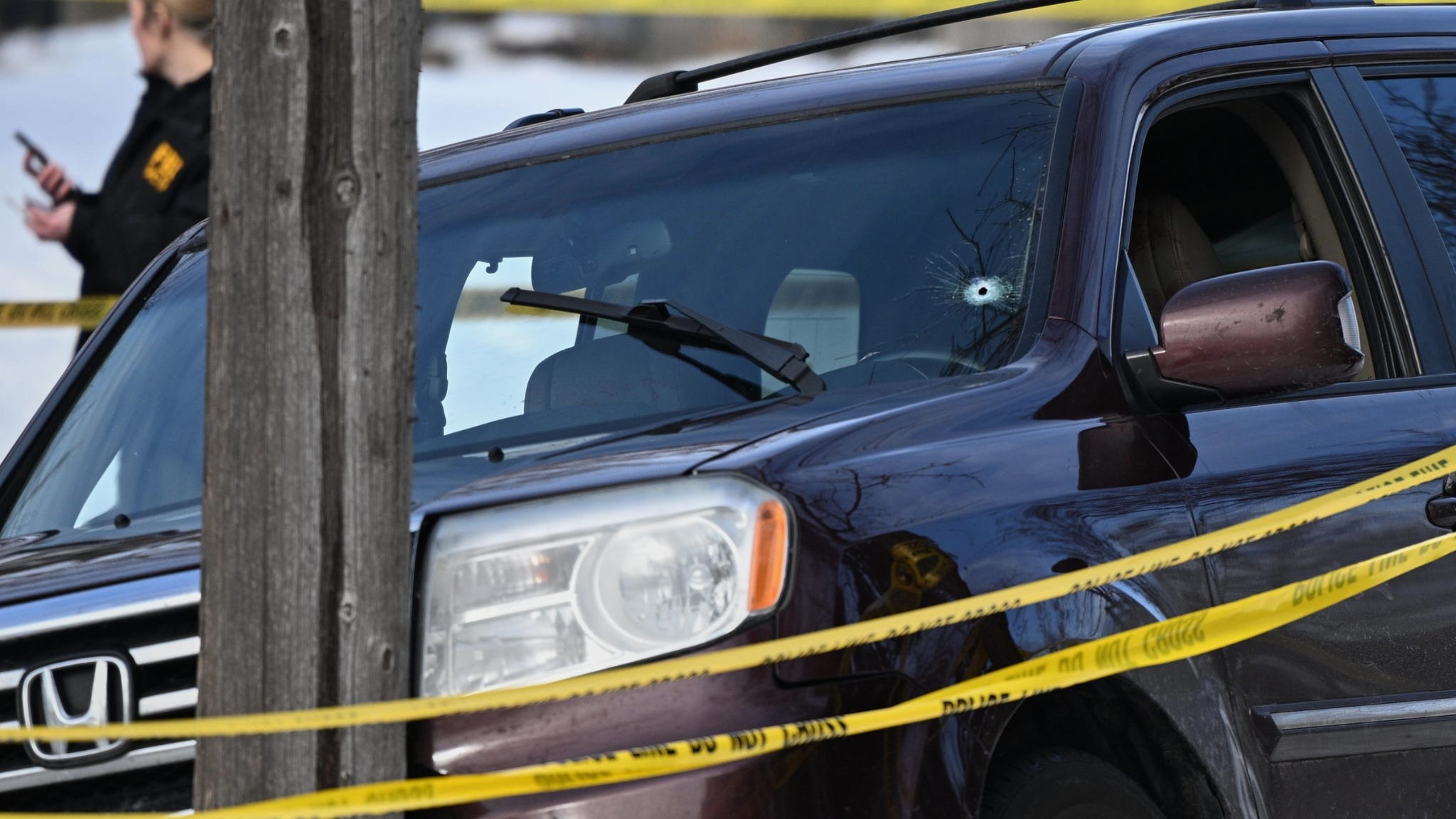
Today, an ICE agent shot and killed Renee Nicole Good, a 37-year-old mother of young child.
According to the Minnesota Star Tribune, Good described herself on Instagram as a “poet and writer and wife and mom and shitty guitar strummer from Colorado; experiencing Minneapolis, MN.”
Here is what your federal government, in an official statement, claimed happened1:
[R]ioters began blocking ICE officers and one of these violent rioters weaponized her vehicle, attempting to run over our law enforcement officers in an attempt to kill them — an act of domestic terrorism. An ICE officer, fearing for his life, the lives of his fellow law enforcement and the safety of the public, fired defensive shots. He used his training and saved his own life and that of his fellow officers. The alleged perpetrator was hit and is deceased.
“Domestic terrorism.”
Here are two stitched-together videos filmed by witnesses, as well as a third video taken from further away. Fair warning, they are disturbing. If you don’t want to watch, here are the two key frames:
Does that look like “terrorism” to you?
I will let you make your own conclusions — certainly I have mine — on whether or not the Department of Homeland Security (DHS) is lying. (The Minneapolis mayor called their explanation “bullshit.”) But I think it’s safe to say in this case that no one should be taking their claims anywhere close to face value.
Almost as shocking as the brutality of this shooting is the sense of impunity, the reflexive and callous disregard for fact, reality, or consequences of their actions.
Under Trump, the government harms people and lies about it without consequences
This is not an isolated incident. The Trump administration, especially DHS, has a long history of brazen lies and falsehoods. When the people harmed have managed to get the federal government into court, these lies quickly fall apart.
For example, in the evidence and findings from CHC v. Noem, our lawsuit on behalf of protesters, clergy, and journalists in Chicago, Judge Ellis found over and over again that the government was outright lying. Key quotes from the 233-page opinion:
The government would have people believe instead that the Chicagoland area is in a vice hold of violence, ransacked by rioters and attacked by agitators. That simply is untrue. And the government’s own evidence in this case belies that assertion. After reviewing all of the evidence submitted and listening to the testimony, I find the defendants’ evidence simply not credible.
…
More tellingly, Defendant Bovino admitted that he lied. He admitted that he lied about whether a rock hit him before he deployed tear gas in Little Village. Videos of what happened in Little Village, even from the agents’ body-worn cameras and helicopter footage, do not match up with agents’ descriptions of the chaos that was going on. The number of protesters was about equal, if not less than, the number of agents gathered at the time that Defendant Bovino threw the tear gas canisters. In fact, when he threw the second one, the crowd was running back. And there was an apparent flash-bang grenade that agents tried to claim were fireworks that the crowd threw. That’s simply not true.
And yet your government lies to you, without hesitation or fear of consequence. Why?
Minnesota can and should close the legal loophole that helps protect the shooter from accountability
There’s a legal backstory that helps explain why DHS is, practically speaking, able to operate with such impunity. When the government — that is, the federal government — violates constitutional rights, it can be hard for citizens to get recourse, even through litigation.2
The reasons are legally complicated, but much of it comes down to a simple loophole. In our system, to sue the government for damages (i.e. compensation) after the fact, you need specific statutory permission, called a “cause of action.” This permission does exist at the state and local level. If your constitutional rights are violated by state or local officers, you can sue, after the fact, for damages under a federal law known as Section 1983.
That is to say, if this had been a Minneapolis police officer or Minnesota state trooper, the victims’ family could sue them retroactively for violating constitutional rights. This possibility of lawsuits is a significant part of how our society maintains accountability for state and local law enforcement. When officers know they could face lawsuits — as all local and state cops know well — they are much more likely to carefully follow the Constitution.
There is no such cause of action for federal officers, insulating them from accountability. (Courts used to provide an alternative known as a “Bivens” action, but the Supreme Court has recently largely choked off that pathway.)
This loophole in federal law, where victims or their families can sue local police, but not federal officers, for violating their constitutional rights is one of those frustrating legal realities of our system.
But it doesn’t have to be that way. And it also wouldn’t take federal legislation to close the loophole. Minnesota could, on its own, pass a law giving Minnesotans a cause of action to sue any and all government officials for violating their constitutional rights. This fix, generally known as a “universal constitutional remedies act” or a “converse-1983” cause of action is widely believed to be both effective and legal.3 It simply would close the loophole, through state law, and subject federal officers, including ICE, to the same standard legal liability that the vast majority of law enforcement in the United States currently operates under.
Minnesota would not be the first state to pursue this fix. Illinois just passed a similar law (though it’s narrow and limited to constitutional violations occurring during civil immigration enforcement), and legislators in California and New York are both quickly pursuing their own versions of a broader cause of action.
Governor Tim Walz, Mayor Jacob Frey, and other Minnesota elected officials are understandably and rightfully outraged today. They should turn that outrage into action and pass a law to hold future ICE agents accountable and ensure this never happens again.
In fact, all states should do the same.
The president was even more outlandish, claiming that Good “viciously ran over the ICE Officer” and that “it is hard to believe he is alive, but is now recovering in the hospital.” There is no indication of harm to the officer in the video. After the shooting he calmly walks over to the crashed vehicle.
To be clear, the shooter still could face criminal prosecution, as Lawfare explains here: Are federal officials immune from state prosecution?
The reasons why are complicated and stem from the specific and deliberate design of the Constitution’s Supremacy Clause. For more, read constitutional scholar Akhil Reed Amar’s landmark 1987 paper: “Of Sovereignty and Federalism.”
What makes stories like this so alarming is not only the individual tragedy, but the broader pattern they reveal: escalating state power exercised without clear accountability, transparency, or meaningful public consent. When policies are implemented through force rather than democratic legitimacy, the risk of violence and instability rises—for communities, for institutions, and ultimately for national security.
History shows that once situations reach this level of confrontation, options narrow quickly. The only real chance to prevent further escalation is earlier—when citizens are still able to clearly articulate priorities, demand guardrails, and require public accountability before policy failures harden into irreversible harm.
If we want fewer tragedies and less chaos, civic engagement can’t wait until after the damage is done. Public priorities must be visible, documented, and impossible to ignore—at home and abroad.
One Voice, One Vote Count & Deliver
https://countanddeliver.org/
It's free, it's user friendly, but it requires the engagement of the majority of voters for it to be effective. It takes a village, but we can do it!
Great to get information on a way forward! Over and over we hear the lie that a person was “weaponizing” their vehicle against ICE agents, only to have it fall apart in court based on video evidence. This is a good way to stop it cold (pun intended).