


In the foreground this week: arguably the administration’s biggest series of unconstitutional abuses yet.
DHS agents are terrorizing Minneapolis. The administration is attempting to gain political control over the Federal Reserve by criminally investigating its chair, Jerome Powell. The FBI raided a Washington Post reporter’s home. Prosecutors are targeting multiple Democratic members of Congress for their video about illegal orders. Not only is the DOJ protecting the agent who killed Renée Good, but prosecutors are seemingly attempting to deflect scrutiny by criminally investigating Good’s widow (yes, really — this latest abuse led at least six prosecutors in the U.S. Attorney’s office to resign).
In the background, though, there’s an important wave of developments in the other direction. A series of legislative proposals in capitals from Albany to Washington to Sacramento all seek to do the same thing: stop this abuse by making what is theoretically unconstitutional much more practically preventable. Each would translate the Constitution’s protections on paper to real bulwarks.
Because the truth is, the vast majority of the Trump administration’s abuses are already illegal. That’s not the problem. The problem is that it can be, in practice, difficult for the law alone to stop a government hellbent on breaking it. (Too often, our system relies on a presumption that people in power will simply follow the rules as written.)
In response, all of these proposed bills use the same, elegantly simple legal strategy: Instead of creating new prohibitions on abusive behavior, which could just as easily be ignored, they simply empower Americans with new legal pathways to enforce the rights they are already supposed to have.
Not new rules. New tools.
In that sense, they’re more than just a wave of good ideas. They represent the closest thing we’ve seen yet to a unified theory of how to uphold the Constitution.
The federal strategy: Why the NOPE Act is such a big deal
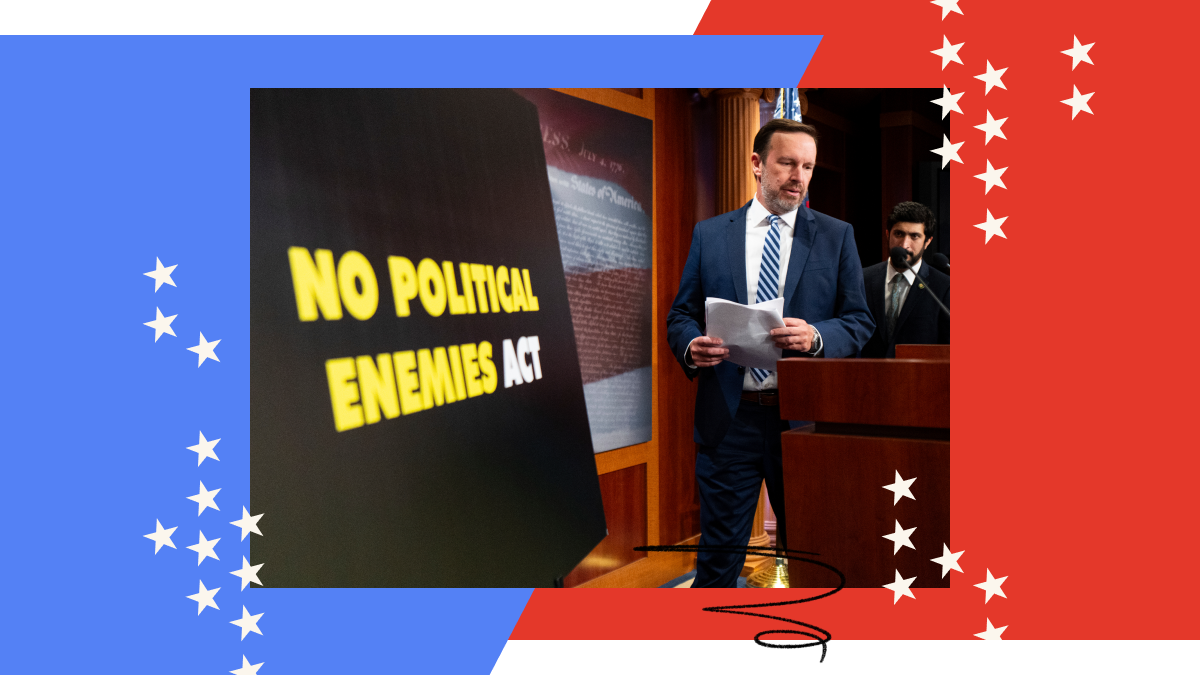
Yesterday, Sen. Chris Murphy and Rep. Jason Crow (the latter of whom appears to be a current target of DOJ weaponization) introduced the No Political Enemies (NOPE) Act.
This legislation aims to protect all Americans and civil society organizations — nonprofits, faith groups, media outlets, educational institutions, and so on — from politically motivated harassment and prosecution by the federal government. In addition to reaffirming the constitutionally protected right to free speech, it would also establish what’s called an “affirmative defense” (lawyer-speak for a legal trump card, like “self-defense”) and provide additional legal tools for those targeted in politically motivated prosecutions, lawsuits, and censorship.
Moreover, the bill would make it so victims of politicized attacks would be allowed to sue federal officials who violate their constitutional rights.
Read more about the bill and its provisions here.
My colleague Justin Vail, on a press conference for the introduction with Sen. Murphy, Senate Minority Leader Schumer, and Rep. Crow, said:
In a democracy, the president cannot use the vast powers of government to silence critics. The strength of the No Political Enemies Act is that it empowers everyday Americans with new tools to defend themselves against political targeting and hold government officials accountable for attacks on their free speech, regardless of who the president is.
The prospect of accountability is a powerful deterrent against abuse. If it passes, the NOPE Act would help restore some of this balance across the federal government.
The state strategy: The Universal Constitutional Remedies Act
Meanwhile, individual states aren’t waiting for Congress. They’re also taking matters into their own hands.
In her state of the state speech yesterday, New York Governor Kathy Hochul argued:
No one, from the president on down, is above the law. That’s why I will move to have New Yorkers hold ICE agents and others accountable in court when they act outside of their scope of duty. We need accountability.
She was talking about her proposal to introduce a “Universal Constitutional Remedies Act.”
This bill — the idea of which I wrote about last week — essentially closes a loophole, a quirk in our system. Currently, you are explicitly allowed to sue state and local officials for violating your constitutional rights, but not federal officials. There’s not really a logical reason for why Congress and the Supreme Court made the choices that led us here, but here we are nonetheless.
States can close this loophole, on their own, without federal action, because of a subtlety in the Constitution’s Supremacy Clause (the part that says federal law gets precedence over state law).
Here’s the key text, see if you can spot the important bit:
This Constitution, and the Laws of the United States which shall be made in Pursuance thereof… shall be the supreme Law of the Land;
Did you catch it?
Three words, “in Pursuance thereof,” are the crux. Federal law is not inherently supreme; it is only supreme by virtue of the Constitution. And so any action by the federal government that is not constitutional by definition does not supersede state law. State laws, like the Universal Constitutional Remedies Act, that focus exclusively on violations of constitutional rights, can therefore still apply to federal officers. Federal supremacy doesn’t apply.
As my colleague Cameron Kistler testified in Sacramento on Tuesday at the introduction of the California version of the law (Scott Wiener’s SB 747):
The bill stands for a simple proposition: If any governmental officer violates your clearly established constitutional rights, you should have a remedy. That is already the law for California state and local officials. If they violate clearly established constitutional rights, they can be sued under Federal Section 1983. But there is no similar law for federal officials — the bill solves that problem.
The bill passed out of committee 11-2.
Why all Americans should support stronger tools to enforce constitutional rights
All of these proposals — to strengthen the tools, not the rules — aren’t partisan. Nor should they be particularly controversial. Yes, most of the unconstitutional abuses right now are coming from the Trump administration. But in the future, these sorts of abuses could easily cut the other way.
Just an example, the right-leaning Free Press wrote yesterday about how the administration’s efforts to prosecute progressive nonprofits has alarmed many of the president’s ideological allies:
[T]he zeal to target liberals like Soros has alarmed a growing number of wealthy conservative donors, who believe investigations could spur Democratic officials in a future administration to attack Republicans. In recent private conversations with some of the donors, senior Trump administration officials who work on tax issues have said they understand those concerns and have tried to assure donors that any investigations would be legal and nonpartisan, according to people familiar with the talks. …
“If you weaponize government to serve your own purpose, it’s going to come back to bite you in the butt,” David Williams, president of the Taxpayers Protection Alliance, a right-leaning nonprofit, told me this week. “That’s our concern.”
It’s true. Politicized retaliation is a dangerous and destructive downward spiral.
The best way to prevent it from tearing our country apart is to pass common sense, nonpartisan laws — like the NOPE Act and the Universal Constitutional Remedies Acts — that make it exceedingly difficult for any government actor to violate constitutional rights.
I'm a New Yorker and am glad to hear my governor is stepping up also 👍
Thank you! Our fragile democratic experiment that began 250 years ago is at risk. We never expected a sitting president to expose these weaknesses. They have always respected political norms, checks and balances, and our Constitutional rights. Thank you for introducing the NOPE Act and encouraging the states to add their protections. Could Congress do more to get people on record as supporting or disagreeing with Administration actions? So what if you don't have the votes? Put people on notice and get them on the record, then let the voters decide in November.