


We are now six weeks from the midterms, and I have good news for you.
Democracy is winning.
From the moment he returned to the White House, Donald Trump has attempted to turn the entire machinery of the federal government — from the FBI to the Postal Service — against the midterm elections. He sought to do this in four ways:
Supercharge conspiracy theories and lies — especially around voter fraud — from inside the White House.
Deploy federal power against opponents, organizations, and officials to intimidate the opposition into compliance.
Use violence to silence Americans and deter voting.
Manipulate election rules and try to block eligible voters. (Think gerrymandering, mail-in ballot restrictions, voter registration list shenanigans, and so on.)
And, of course, there is a fifth and final strategy still to come:
If those four fail to produce the results he wants, seek to overturn them.
It was — and continues to be — up to all of us to stop him. (Here’s how.)
American democracy has never faced the federal government arrayed against it like this. And yet we — the big “we”: you, me, and everyone else in this country committed to protecting free and fair elections — we are winning across the board.
This is absolutely not a reason for complacency. Still six weeks until Election Day (and 14 weeks until the next Congress is sworn in). But this win streak should make us all feel more confident, more optimistic, and more hopeful.
Deceive: Trump has mostly failed to manufacture the pretext for disruption and denial
The president has worked tirelessly to try to convince Americans that elections are not to be trusted.
It’s not working.
Trump hosted a prime-time address (that was not carried on major networks). DHS claimed it found a quarter-million “noncitizen registrants” in four states (but when pressed, every name produced — every single one! — was a U.S. citizen and eligible voter). The Census Bureau put out an “unsigned” report on voter fraud (that was immediately slammed by bipartisan experts). He hired election deniers for various federal roles (several of whom, notably Joe diGenova and Ed Martin, have already quit).
And, of course, the president himself posts election conspiracy theories on social media constantly.
By my non-scientific count, the president has posted about election conspiracy theories, voter fraud, or the 2020 election on Truth Social 153 times so far this year. That’s more than every other day.1
He’s obsessed with the Big Lie and the false specter of fraud. He’s still obsessed with the 2020 election. He seems to hope that by talking even more about conspiracy theories, he can do what he failed to do six years ago: sabotage or overturn an election.
But instead of roiling the fever swamps of anger and discontent, the administration’s all-out propaganda push seems to have had the opposite effect.
For most voters, lies about elections are becoming white noise.
In August, a Navigator poll found that 60 percent of the country (including 61 percent of independents, 49 percent of non-MAGA Republicans, and even 21 percent of MAGA Republicans) think Trump spends too much time talking about the 2020 election.
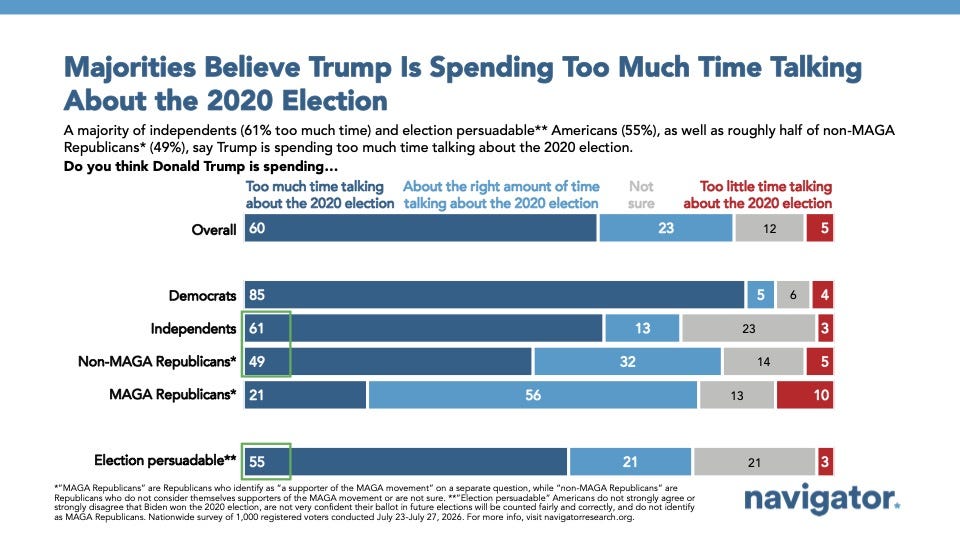
The same poll found 72 percent of Americans are confident that their ballot will be counted correctly and fairly.
Americans’ biggest concerns about the election aren’t voter fraud conspiracy theories (that’s 29 percent very concerned). Instead, they are — in order — ICE at polling locations (37 percent very concerned), legitimate votes not being counted (35 percent), misinformation about results of the election (35 percent), and Republicans trying to rig election laws (35 percent).
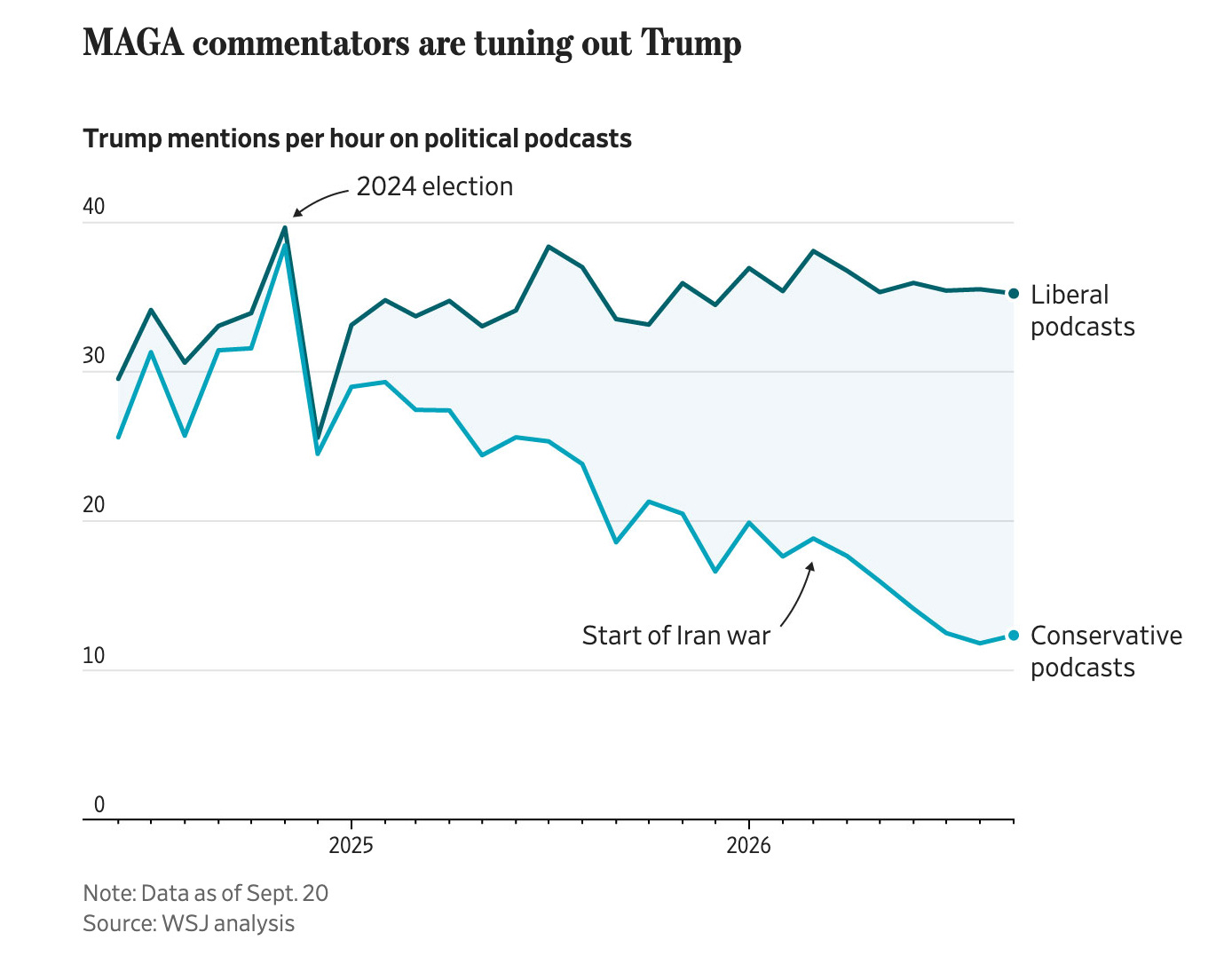
Yesterday, a Wall Street Journal investigation of MAGA commentators found that they too seem to be tuning out the president:
Mentions of Trump’s name per hour on conservative podcasts have fallen nearly 70% from their peak in the run-up to the 2024 election.
Check it out. White noise:
Disrupt: Federal intimidation efforts sputter while election rules remain broadly unchanged
Donald Trump continues trying to disrupt the election by using federal power to intimidate the opposition, using violence to deter voting, and manipulating the rules to block eligible voters.
None of these, so far, have entirely worked. Yes, he has sown chaos and confusion and made millions of Americans rightfully afraid that our voices will be silenced in November. Yes, he has ripped American democracy at its very seams, pushing us to the brink of disaster. Yes, he has positioned the federal government firmly against the right of the people to select their leaders.
But in the face of that onslaught, we — again, the big collective “we” — have had six major wins that block his disruption.
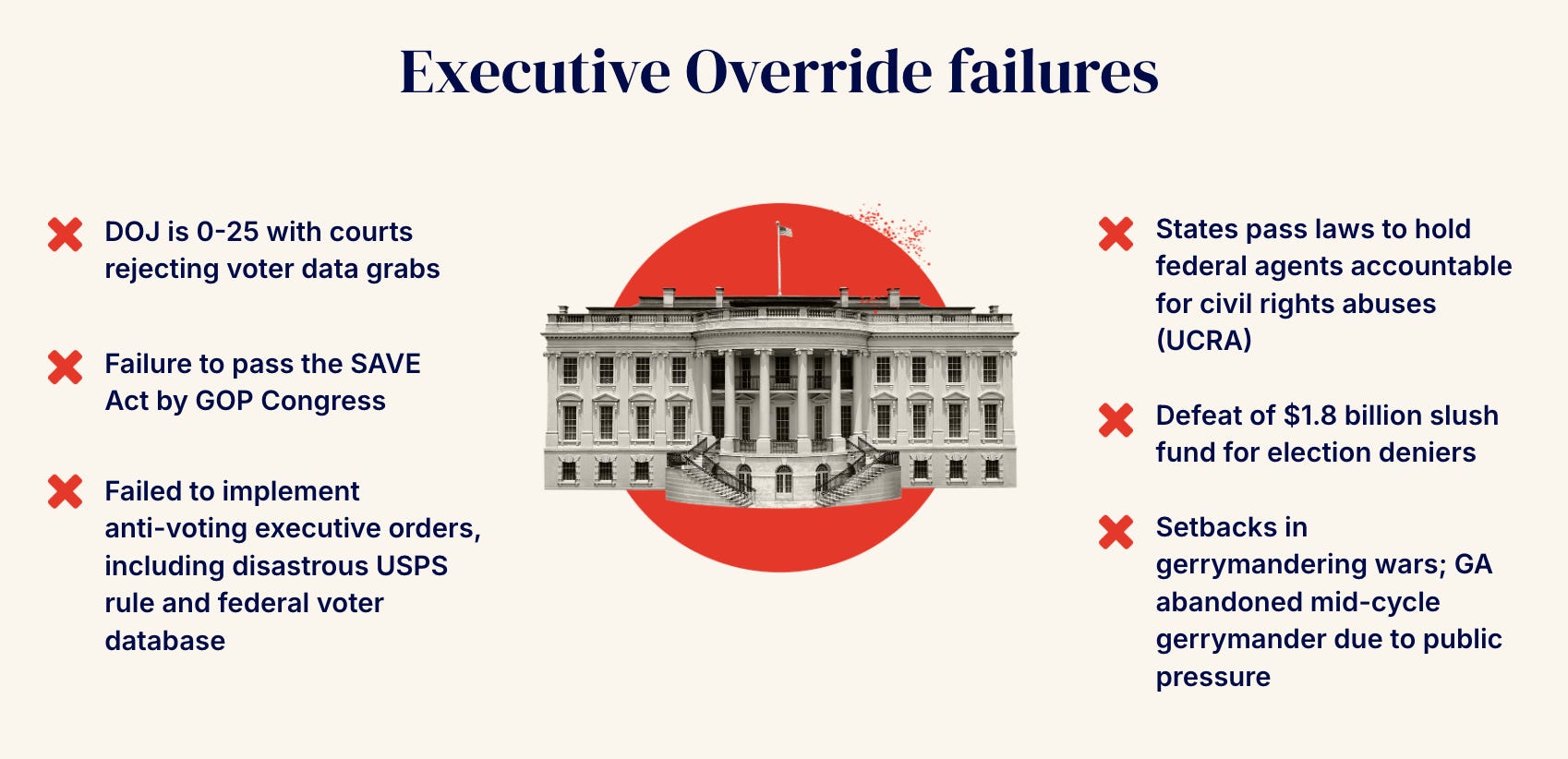
First, the Department of Justice went 0–25 in the courts trying to seize voter data from states. The latest legal loss came on Tuesday when a federal court rejected the administration’s attempt to force Washington state to hand over voter information. (See all the cases via Democracy Docket.)
Second, Trump failed to coerce Congress into passing the SAVE America Act. Had it passed, it would have been, according to the Brennan Center, “the most restrictive voting bill ever approved.” It did not pass.
Third, his sweeping mail-in voting executive order failed at the Supreme Court. The USPS mess may have been a doomed strategy from the start, but still — it failed. Protect Democracy’s litigation against other parts of the order is pending, but we feel confident courts will prevent the worst harms.
Fourth, five states have passed Universal Constitutional Remedies Acts. These landmark measures — signed into law in New York, Vermont, Connecticut, and Massachusetts and awaiting the governor’s signature in California — allow private citizens to sue federal officials for violations of constitutional rights. This provides an important new deterrent for federal officials who might consider impinging on constitutional rights.
Fifth, the president’s proposed $1.8 billion slush fund for election deniers sank like a stone in Congress. Remember that? Election deniers may feel a sense of impunity, but at least they don’t stand to profit from potential disruptions and crimes in the future.
Finally, the extraordinary mid-cycle redistricting wars and post-Callais scramble to dismantle Black representation failed to net the system-tilting advantage Trump was expecting. Currently, the Cook Political Report projects a four-seat gain for Trump’s party relative to 2024, far short of the roughly two dozen he had hoped for. Gerrymandering remains an existential threat to democracy — and to minority representation — but it’s not going to stop this particular election from threatening the president’s hold on power.
(An aside: that modest advantage from rules changes came at a catastrophic cost for our democracy. As our report last week found, one in 10 Americans were moved to a new district entirely, and one in five had their districts significantly transformed. Minority voters in Texas, Florida, Louisiana, Alabama, Tennessee, and North Carolina saw their representation undermined by new racist gerrymanders. Read more: The hidden casualties of the gerrymandering wars →)
Deny: Trump’s election denial is still to come — but on much weaker footing
All that said, we are winning, but we have not won.
The real challenges will come on Election Day and afterward. During the voting period, the counting of ballots, the certification of results, and potentially even the seating of the new Congress, expect the president to meddle. Think ham-handed attempts to seize ballots, threats to prosecute elections officials, and mass challenges to certain categories of ballots. (Isaac Gilles explained eight of the scenarios we’re most worried about here: What Protect Democracy specifically is doing to protect the midterms.)
While all Trump’s failures above mean that he is dramatically less likely to succeed in those attempts, his losing record to date may also make him more likely to try some of the most extreme and dangerous gambits. (Some of his failures — e.g., the inability to pass the SAVE America Act — will also be used as pretext for what’s to come.)
Desperate people do desperate things.
Donald Trump is getting desperate.
Six weeks to go before Election Day.
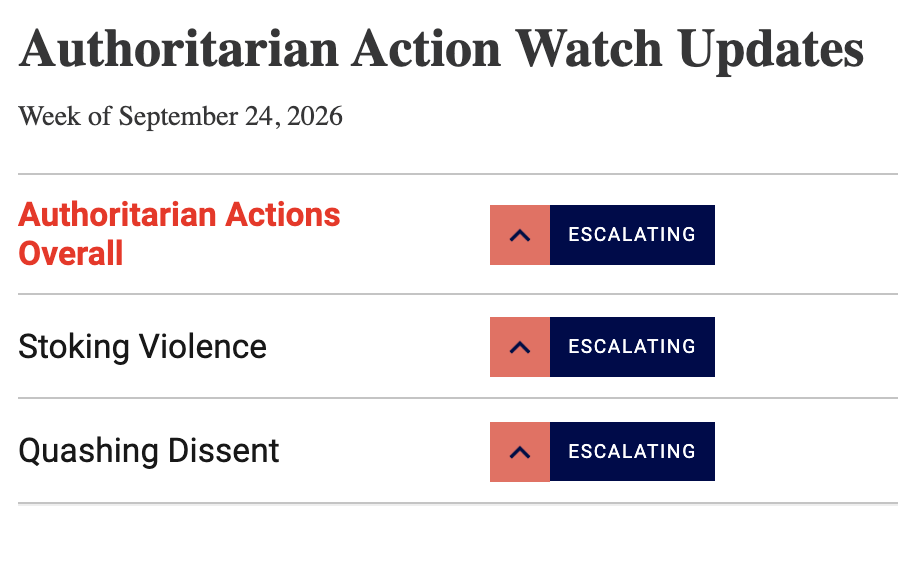
Two notable movements in the Authoritarian Action Watch this week.
First, Trump’s decision to try to throw reporters out of the press pool for unflattering coverage is pretty much the textbook definition of quashing dissent. But because the media as a whole — including Fox News — is pushing back forcefully, the threat is unlikely to succeed. Quashing Dissent is ESCALATING.
Second, the latest shooting in Austin is a reminder of an unsustainable status quo. The administration’s violence, directed primarily through ICE, grows ever more serious. Stoking Violence is ESCALATING.
Overall: Authoritarian actions are ESCALATING.
See all the developments: Authoritarian Action Watch.
How you can protect democracy #102
Save the Election Protection Hotline 🗳️— Every voter deserves a safe, accessible experience at the polls, and if something goes wrong, you shouldn’t have to figure it out alone. The Election Protection Hotline, administered by the Lawyers’ Committee for Civil Rights Under Law, connects voters with trained volunteers who can answer questions and help resolve problems on the spot. If someone runs into a problem while voting, they can call or text Election Protection for help in real time.
The coalition is a nonpartisan network of more than 300 local, state, and national partners that operates year-round and is available by phone, text, WhatsApp, and Facebook message. Whether you have questions about your registration, run into problems at the polls, or need help understanding your rights, give them a call.
What you can do:
Save the Election Protection Hotline to your phone and share it with your community. Call, text, WhatsApp, or Facebook if you have questions about your registration, voting options, ID requirements, or what to do if your name isn’t on the rolls. Their volunteers are trained to help with all of it:
English: 1-866-OUR-VOTE (866-687-8683)
Spanish: 1-888-VE-Y-VOTA (888-839-8682)
Asian Languages: 1-888-API-VOTE (888-274-8683)
Arabic: 1-844-YALLA-US (844-925-5287)
Find voting information for your state including registration deadlines, absentee and mail ballot rules, and early voting options.
Download and share their 2026 Black Voter Survival Guide with your community.
Use their Social Media Toolkit to share reliable voting information and Election Protection resources with your networks.
Explore their volunteer options to help protect voters’ rights as a poll monitor or hotline volunteer.
Extra Credit: Share the hotline numbers with at least 5 people in your life before Election Day — save them in your contacts, text them to your group chat, or post them on social media so everyone knows where to turn if something goes wrong at the polls.
There’s over 100 other things you can do in our database. Start checking them off: How you can protect democracy.
Interestingly, the rate of election conspiracy theory or disinformation posts does seems to be slowing down a little. In June, he posted 29 times. But in August, just 19 posts. In September so far? Only six. Maybe he’s getting tired of the conspiracy theories too?