


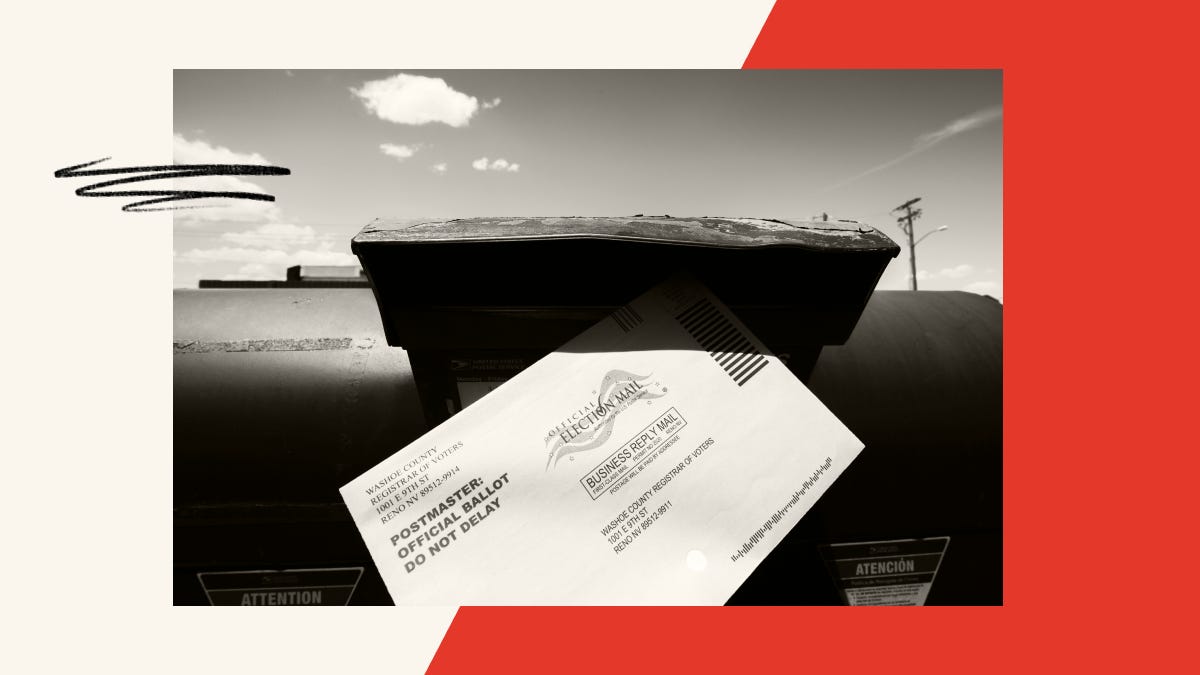
You probably heard at least something this week about Donald Trump, the US Postal Service, and the Supreme Court. It probably did not make a lot of sense.
This saga has been remarkably confusing. Trump’s mail-in voting executive order is not an existential threat to free and fair elections — at least not yet. If you plan to vote by mail, you’re almost certainly fine doing so. (Just do it as early as you can.) But this is all still a big deal. The administration is purposefully trying to create chaos around the elections in a destructive but ultimately half-baked, throw-out-everything-they-can-find strategy to deceive, disrupt, and deny.
To summarize: There is an order from the White House instructing the USPS to create what’s called a “rule” to subvert mail-in voting.
First, the order: In March, the president signed an absolutely bananas executive order attempting to assert broad authority over voter lists and voting by mail in the United States. Among other crazy things, it instructs USPS to make a rule to refuse to deliver ballots to anyone not pre-registered with the federal government by state officials. A bunch of people, including many states, sued, and U.S. District Judge Indira Talwani effectively blocked the order with two different rulings. The administration asked the First Circuit Court of Appeals to stay one of the rulings, which the appellate court denied. For weeks, the Supreme Court sat on the administration’s pleas to intervene.
Second, the rule: In early June, after months of likely internal back and forth that we may never know about, USPS leadership apparently bowed to pressure from the White House and proposed a version of the rule that would kind-of, sort-of implement parts of the order. Then the USPS moved to finalize that rule last Friday, despite tens of thousands of negative comments from the public and stakeholders. The final rule was published on Wednesday.
Third, the order again: On Monday, the Supreme Court suddenly woke up and stepped in on procedural grounds, essentially saying one of Judge Talwani’s two rulings against the order had been premature because the rule didn’t exist when the lawsuits were filed.
Fourth, back to the rule: On Tuesday, Judge Talwani found that the USPS had violated the other district court ruling against the order (the one SCOTUS didn’t block) by issuing the final rule in the first place, and on Wednesday she vacated that district court ruling in light of the Supreme Court’s stay in the states’ case. Meanwhile, 25 states and others have now sued to block the USPS rule. So now the litigation process restarts, with the USPS’s final rule front and center. You should expect it to likely be back on hold within a day or two.
Confused? Me too.
By the way, there are 68 days until Election Day. The USPS is apparently unable to say when its “portal” will even be active. The first mail ballots go out in just days in some states.
Tick tock.
What you need to know: This is almost certainly noise — just vote early
Even with the Supreme Court’s shenanigans this week, it’s very unlikely that the Trump administration is able to meaningfully interfere with mail ballots this election.
As the Supreme Court itself said:
The Court’s disposition of this application does not mean that any measure taken by the Government to implement the [Executive] Order will necessarily be lawful. On that score, time will tell.
Meanwhile, voting by mail remains overwhelmingly safe, secure, and protected by law. The states control election rules, not the president. As the Constitution says: “The Times, Places and Manner of holding Elections for Senators and Representatives, shall be prescribed in each State by the Legislature thereof,” subject to congressional override.
In 2024, roughly 48 million people voted by mail — a similar number will likely vote that way this year. Mail voting is a convenient and accessible option, especially for seniors, military voters, people in rural areas, and people with disabilities. Even Donald Trump thinks it’s great: He again voted by mail in Florida two weeks ago.
If you had previously planned to vote by mail, you should vote by mail.
More importantly, regardless of whether you vote by mail or in person, consider voting as early as possible. 48 states (sorry, Missouri and Wyoming) have online ballot tracking tools where you can see if your ballot was accepted. Even if something truly insane were to happen with any of this, voting early means there’s plenty of time to remedy it.
Plus, voting early — whether in person or by mail — is extremely helpful to election officials. The sooner you vote, the sooner your vote can be counted and the sooner we’re likely to have results on election night.
What you should know: The USPS mess is a window into Trump’s election strategy
All this chaos and confusion, it’s not really accidental. It’s also not just the byproduct of complex legal processes. It’s an intentional goal by Donald Trump and the people around him.
His strategy — to deceive, to disrupt, and to deny — is hardly surgical. You shouldn’t think of it as a finely tuned set of steps. He isn’t playing six-dimensional chess. (I think people often overreact to or misinterpret individual events because they assume, on some level, that there is a secret chess game.)
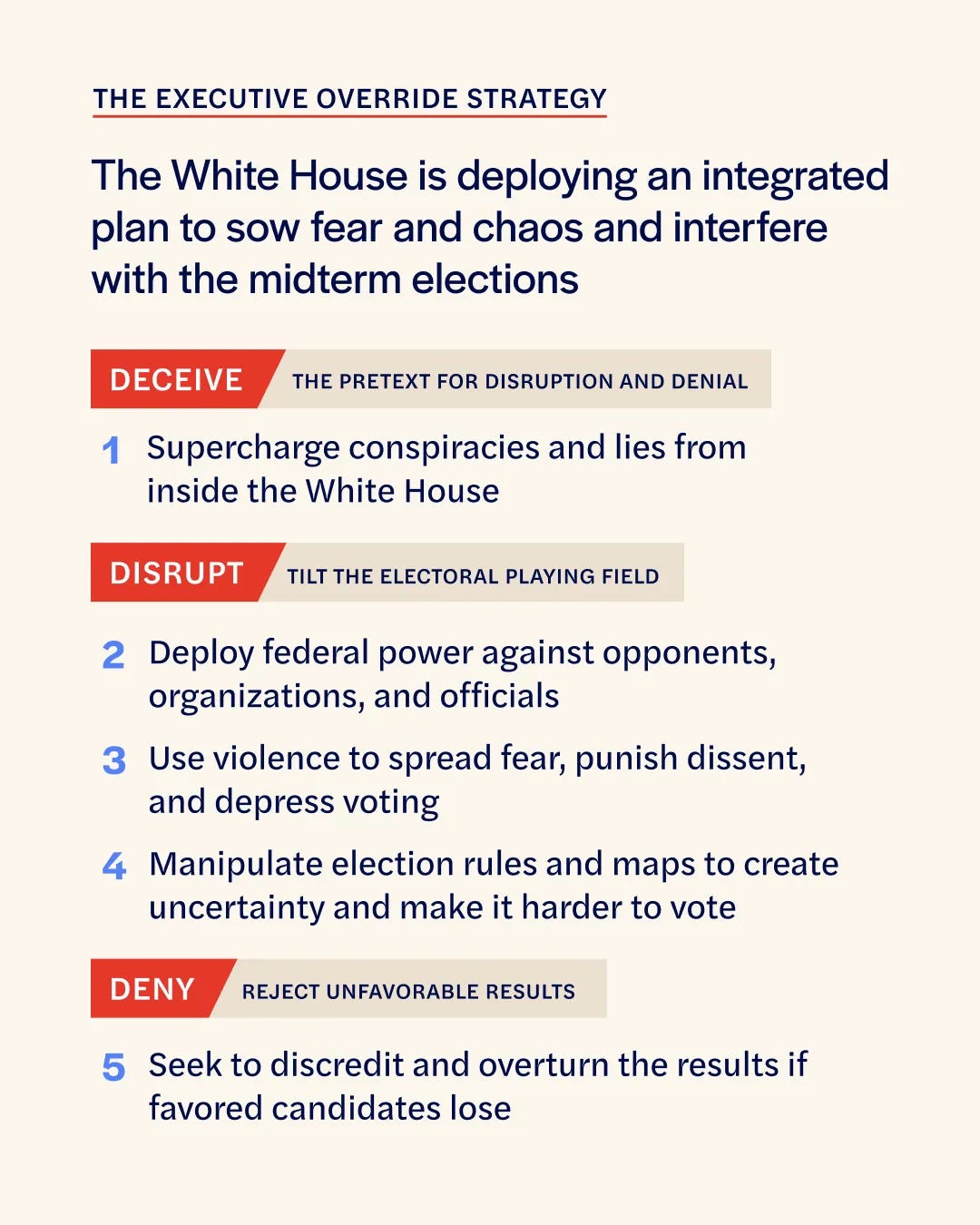
Instead, you should think of this whole deceive, disrupt, deny playbook as the equivalent of picking up the chess pieces and hurling them at the other side of the board.
It’s chaotic, it’s messy, it’s improvised, and it’s ham-handed. But it’s also incredibly destructive. And it’s not guaranteed to fail.
Even if Donald Trump falls short in his ostensible goal — to blow up mail-in voting in a way that systematically disenfranchises enough Democratic-leaning voters to rig the midterms1 — he has likely already succeeded in spreading confusion, doubt, uncertainty, and fear.
In the end, that’s his aim: to get all of us to doubt the security and reliability of our elections. And maybe, just maybe, that will be enough cover to deny and overturn the results.
So what can we do about it?
Instead of feeling afraid, get angry. Every American should feel indignant that the person who is supposed to be chief protector of our democracy is using that position to try to tear it apart, consequences be damned.
Then take that anger and channel it. Promise yourself that you’ll vote no matter what, no matter what chaos this administration causes. Register other people to vote too. Take this training about how to protect voters in your community. Consider becoming an election observer. Protect the process that he’s so maliciously and incompetently trying to destroy.
Or better yet? Sign up to be a poll worker:
How you can protect democracy #28
Become a poll worker: One of the most direct ways to protect our elections is by serving as a poll worker, helping ensure voting locations run smoothly and voters are supported throughout Election Day.
Poll workers are trained election staff who prepare polling stations, check in voters, manage the voting process, and address questions as they arise — committing to nonpartisan professionalism regardless of their own political beliefs. These roles are essential to keeping elections fair, accessible, and well-run.
Election administrators across the country are already recruiting poll workers for 2026 elections. Without enough poll workers, polling places close and voters may not have an accessible place to cast their ballot.
What you can do:
Sign up to be a poll worker through Power the Polls, a nonpartisan initiative that has connected over one million people with local poll worker opportunities since 2020.
Explore the EAC’s poll worker resources for training materials, recruitment guides, and state-by-state information on poll worker requirements.
Familiarize yourself with common Election Day challenges so you can address them calmly and effectively as they arise.
Share Election Protection resources with voters in your community so they know where to turn if they encounter issues on Election Day.
Extra Credit: Download the EAC’s customizable social media toolkit and share it with your networks to help recruit poll workers in your community.
The How you can protect democracy playbook currently has 99 actions. (I loved the Civil Superpowers Quiz, just added this week — I’m a “Defender.”)
Two notable movements in the Authoritarian Action Watch this week.
First, the USPS mess (above) tips Corrupting Elections up to ESCALATING.
Second, the trade war with Canada. Most of the attention is on the economic impacts, but don’t forget — Trump’s tariffs remain one of the largest and most consequential power grabs away from Congress. (See: Arbitrary and unpredictable taxes are, quite literally, what the Founders rebelled against). As the Constitution says: “The Congress shall have Power To lay and collect Taxes, Duties, Imposts and Excises.” In other words: Tariffs are Congress’ job. That’s not what’s happening. Aggrandizing Executive Power is RAPIDLY ESCALATING.
See the rest of the updates.
Final hits: The Department of Homeland Security weaponized NSPM-7 to surveil core First Amendment activity. Read Mona Charen: It’s not the time to panic; it’s the time to get ready. Watch Ian Bassin on how Trump has learned from history to abuse presidential powers. And three more election interference stories to watch this week here.
See you in September.
For what it’s worth, it’s extremely unclear whether his plot would disproportionately harm Democrats. Longtime Republican election super-lawyer Ben Ginsberg: “I think you’re going to see some blowback from Republicans in the coming weeks, because after all, Republicans are the older party and older folks like to vote by mail. They’re the rural party… And certainly vote by mail is important to people in rural areas.”
Oppose Trump’s Attacks on Voting Rights
https://world-outlook.com/2026/08/25/oppose-trumps-attacks-on-voting-rights/
The US president has again threatened to use executive power to subvert the fall midterm elections. If successful, this move would strike a crippling blow to democratic rights and would represent a giant step toward one-man rule.
During an August 10 interview with Donald Trump, right-wing commentator Wayne Allyn Root suggested the president might declare a national security emergency to enact provisions of the Safeguard American Voter Eligibility Act (SAVE), currently stalled in the Senate. “If you do this in the next month,” Root told Trump, “we will get photo ID, proof of citizenship, and a limit to mail-in ballots, and you don’t even need the Senate’s help.”
“Stranger things have happened,” the president responded. “I’ll leave it at that.”
The SAVE Act would disenfranchise millions, particularly among those populations the administration fears most: Blacks, Latinos, and Native Americans; youth; women; and workers in the factories and on the land.
Under the guise of ensuring only US citizens cast a ballot, the Act would require individuals to present proof of citizenship in person at an election office in order to register to vote. Only an unexpired passport, or an enhanced driver’s license — available only in five states, would serve as stand-alone proof.
A military ID would have to be accompanied by service records indicating birthplace; all other forms of photo ID — including the REAL ID — would have to be coupled with a birth certificate bearing an official seal. Most insulting is that tribal ID alone — the document that proves one’s Native American ancestors were the first humans to occupy this land — would not be considered proof of citizenship.
Currently, about 12 percent of voters do not have the necessary documents on hand to meet SAVE Act standards. To get them costs time and money, in essence, a hidden “poll tax.” These hurdles would impact working people disproportionately as they are less likely to have a passport or the flexibility to visit an election office during business hours. And the burden would fall more heavily on some than others:
In the 30 largest counties by area in the West, rural voters would have to drive an average of 260 miles round-trip to an election office. In Alaska and Hawaii, some voters would have to fly. This cost in money and time is significant, particularly for workers and small farmers and ranchers.
People of color are disproportionately represented among those without ready access to proof of citizenship. Nearly half of African Americans under 30 do not have an ID with their current name and address. Many Blacks born before the civil rights era were never issued a birth certificate at all.
About 24% of those under 30 also do not have ready access to qualifying documents. Young people, who tend to move more frequently, would need to present their documents each time they re-register.
An estimated 69 million women do not have a birth certificate that matches their legal name. They would also have to provide additional paperwork.
The SAVE Act adds to a pattern of other attacks on voting rights by the Trump administration.
On March 31, the president issued an executive order requiring states to turn voter rolls over to the Postal Service — effectively seizing control of the voting process, a prerogative of the states under the US Constitution — and blocking the post office from delivering completed ballots of voters who are not on federally approved lists.
On August 21, the Postal Service published regulations that would comply with Trump’s call to restrict the popular voting-by-mail practice just months before the midterm elections. The Postal Service said it would deliver mail ballots only in states that shared voter data with the federal government and would review every envelope for compliance with the new standards.
The March 31 executive order had been largely blocked by federal courts. But on August 24, in an emergency ruling, the Supreme Court said Trump could proceed with implementing the restrictions to mail-in ballots.
(…)
thanks, Ben. Makes sense.