


On Thursday night, the president will address the American people. Reporting suggests he will cite newly (and selectively) declassified “intelligence” about the 2020 election to further his longstanding conspiracy theories.
That claim, on its face, might seem like Trump indulging a personal obsession — he thinks he won in 2020, and he needs to prove it. As we’ve covered over the past few months, though, his claims serve a larger purpose. They are designed not just to relitigate 2020, but to undermine confidence in the 2026 midterms and to justify new measures to enable his allies to override our elections.
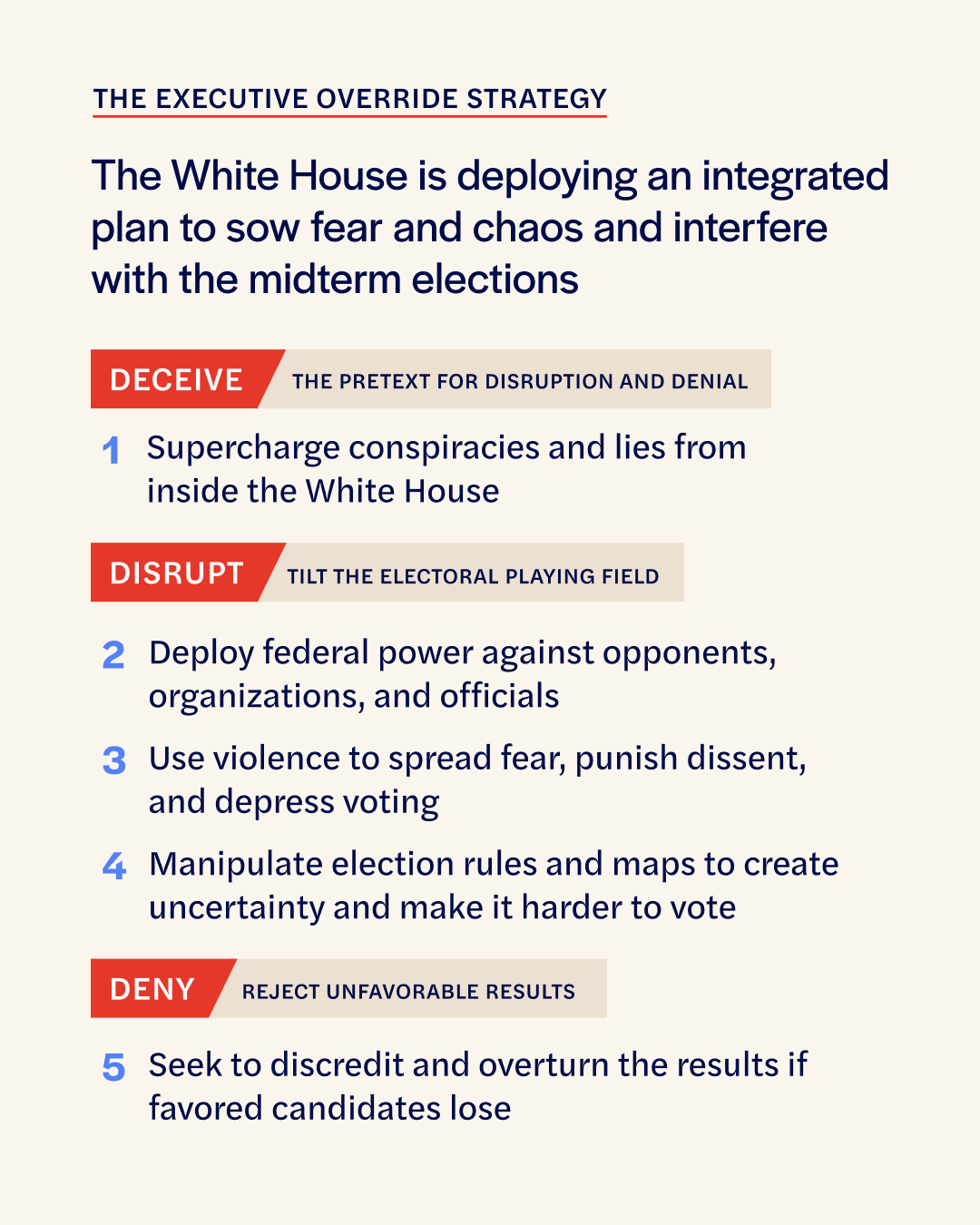
This is one piece of a broader strategy that the president has pursued for months: Deceive the American people about the security of our elections, Disrupt the playing field in ways that favor his party, and ultimately Deny results he doesn’t like after ballots are cast. Protect Democracy first described this strategy in our Executive Override report, issued in March. This week, we published an update that explains how the strategy has evolved in the last four months and how the pushback is faring
Read more — Deceive, Disrupt, Deny in full effect
Politicized intelligence is one threat among many
Politicized intelligence has been a concern since the start of Trump’s second term. After Director of National Intelligence Tulsi Gabbard took part in an FBI raid on Fulton County related to the 2020 election earlier this year, Ben Berwick and Ansley Skipper wrote this:
“Gabbard is steeped in election conspiracies and appears to be looking to curry favor with the president by being his election denial point person in the executive branch.”
In the months since, the president has replaced Gabbard with Bill Pulte, an interim appointee with no intelligence experience who seems to have been selected primarily for his willingness to serve the president. Jess Marsden warned:
“Unlike lies about vote-counting or voting machines — which have been circulating for years and have never been proven — misinformation about foreign interference in elections is territory that’s not nearly as well-worn. The DNI could use selective disclosures of raw intelligence — on its own, not evidence of wrongdoing, but potentially highly suggestive to a lay audience — to bolster false claims about the election.”
Like most of Trump’s playbook on elections, then, this threat was entirely predictable. And it’s far from the only development in the Override strategy since we first published our report. Since March, the president has leveraged all three parts of the playbook:
Deceive: The president has spent the spring spreading lies about California vote counting and using the Federal Communications Commission and the Department of Justice to go after the news media — on top of his politicization of the Office of the DNI. These efforts have different targets, but each is designed to use the power of the federal government to sow doubt about the security of our elections and lay the foundation for the administration to interfere in them.
Disrupt: Trump’s continued obsession with the SAVE Act has been joined by an executive order and a proposed Postal Service rule that would let the federal government decide which mail ballots get delivered (both of which have been enjoined by courts for now). Add to that, he’s advocated for a series of Supreme Court decisions that have furthered the administration’s efforts to sow chaos this election season. These developments, along with several others, are part of a broader strategy to tilt the playing field toward Trump and his allies.
Deny: Any effort the president makes to deceive or disrupt also gives him ground to deny results he doesn’t like after the fact. To further that effort, the president has purged dissenting voices from the Republican Party and sought to create a $1.8 billion slush fund to reward allies willing to break the law on his behalf. And his allies in the states have engaged in their own small-scale version of denial, canceling elections midstream and nullifying completed results. All of this is only likely to ramp up as Election Day gets closer.
Read more — The strategy hiding in plain sight
The override strategy is facing pushback
None of this is happening in a vacuum. Even as the president has weaponized the federal government against the midterms, he has met resistance at nearly every turn. And that’s because his approach has no legal authority. Our elections are run by state and local officials across the country; not by the President.
Federal courts have blocked the Postal Service rule, and the administration is 0-15 in cases over its attempts to seize state voter roll data. Congress has, for now, rejected the SAVE Act, forced Trump to back down — at least initially — on the slush fund (which also received a stinging rebuke in court), and pushed him to change course on Pulte’s official nomination before he installed him temporarily.
Civil society has mobilized as well. More than 100 activist groups signed a joint letter of solidarity after the Southern Poverty Law Center and Ohio Organizing Collaborative were targeted. A federal court, in a lawsuit brought by the New Hampshire Youth Movement, struck down a state law that would have made it harder for students to register to vote. 50 labor and religious groups condemned the indictment of anti-ICE protesters in Minnesota. And Illinois, Vermont, New York, and Connecticut have passed laws letting residents sue federal agents who violate their constitutional rights — a direct response to fears that armed agents could be deployed to polling places.
There’s more work to be done, but we have built a strong foundation.
What we can do
We don’t know exactly what Trump is going to say on Thursday night. Odds are, it will be as inflammatory as possible — designed to make some Americans feel unsure about the security of our elections, and to convince others that the president and his allies are already stealing the midterms.
In the months ahead, we expect Trump’s election subversion efforts to become even more focused, and new tactics to be added to the playbook. The administration might use zombie lawsuits to seed legal challenges to election results ahead of time, activating them when results don’t go their way. It could declare emergencies to try to wrestle control over elections from state and local officials. It could set up a conflict with the courts as it continues trying to decide who is and is not eligible to vote. It could also use federal law enforcement to intimidate voters in key areas in the weeks before Election Day. And, as now seems likely, it could politicize intelligence with the goal of sowing doubts about the security of our elections.
Right now, Trump’s election subversion effort is not succeeding — because the American people are not letting it.
The best way to combat election lies is to understand how much control each of us still has over the outcome of this election. The president and his allies want us to feel like we won’t be able to vote, or our votes won’t be counted or won’t matter. Our job is to prove them wrong.
Next week, we’ll have more to say about the actions you can take in the months ahead.


Everything he does to discredit the midterms is going to make more people want a solution like the No Confidence Amendment I'm supporting (https://UTW.vote/explainer, for the curious). I'm building as much support as I can, through posts and through comments like this one, so that no matter what happens in November, America wins. If midterms give us a Congress that actually wants to help our country, great. If they don't, we'll take our country back anyway. And if Trump manages to cancel or postpone the November elections, then we'll end up ratifying No Confidence even sooner than we would have otherwise.
Thank you, Protect Democracy!
An important action everyone can take to ensure free and fair elections: help young people register to vote.
The highest concentration of unregistered is among 18-year-olds, and they need not wait until that birthday. Many states offer pre-registration at 15-17, so high school students only have to turn 18 and they can head to the polls.
This also means high school is the time and place to welcome up-and-coming voters to our democracy, this and every year.