


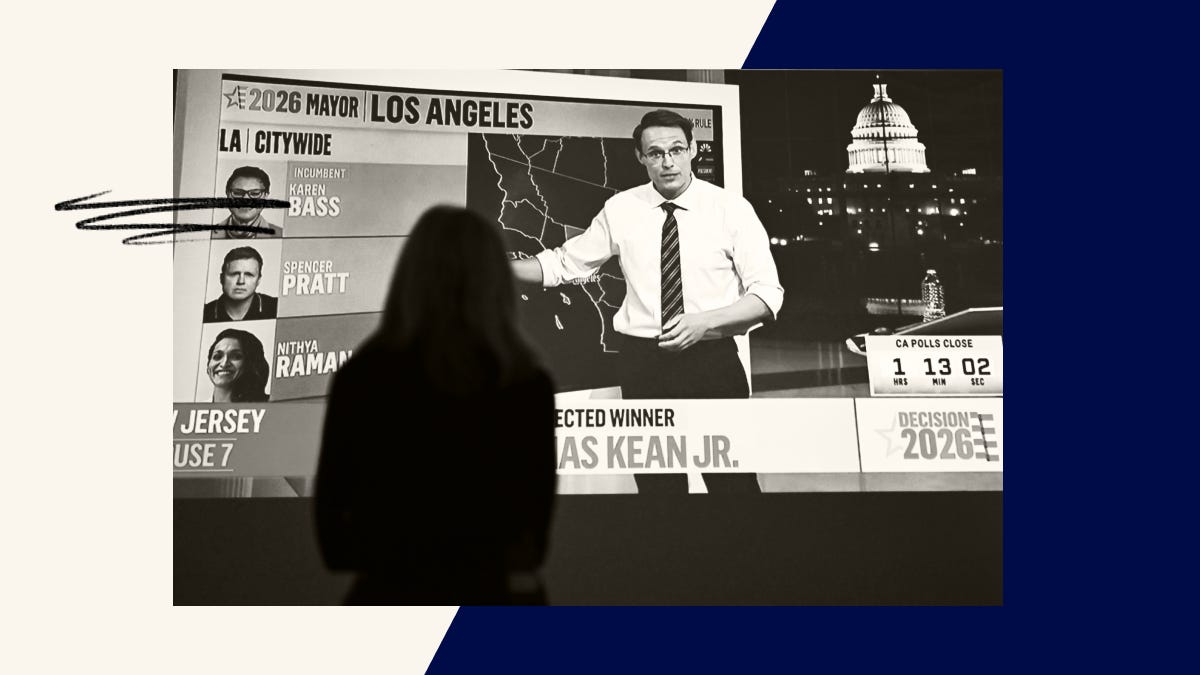
Los Angeles hasn’t had a Republican mayor since 2001. In the 2024 presidential election, Kamala Harris won more than two-thirds of the vote in Los Angeles County. Even in 2013, amid a harsh political environment for Democrats across the country, the top-two vote getters in the mayoral primary were both Democrats. So why are President Trump and his allies now up in arms over the failure of reality TV star-turned-LA mayoral candidate Spencer Pratt to advance to the general election this fall?
Spoiler alert: It doesn’t have anything to do with Pratt at all. It’s all about how California counts its ballots (slowly) — and how that can be weaponized to erode trust in the elections.
In the hours after voting closed in California on June 2, Pratt — a Republican — had a small lead amongst the first ballots to be counted in the race for a second-place spot to challenge incumbent Mayor Karen Bass. But in this race, tabulations released on Election Day represented somewhere in the range of 60% of the total, and did not include the 25% of votes in California that are typically vote-by-mail ballots cast on or shortly before Election Day. These ballots can be counted if they arrive within seven days after Election Day, as long as they are postmarked by Election Day. As those Election Day ballots were counted, they favored Nithya Raman, a progressive challenger to Bass from within the Democratic party, by a sufficient margin to secure her spot over Pratt in second place.
In other words, it played out as a repeat of the presidential election in 2020: The initial vote count was a “red mirage” favoring Republicans, influenced by the fact that Republicans are more likely to send in mail ballots early and vote in person. As the full picture of the ballots cast on and before Election Day became clear, we learned that they favored Raman, and she secured the second-place spot to challenge Bass.
There’s nothing surprising about this outcome — similar patterns have occurred in races since at least 2020. And there’s nothing surprising about Trump using his megaphone to spew election disinformation. But Trump and his allies aren’t stopping with spreading rumors. Assistant U.S. Attorney Bill Essayli posted on social media that he was opening “multiple election fraud investigations” to look into the results in the state. He told Glenn Beck this week that he expected to bring prosecutions after the primary was certified. There is not, as of this writing, any reason to think that these investigations will turn up actual evidence of fraud.
And, it’s worth noting, Trump and his allies don’t seem to care that Steve Hilton, the Republican gubernatorial candidate, made it out of the primary to compete against Democrat Xavier Becerra. In fact, Hilton himself acknowledged that his team hasn’t found evidence of interference. “We’ve seen nothing that would warrant that kind of intervention,” he said in a June 9 press conference.
In fact, Trump and his allies’ crusade doesn’t have anything to do with the California primaries at all. It’s part of their overall plan to interfere with the 2026 midterm, which we explain in Executive Override: to deceive the public about the legitimacy of the elections, thereby creating a pretext to disrupt election processes (for instance, by imposing unlawful new rules on mail voting) and eventually to deny the results.
Read more — The Post Office has no business deciding who votes
A possible silver lining? By claiming that California’s slow vote count is somehow fraudulent now — and giving California officials the opportunity to debunk those claims and continue ongoing work to count ballots faster — Trump could wind up inoculating the public against his claims. In the fall, when control of Congress could come down to the outcome of House races in California, those same fraud claims may be less effective, as election law expert Rick Hasen has argued.
In Ohio, the deceive strategy turns into a show of force
If California shows how the administration manufactures a pretext for election interference, recent events in Ohio show the next steps in the playbook. On Thursday, FBI agents raided the Cleveland offices of the Ohio Organizing Collaborative, a pro-democracy group that runs grassroots voter registration drives in Cleveland, Columbus, and Cincinnati, with a focus on helping underrepresented communities register to vote. Federal agents — more than 100 — reportedly showed up at the homes of the group’s leaders and staff across the state, serving subpoenas and seeking devices and information. Agents told the people they contacted that the search related to a voter-fraud investigation.
Board member Prentiss Haney described the raids as “straight-up intimidation tactics,” and that seems spot on. As of now, there is no public evidence that the group did anything wrong — and notably, the Ohio Organizing Collaborative has joined lawsuits challenging Ohio’s redistricting on behalf of Black voters, making it exactly the kind of pro-democracy actor the administration has been eager to target. Whether or not these investigations ever yield charges, the immediate effect is to intimidate the organizations that help eligible Americans register and vote — and to feed the “voter fraud” narrative the administration needs to justify intervening later.
Shenanigans at the ODNI could supercharge the deceive strategy
At the same time, Trump and his allies are spreading disinformation about California and intimidating nonprofits in Ohio, they are laying the groundwork for another even more concerning deceive tactic: Trump’s effort to install a loyalist (first Bill Pulte, now Jay Clayton) as director of national intelligence (DNI), replacing Tulsi Gabbard.
The DNI has access to a host of highly sensitive national security information, which affords major opportunities to spread disinformation about candidates, their supporters, and the electoral system itself. This could look like a selective leak designed to tarnish a political opponent or false claims about foreign interference in the election process itself. Gabbard pulled a page from this playbook when she involved herself in the FBI raid in Fulton County, Georgia, where hundreds of boxes filled with ballots and other documents related to the 2020 election were seized.
Because the DNI has so much responsibility for sensitive intelligence, and is a role that is prime for weaponization if placed in the wrong hands, Congress required that the position be filled by someone with “extensive national security experience.” Neither Pulte nor Clayton has any. Pulte (who is still on track to take the DNI role, at least briefly) began his career at his family’s construction company, where he had a history of targeting his relatives with weird, vindictive attacks. He then leveraged campaign donations to President Trump into an appointment to be director of the Federal Housing Finance Agency (FHFA) — and turned that agency into a key node in Trump’s retribution campaign. As director of FHFA, Pulte was behind investigations into New York Attorney General Letitia James, Senator Adam Schiff, and Federal Reserve board member Lisa Cook. (To be clear, none of those investigations have led to convictions — Cook and Schiff were never charged, and the mortgage-fraud indictment against James was dismissed.)
Clayton’s career is more conventionally distinguished — he was a longtime partner at Sullivan & Cromwell and served as chair of the Securities and Exchange Commission during Trump’s first term. He was confirmed last year as U.S. Attorney for the Southern District of New York. But he, too, has been willing to embrace (or at least not resist) Trump’s agenda of weaponized law enforcement. He reportedly advised Southern District of New York (SDNY) prosecutor Danielle Sassoon (then the acting head of SDNY) to follow the Department of Justice’s (DOJ) order to drop the criminal case against then-NYC mayor Eric Adams. He didn’t intervene when the DOJ fired respected SDNY prosecutor Maurene Comey, the daughter of former FBI director James Comey. And just last week, he jumped on the California voter-fraud bandwagon, going on CNBC to endorse Trump’s false claims about California’s elections, saying “On the [election] integrity side, we’re doing an absolutely terrible job, and the American people are right to question it.”
As DNI, Clayton (or Pulte) would have access to a new set of tools to supercharge election conspiracies. Unlike lies about vote-counting or voting machines — which have been circulating for years and have never been proven — misinformation about foreign interference in elections is territory that’s not nearly as well-worn. The DNI could use selective disclosures of raw intelligence — on its own, not evidence of wrongdoing, but potentially highly suggestive to a lay audience — to bolster false claims about the election. And media outlets will have less willingness or ability to conclusively debunk lies that purport to be grounded in sensitive national security information.
An additional reason for concern is that Trump is signaling that he wants to make changes at the agency to erode its nonpartisan, professional bona fides. Trump said this week that Pulte should be “less shackled,” and that he would encourage Pulte to fire many of the national security professionals who work in the agency. That’s likely to discourage future whistleblowers about misinformation, a play we’ve seen the administration run at other agencies. (Add to that a new proposal that would allow agencies to require employees to sign nondisclosure agreements, another layer of chill on disclosures of wrongdoing.)
Read more — Muzzling America’s workforce
Senate Democrats are signaling that they will go along with Clayton’s permanent nomination to the post at DNI — and preventing Pulte from a lengthy tenure as acting DNI is definitely a win. But there’s still more we can do to head off the administration’s misinformation strategy, including by continuing to debunk ongoing lies about California:
Help inoculate against misinformation by exposing the strategy in advance: Public understanding of Trump’s override strategy is an effective form of inoculation. Sharing that California is following its laws and processes and that there is no evidence of fraud or irregularities is crucial to preventing the spread of conspiracies in the short term. So too is noting Trump’s rush to claim things are rigged whenever his partisan allies lose — something we all need to be prepared for come November.
If you lead a nonprofit or civic group, prepare in advance: The Ohio raid is a warning to every organization that helps Americans register and vote. Protect Democracy’s Nonprofit Toolkit walks through how to respond to government investigations — and as we saw with the SPLC, the groups that fare best are the ones that prepared in advance and refused to face it alone.
For Californians, call your state legislators: Let them know that they should continue to invest in and protect elections. These instructions on the app 5Calls can help you do so. Bonus points for calling the offices of Senate President Pro Tempore Monique Limón and Speaker of the Assembly Robert Rivas, since they are actively in budget discussions about election funding this week.
ICE surges are ramping back up as we head into the summer
Deployments of ICE agents to cities across the country began in earnest in the summer of 2025, and a year later, they are set to ramp up again. White House border czar Tom Homan has said that one of those surges will target New York City, explaining that the surge would happen because Governor Kathy Hochul is no longer allowing state and local law enforcement to double as immigration officials across the state.
While Homan acknowledged that he “had to” surge ICE into the city, he also made it clear that he doesn’t want to repeat what happened in Minnesota. “You will not see a Minnesota. I will not let Minnesota happen,” he said.
See the Authoritarian Action Watch.

Not just lies, but corruption, too. Here's what Senator Murphy had to say: https://www.murphy.senate.gov/newsroom/press-releases/murphy-details-unprecedented-corruption-of-trump-white-house-over-the-last-500-days