


46% of American voters now believe the lie that there is widespread fraud in U.S. elections. Nearly half the country. That’s according to a new Reuters/Ipsos poll, which highlights the dangers of the Deceive component of the administration’s Executive Override playbook. (Reuters appropriately notes alongside reporting those results that extensive audits have repeatedly shown fraud to be exceedingly rare.)
The recent polling isn’t an accident — it’s the result of a deliberate Trump strategy. In order for the administration to successfully interfere with the election and, ultimately, overturn unfavorable results, they first need to convince a sufficient portion of the public that our election system is unreliable. As Reuters captured it: “President Donald Trump’s years-long campaign to undermine faith in U.S. elections has gained broad traction with the American public.”
For years, election denialism was a movement of outsiders — fringe actors, online communities, and hyper-partisan media. Trump was the ringleader, but the machinery had limits, particularly within the federal government. In the aftermath of the 2020 election, Trump and his allies tried to sell the public on their lies, but never got traction. Then, only about 30% of all voters bought Trump’s claims that the election was rigged. That’s a lot of people — far too many — but it wasn’t nearly enough to lay the foundation for a successful legal and political strategy to overthrow the results. (And of course, ever since 2020, Trump has waged an ongoing campaign to erode trust in elections.)
Unlike 2020, today the lies and conspiracies are coming from not just the Oval Office but all across the federal government. Since taking office in January 2025, the second Trump administration has institutionalized election denialism, stocking the executive branch with loyalists — including leading election deniers — who actively promote the falsehood that the 2020 election was stolen and that our election system cannot be trusted.
And the administration is not simply repeating its old lies; it is using the investigative, intelligence, and enforcement powers of the executive branch to manufacture the appearance of evidence for those lies.
Read more — How the Trump administration plans to interfere with the 2026 elections, and what you can do about it
The three lies to end democracy
The Administration is not just talking. The president has turned the formal powers of the executive branch into an amplifier for election conspiracy theories — and he’s filled the halls of power with people who are equally committed to the project.
Three false claims are doing the heavy lifting.
Lie One: The 2020 “Big Lie,” rejuvenated. Trump and his appointees continue to insist the 2020 election was stolen. And rather than recognize the January 6 attack on the Capitol as a national tragedy, the White House has sought to lionize the perpetrators — turning violent insurrectionists into heroes, or at least victims. We continue to see fidelity to the 2020 Big Lie being used as a litmus test for Trump’s nominees. For months, his judicial nominees have refused to acknowledge Trump’s defeat in 2020 — now the nominee for the Fed Chair (a purportedly independent role) is scared to say Trump lost.
Lie Two: Mail-in voting and voting machines are “rigged.” The administration has repeatedly sought to cast doubt on the reliability of mail-in voting and electronic voting systems. Trump has ordered the U.S. Election Assistance Commission to decertify every voting machine it had previously certified — an order beyond his authority that is now the subject of pending litigation. The Reuters poll found 53% of respondents expressed concern about fraudulent absentee or mail-in ballots. And yet authoritative analyses of this continue to show there is no issue here, which is not surprising given how many controls state officials have in place to prevent this type of fraud. It’s worth noting, as well, that Trump and his family vote by mail. NPR’s headline says it all: “Trump, While Attacking Mail Voting, Casts Mail Ballot Again.”
Lie Three: Noncitizens are stealing elections. This has been the administration’s dominant false narrative. In reality, states have robust systems to prevent noncitizen voting, and it is vanishingly rare. Michigan’s 2024 audit turned up just 15 potential noncitizen votes out of more than 5.7 million cast. Georgia found 20 out of 8.2 million registered voters. The near-nonexistence of noncitizen voting makes sense: States have strong controls over their voter rolls and any noncitizen who tried to cast a ballot would face severe criminal and immigration penalties. Reuters summed it up well: “Years of messaging by Trump and his allies casting doubt on voting have resonated strongly with Republicans, particularly around claims that non‑citizens vote in significant numbers and that mail‑in ballots are unreliable, despite repeated audits and academic research finding fraud in either case to be exceedingly rare.”
So none of these claims hold up to scrutiny. They have been debunked time and time again. But that hasn’t kept the Administration from taking ever more extreme measures to try to propagate them.
Turning the federal government into a disinformation machine
These lies are dangerous enough on their own, but the administration isn’t just repeating lies. It’s using the federal government's powers to manufacture the appearance of evidence for them, effectively turning law enforcement and intelligence agencies into conduits for partisan disinformation.
Consider four key examples:
1. The FBI’s raid on Fulton County, Georgia. In January 2026, federal agents raided an election office in Fulton County, seizing hundreds of boxes of state election materials. Bizarrely, Director of National Intelligence Tulsi Gabbard was personally present for the raid — despite having no domestic law enforcement authority.
The affidavit used to get a search warrant relied on misleading claims that omitted key findings from prior state reviews. Fulton County’s 2020 ballots were counted three separate times, with results affirmed each time.
The raid is a sign of what’s to come: using federal law enforcement to try to breathe life into repeatedly debunked conspiracy theories. As one Fulton County commissioner put it:
This is just a mechanism to bring 2020 up and say that Fulton County doesn’t run good elections, that they can’t be trusted, so that people in 2026 won’t feel like their vote is accurately counted. It’s just an entire strategy to disrupt the 2026 midterm elections, and we’re not going to let them do it.
And there’s probably more to come: Former Attorney General Bondi appointed the U.S. attorney who obtained the search warrant to lead election-integrity investigations nationwide
2. Seizing state voter rolls — at times, at gunpoint. The administration has demanded full, unredacted voter rolls from 48 states and D.C., and sued more than 25 states that refused to comply. After the murder of Alex Pretti in Minneapolis, the administration demanded that Minnesota provide its voter rolls as a condition of de-escalating the terror unleashed by federal immigration authorities. Read that sentence again. They demanded state voter rolls at the point of a gun.
Federal courts have dismissed multiple DOJ lawsuits seeking data. But confidential memoranda reveal the real plan: DOJ intends to analyze the data and instruct states to remove specific voters — an extraordinary assertion of federal authority over state election administration. DOJ is also sharing voter roll data with DHS, creating a serious risk that eligible naturalized citizens will be wrongly flagged and purged before the 2026 midterms.
3. Manufacturing prosecutions to advance a conspiracy theory. The administration has weaponized the Justice Department’s criminal prosecution power to create a fog of deception around elections. It has sought but failed to find and prosecute noncitizens for voting — not surprising, given the paucity of noncitizen voting. But still, their efforts can generate headlines.
The Administration even turns unrelated retaliatory prosecutions against perceived political opponents into efforts to shore up its election lies. Alongside the Trump Justice Department’s indictment of the Southern Poverty Law Center (SPLC) last week, Trump posted on social media: “The Southern Poverty Law Center…has been charged with FRAUD.… If it is true, the 2020 Presidential Election should be permanently wiped from the books and be of no further force or effect!” The DOJ allegations against SPLC — the Department’s latest attempt to silence critics, perceived opponents, and those who continue to pursue justice, equality, and the rule of law — have nothing at all to do with the 2020 election. That, of course, doesn’t stop the effort to use vexatious DOJ prosecutions to feed election lies.
4. Seizing voting machines to spread conspiracies about Venezuela. In May 2025, a team supervised by Gabbard seized voting machines and forensic data copies from Puerto Rico, ostensibly to investigate allegations that Venezuela had hacked the territory’s voting systems. Independent experts noted that features Gabbard’s office described as “vulnerabilities” — such as cellular modems transmitting encrypted vote totals — are common, well-understood components of election infrastructure.
The pattern across all four examples is the same: Use the power of the federal government to stage dramatic, high-profile actions that look like they’re indicative of some sort of fraud — even when they’re not.
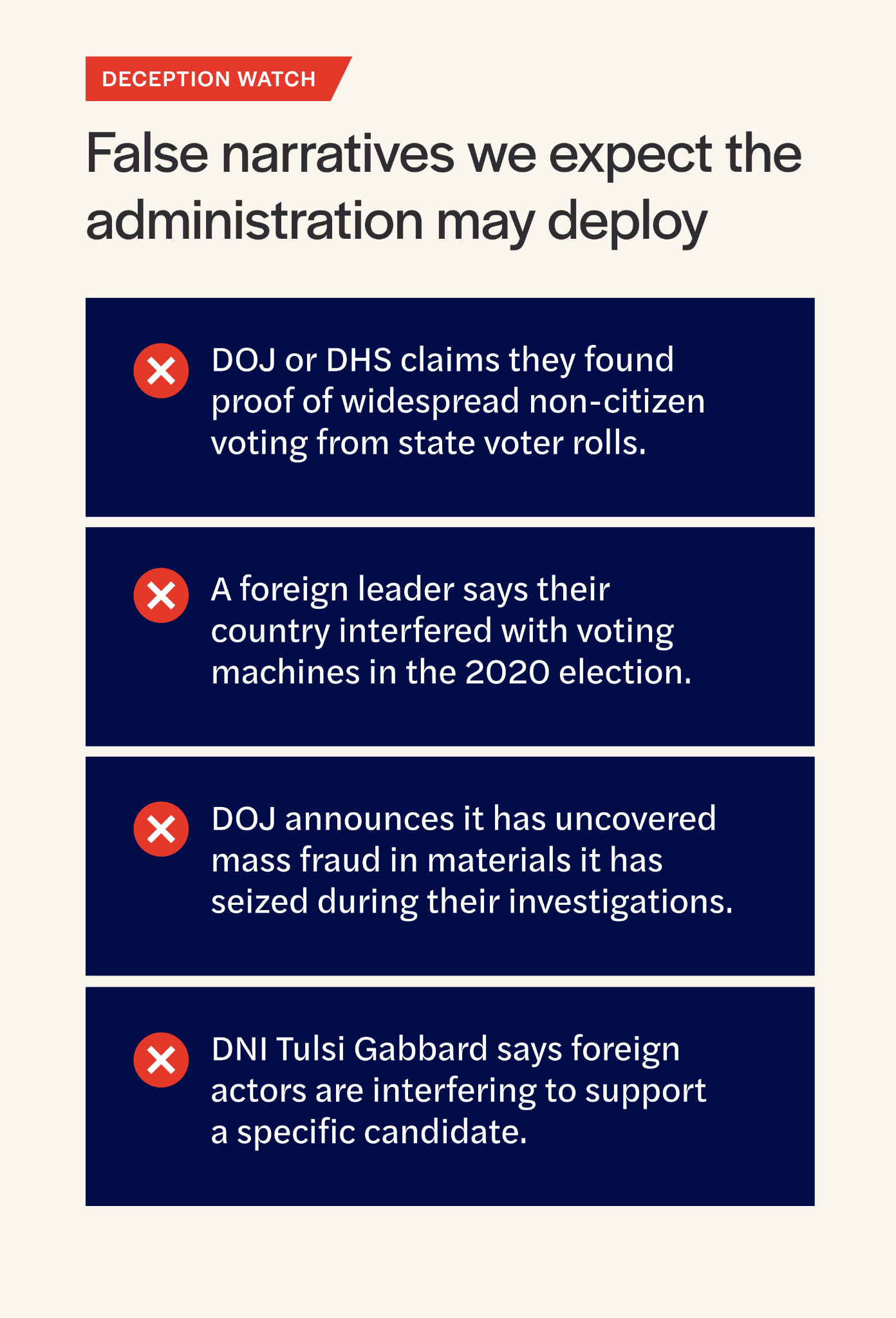
And so we should be on guard for the administration to use these abuses of power to magically manufacture “evidence” to support its false narratives. Don’t be surprised to see claims of one of the following in the months ahead — and treat it with extreme skepticism.
Silencing the people who fight disinformation
At the same time the administration is abusing power to supercharge election lies, it is systematically dismantling the infrastructure that exists to counter them.
Targeting trusted sources of accurate information. In December 2025, the State Department directed consular officers to deny visas to foreign nationals who have worked in fact-checking, content moderation, trust and safety, or combating misinformation. (Our team has filed a lawsuit challenging this policy.) This directive, coupled with years of political pressure, has already had a chilling effect. Meta eliminated its third-party fact-checking program in January 2025, explicitly citing the political environment. Other platforms have similarly retreated from content moderation.
Gutting federal election security programs. On Attorney General Bondi’s first day in office, she disbanded the FBI task force tracking foreign influence operations from Russia, China, and Iran. Since Trump took office, roughly a third of the workforce of DHS’s Cybersecurity and Infrastructure Security Agency (CISA) — approximately 1,000 employees — has departed through firings, forced resignations, and buyouts. In March 2025, CISA halted all election security support for state officials and terminated funding for the cross-state threat-monitoring system. CISA’s proposed fiscal year 2026 budget would entirely eliminate the agency’s Election Security Program. And for the first time in years, CISA did not activate its Election Day situation room during the November 2025 elections.
Ramping up censorship of the media. And this week, we saw Trump’s Federal Communications Commission (FCC) chairman advance efforts to silence media companies that don’t follow the party line. Alongside Trump’s call (again) to fire Jimmy Kimmel, the FCC issued a highly unusual order threatening ABC broadcast licenses. All part of a long-running campaign to silence or intimidate media that don’t stick to the White House’s preferred narrative.
Put it all together. Election conspiracy theories now face fewer checks — at the precise moment the federal government is working hardest to spread them.
How we can defeat the deception
The White House’s deception strategy only works if it goes unanswered. Here is what defeating it looks like: If you talk about elections — with family, followers, or readers — debunk without amplifying. Instead, lead with the truth, briefly name the lie and why it’s false, then return to the truth — what researchers call the “truth sandwich.” (More good tips on how to prebunk misinformation here.)
If you lead an institution — a company, a university, a church, a civic organization — speak up when the government abuses its power to spread lies. In response to the retaliatory prosecution of SPLC, for example, a broad range of organizations, advocates, and experts have joined a chorus to debunk the Administration’s cooked up claims and stand in solidarity with SPLC. To take another example, Trump’s allies at the FCC have sought to weaponize existing rules to suppress criticism of the administration. This week, we and our partners at TechFreedom asked the federal appeals court in Washington to intervene and stop it. And last week, we described the extensive efforts from our team and many others to stop DOJ from abusing its power to interfere with state voter rolls as part of a campaign of deception.
If you hold public office — at any level — refuse to act on the lies. The election-deception strategy is a pretext to make it plausible for officials to disrupt voting, contest counts, and reject results. The good news is our elections are carried out by state and local officials all around the country, so the administration itself has very little legal authority to interfere in the election. Congress should continue to reject the SAVE Act, which would translate the deception into a federal effort to disrupt voting. State and local officials should continue to administer their elections by the law and facts.
That 46% number in the Reuters poll is alarming. But the administration’s election deception strategy only works if it goes unanswered. It can move the other direction the same way — when the truth is told clearly, when abuses of power are met with resistance, and when the people who run our elections refuse to be intimidated into acting on lies.
Between now and November, that’s the work.
This was part three of our ongoing Executive Override series. All of the pieces in this series will be posted here. Check out the prior ones. And make sure you’re subscribed to get the next ones in your inbox.
Corrupting Elections – Rapidly Escalating
Mid-decade gerrymandering gets a major boost from the Supreme Court
What began in summer 2025, when President Trump urged Texas Republicans to redraw congressional districts to protect the GOP’s narrow House majority, has since grown into one of the largest coordinated attempts to redraw congressional districts in modern American history. As of April 2026, six states — California, Missouri, North Carolina, Ohio, Texas, and Utah — have new congressional maps, with several more in flux.
On April 21, Virginia voters narrowly approved a constitutional amendment to redraw congressional districts in Democrats’ favor, only to see a circuit court judge block certification of the results — a challenge now before the state supreme court. That same day, the U.S. Supreme Court cleared Texas’s redrawn map over a lower court finding of illegal racial gerrymandering. Florida Gov. Ron DeSantis then called a special session to consider new maps, since enacted into law, that analysts say could produce a 24–4 Republican advantage in the state’s congressional delegation.
On April 29, the Supreme Court worsened the crisis. In Louisiana v. Callais, the Court’s 6-3 majority effectively gutted Section 2 of the Voting Rights Act — the last meaningful federal check on racially discriminatory maps. It removes the guardrail that made extreme gerrymandering legally risky, and could undercut the representation of millions of minority voters. Since the decision, the governor of Louisiana has suspended an ongoing Congressional primary by executive order (which has since been challenged in litigation) and state officials in Alabama, Tennessee, and Georgia are attempting to rush gerrymanders in time to enact racially discriminatory maps that could flip additional majority-minority seats. This impact will unfold even further over time — analysts estimate up to 19 majority-minority seats could be removed as a result of the Callais decision through the 2028 election. What is happening is not normal political competition. It is a coordinated attempt — initiated by a sitting president and now enabled by the Supreme Court — to lock in congressional majorities for a single party through map manipulation.
Quashing Dissent – Rapidly Escalating
The administration is pressuring ABC to fire Jimmy Kimmel (again)
In the days following a shooting incident at the White House Correspondents’ Dinner, the White House is trying to use the episode to renew pressure on ABC and its parent company Disney to dismiss late-night host Jimmy Kimmel. The controversy traces to a Thursday night sketch (days before the assassination attempt) on Jimmy Kimmel Live! in which Kimmel performed a mock host’s speech and joked that first lady Melania Trump had “a glow like an expectant widow.”
Both President Trump and the first lady suggested Kimmel should be fired. But most troublingly, Brendan Carr, the chairman of the FCC, has also taken action against ABC in the days since Kimmel’s joke aired, formally calling for ABC to defend its license to broadcast. This is not an isolated incident. In September, ABC and two of the country’s largest TV station owners — Nexstar Media and Sinclair — suspended Kimmel’s show after Carr threatened affiliates following comments Kimmel made about the death of conservative activist Charlie Kirk.
Protect Democracy has been fighting back. Just this week, we filed a legal action in the D.C. Court of Appeals, seeking to force the FCC to respond to a formal petition filed last fall calling on the FCC to rescind the news distortion policy. The policy is one of the enforcement levers that Carr has abused to censor protected speech, and when the petition was filed, Carr responded by tweeting “How about no”. The petitioners behind this action include a bipartisan coalition of former FCC chairs, commissioners, and senior-level staff, joined by the Radio Television Digital News Association (RTDNA). The stakes extend beyond one television host. As former Republican FCC Chairman and petitioner Mark Fowler warned, the government has no legitimate role in deciding what speech is acceptable.
Politicizing Independent Institutions – Escalating
The second indictment of James Comey is a further weaponization of the Justice Department
On April 28, former FBI Director James Comey was indicted for a second time, on charges of making a threat against the president and transmitting a threat in interstate commerce — stemming from a photo of seashells he posted on Instagram.
This is the administration’s second attempt to prosecute Comey. The first indictment, brought in September on charges of lying to Congress, was dismissed late last year by a federal judge who found that the interim U.S. attorney who secured the indictment had been improperly appointed. The pattern of retaliation is not subtle: Trump publicly urged then-Attorney General Pam Bondi to take action against Comey, writing in a public post on Truth Social that “we can’t delay any longer.”
The Justice Department exists to enforce the law impartially, not to prosecute the president’s critics. Twice now, the administration has sought to use federal criminal charges against a man whose primary offense appears to be his public opposition to the president. The first indictment collapsed in court. The independence of the federal judiciary, and the citizens who serve as jurors, remain the last meaningful check on this pattern of abuse.
See the Authoritarian Action Watch.

Proof that you just can't fix #GOP stupid! Q. E. D. #Politics
There is absolutely NO cause or reason to continue with the antiquated electoral college that has been mass marketed as an alleged benefit to We The People. Not one iota. So, who benefits?
The Electoral College, established in the 1787 U.S. Constitution, was designed to protect the interests of ‘smaller states’ and accommodate the "three-fifths compromise," allowing Southern states to count enslaved populations towards their electoral strength.
The National Popular Vote Interstate Compact (NPVIC) initiated in 2006 aims to pledge state electoral votes to the national popular vote winner, taking effect when enough states join to reach 270 votes.
Weird how little main stream and social media coverage the NPVIC has received in the last 16 years following the cleverly marketed Citizens United Supreme Court ruling in 2010.