


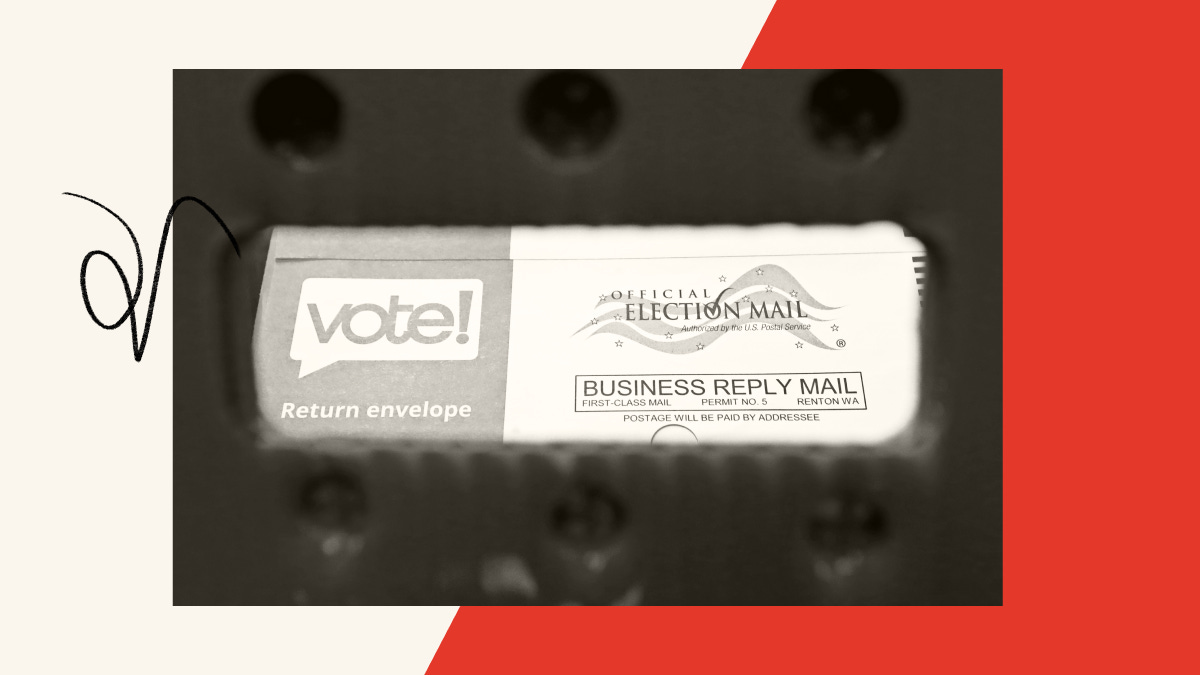
Picture the path a ballot takes to get to your mailbox. A county clerk prints it, seals it in an envelope, and hands it off to a letter carrier, who drives it to your street and walks it to your door. It’s a route that has run, more or less unchanged, for as long as Americans have voted by mail.
Last Friday, the Postal Service proposed a rule that would add a checkpoint to this process. Before that ballot could reach you, your name would have to be checked against a federal list. If your name isn’t on it — or if USPS rules there are other technicalities, like the envelope not conforming to new standards — the USPS could refuse to deliver your ballot.
There are so many problems with this proposal that it’s hard to know where to begin. But to briefly name a few:
First, it isn’t the Postal Service’s job to be the gatekeeper of who can vote by mail, and the president has no authority to make it do that job.
Second, it’s built on a fiction: that mail voting is rife with fraud. Worse, it’s designed to manufacture proof of that fiction. The voter lists states would hand over, the rule says plainly, are meant to “facilitate law enforcement efforts” — letting officials cross-check how many ballots went out against how many came back and flag the gaps for investigation.
Third, it asks states and USPS to build expensive new systems from scratch, just a few months before an election. Exactly when every hour should go to running a clean election.
Finally, the rule would do what its design all but guarantees: sow confusion, and leave eligible voters without the ballots they’re entitled to.
That last point is the key to explaining what is going on here. It fits a pattern we’ve been tracking all year — what our Executive Override report calls the administration’s Deceive, Disrupt, Deny strategy. This rule falls in the “Disrupt” bucket: using federal power to change the rules of the game and throw sand in the gears of an election.
An election the administration is afraid to lose.
What the rule actually does
The proposed rule implements part of an executive order Trump signed on March 31 — his second attempt to seize control over how elections are run. It would impose new requirements on mail ballots for federal general, special, and runoff elections (though, notably, not primaries, and not military and overseas ballots):
A master federal dataset of mail voters. States would have to submit to USPS the name and address of every voter receiving a mail ballot, along with unique barcodes for both the outbound and return envelopes, through a new “Federal Ballot Mail Portal.”
New envelope specifications. Every ballot envelope would have to carry the official Election Mail logo, be “automation compatible,” bear a uniquely serialized barcode, and pass a USPS design review. To be clear, those are good practices if adopted with the time and funds to do so. As proposed here, it’s a chaotic and unworkable mandate.
A federal gatekeeping function. Before accepting a ballot mailing, USPS would check it against the state-submitted list. Mailings to people not on the list — or that don’t meet the new standards — “will not be accepted and will be returned” to election officials. And any state that doesn’t certify compliance gets shut out and its mailings “will not be accepted.”
Read more — The U.S. Postal Service’s role in elections, explained
It isn’t the Postal Service’s job
Step back from the envelopes and barcodes for a moment, because there’s a more basic problem: The Postal Service has no authority to do any of this.
The president doesn’t run the Postal Service, and Congress built it that way on purpose. USPS answers not to the White House but to a bipartisan board of governors — no more than five from one party, serving staggered seven-year terms — and they, not the president, appoint a postmaster general the president can’t fire. Congress structured it this way in 1970 for a reason: An institution that carries the nation’s mail, ballots included, has to operate free of partisan interference.
The president has even less authority over how elections are run. The Constitution hands the “times, places, and manner” of federal elections to the states and to Congress — not the executive branch. So a presidential order directing the Postal Service to police the nation’s ballots bulldozes two limits at once: It commands an agency the president doesn’t control to do a job the Constitution gives to someone else.
That’s why this is not merely bad policy — it’s very likely unlawful, and the courts have already said as much about its predecessor. They blocked major provisions of Trump’s first election executive order on exactly these grounds, with one federal judge writing that the president “lacks the authority to direct such changes.” This rule implements part of his second order and rests on the same shaky foundation. A coalition of 23 states and the District of Columbia has already sued.
Two ways this rule fails the voter
Even if you take the rule on its own terms, as a piece of policy, it still does not work.
Election officials would have to build almost everything it requires — new envelopes, uniquely serialized barcodes, a roster of every mail voter fed into an untested federal portal — in the few months before November. This is a sizable task, and many simply cannot. As one former official told Votebeat, ordering compliant envelopes for a small county of 2,500 voters can run about $10,000, and rural jurisdictions often have no barcode tech at all. The executive order provides no money to close that infrastructure gap. Many states have no time to find the funding, and many local offices are prohibited from accepting outside help. A financially strapped USPS gets no new funding for these new duties either.
In fact, the rule absolves the Postal Service of the consequences, stating it’s “not responsible for service delays” caused by noncompliant mailings, and “assumes no responsibility” for a ballot until it is accepted into the mail. New hurdles with no money to clear them on an impossible timeline, and when ballots are delayed or denied as a result, it is the voter’s problem.
This points to the second failure, which is not, in fact, a failure in the design: The unworkability is the design. An administration that wanted mail voting to run smoothly would not rewrite its machinery five months before an election with no funding attached. An administration that wants confusion would do exactly this.
This is not the administration’s first reach for voter data. Its Justice Department has already demanded the rolls from nearly every state and pushed to run them through the error-prone SAVE system (an effort being challenged in court). A registry of everyone who votes by mail is another piece of the same project.
Read more — Election deniers want your data
Put plainly: This looks less like a way to deliver the mail than a way to watch the people who use it.
This rule doesn’t stand alone
The postal rule is one move in a larger pattern: the administration and its allies changing the rules while the game is already being played.
Consider Watson v. RNC, which the Supreme Court will decide by the end of June. At issue is whether states can count mail ballots postmarked by Election Day but delivered a few days later — a protection 14 states and D.C. extend to military, overseas, and rural voters. A Votebeat analysis found a ruling for the RNC could have put at least 750,000 ballots from 2024 at risk, wiping out those laws months before November, after voters spent years relying on them.
Or consider Callais. On April 29, the Supreme Court gutted the heart of the Voting Rights Act, leaving Section 2 all but a dead letter two weeks before Louisiana’s congressional primary. The chaos was immediate: the governor declared an “election emergency” and suspended the U.S. House primary days before early voting, while Alabama, Tennessee, and Florida raced to redraw their maps mid-cycle, and Trump cheered that if voters “have to vote twice, so be it.” In some places, voters and candidates didn’t know which district they were in.
Each of these moves — the postal rule, the ballot-deadline case, the redistricting scramble — changes the rules close to, or even during, the election. That is not incidental to the strategy. It is the strategy. When the rules keep shifting under voters’ and officials’ feet, no one can be sure what’s required, ballots get lost in the confusion, and confidence in the whole system erodes. Authoritarians around the world have long understood that you don’t need to cancel an election to control it — you just have to keep everyone guessing about the rules until the confusion itself does the work.
What you can do
Here is the good news: This rule isn’t final. It’s a proposal, and a proposed rule has to go through a 30-day public comment period before it can take effect. That is a real window, and public comment on rules like this one carries weight, especially from the election officials who would have to carry it out. If you run elections, this is the moment to document, on the record, what it would cost and what it would break. If you don’t, you can still file a comment saying so.
And if you vote by mail, the most useful thing you can do is the simplest: Don’t let the noise change your plans. Mail voting is safe; this rule is not in effect, and it may never be. Check your registration, know your state’s deadlines, and return your ballot early. The administration’s strategy runs on confusion and on the feeling that resistance is pointless. Neither is true.
The Postal Service has carried America’s ballots for two and a half centuries without deciding which ones count. It shouldn’t start now.
Register for The UnPopulist’s Liberalism Conference
Protect Democracy is proud to be involved in this year’s LibCon, which will focus on rebuilding American democratic institutions. The event, which will be held on July 16 and 17 at the Watergate Hotel, will feature The Atlantic’s Adam Serwer and Anne Applebaum, Francis Fukuyama, and Protect Democracy co-founder Justin Florence.
Trump doubles down on politicization
An executive order signed on June 3 will recategorize thousands of protected civil servants as political appointees, meaning they can be fired at will for no reason. The removal of these protections will extend the president’s reach into more of the operations of the government, and could mean that everyone from epidemiologists to meteorologists who track severe weather could now face political pressures that will be totally new to them. The order does not hit every civil servant, but it’s another attempt to chip away at the independence of the federal workforce, which touches the lives of every American in ways that they usually don’t have to think about.
See the Authoritarian Action Watch.


197410 Once again we are challenged by a convicted felon in the White House to maintain an established democratic tradition that should not require any fixing. Where in his deranged mind do such ideals emerge? I think he is well aware if he does not maintain control of congress he and all his participants will be in for years of legal issues and I hope some will serve hard time for their participation in support of this Presidents' fragrant violation of numerous laws in their attempt to destroy democracy and establish a new order controlled by billionaires and political hacks.
The Post Office was never designed to determine who is a voter. None of its systems can reliably carry out this crazy task. Sure path to failure and delay and obfuscation, which is the idea anyway.