


Dear Civil Servant,
Since at least 2020, Trump and his allies have been working on a plan to formally turn certain civil servants into at-will employees who could be easily fired. Originally called Schedule F and now called Schedule Policy/Career, the details of the plan have been public for some time, but the actual list of positions that will lose employment rights (i.e., the list this Administration has been working on for well over a year) has been shrouded in mystery. (We should know; we tried to FOIA it).
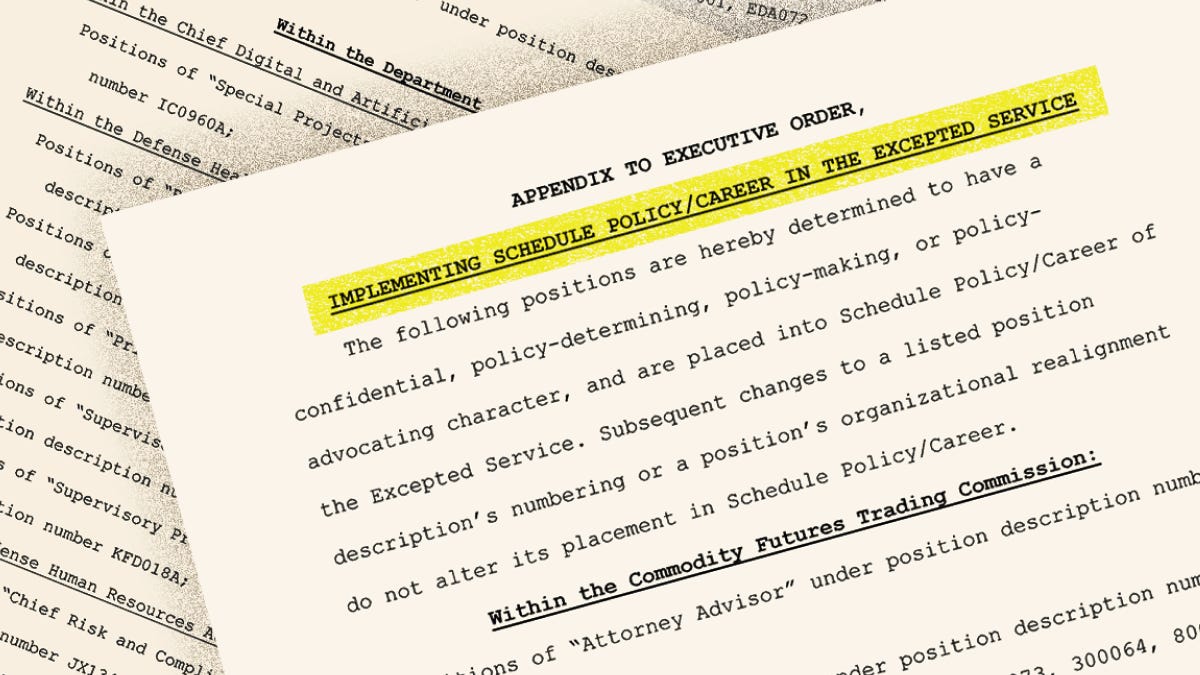
No longer. With Executive Order Implementing Schedule Policy/Career in the Excepted Service, the Trump administration published a list of positions that were formally moved into Schedule Policy/Career, which have now purportedly lost the tenure protections Congress created to protect the American public from a politicized civil service.
There are some surprises in the list and many questions that remain unanswered. The list itself is written in a way that obfuscates key information — such as how many employees were reclassified at each agency, the GS levels of the reclassified employees, and more. That’s why we need civil servants’ help. In order to effectively challenge the rule in court, we need to hear from you in this survey.
Not sure if you’re on the list? You can view the list here and search for your job title. If you spot it, note the “position description” number listed next to it. You can ordinarily find your position description number on your SF-50, which should be accessible on eOPF. You should also be notified by your agency within a week of the date the executive order was released — so by June 10, 2026.
What we don’t know (for sure)
The list of positions appended to the executive order gives the absolute minimum amount of information about the reclassified positions — and as a result, the list itself doesn’t inform the public about the scope or nature of this fundamental change. This includes basics, like:
The total number of positions,
The number of positions covered by each of the position descriptions being reclassified,
The number of impacted positions and current employees at each agency,
The seniority level of each of the impacted positions, or
The occupational series of the positions (more on that below), which would identify specifically which jobs were reclassified and what those positions do.
A “fact sheet” accompanying the executive order states that it moved about 8,000 positions into Schedule Policy/Career and that it overwhelmingly affects high-level positions — it states that ”97% of reclassified positions are GS-15 or Senior Level positions.” However, those numbers are not apparent from the executive order’s list of positions, which includes only job title and “position description” number — a non-standardized number that varies from agency to agency and is not generally publicly available.
And many of the listed job titles — “attorney advisor,” for example — apply to many people. So a single listing of a position could indicate that a single job is being reclassified, or it could mean that three dozen jobs with that job title are being reclassified. There’s simply no way to know by looking at the list.
This list could have been written in a way that made this basic information transparent, so that the public could judge the change for itself. It could have listed the GS-level of each position, a number that generally reflects the level of difficulty and responsibility required for the position. (The scale starts at GS-1 and goes up to GS-15.) It also could have listed the occupational series number for each position, which is the federal government’s code for classifying jobs based on the specifics of what they do. (For example, nurses are all part of one occupational series.) This number identifies each position with specificity and transparency, as the codes are publicly available. The list also did not specify the number of positions — overall, at each agency, or under each job title — that were reclassified. Given that the administration clearly has these numbers, as it’s been citing numbers and statistics publicly, the fact that it has kept that data secret does not seem accidental.
Finally, we do not know if this is the end or simply the beginning. It’s unclear if more executive orders will follow, moving additional positions, and if so when that will happen.
What we do know about who’s on the list
As information begins to trickle out of the government about who actually got reclassified into Schedule P/C, we are likely going to get a fuller picture in the coming weeks. But there are some basic takeaways that jumped out at us right away, which might help civil servants or the public make some sense of the new information:
The top three agencies in terms of number of positions moved into Schedule P/C are:
The Department of Defense (~1600 positions),
The Department of Homeland Security (~570 positions), and
The Department of Health and Human Services (~390 positions).
In terms of job titles:
Over 400 positions had the word “attorney” in the title
Around 150 positions had the word “budget” in the title, and
Around 50 positions had the word “grant” in the title.
The list includes some jobs with safety implications. One of the reasons Congress insulated civil servants from at-will employment is to ensure they could keep us safe in the face of political pressures. Some of positions that the administration claims it can now fire without even giving a reason include:
Policy analyst at National Oceanic and Atmospheric Administration (NOAA), which tracks extreme weather like hurricanes,
Supervisory program analyst at the Consumer Product Safety Commission, which protects the public from dangerous consumer products, and
Program manager at the Nuclear National Security Administration, which manages our nuclear weapons stockpile.
The list includes some jobs that rely on scientific or medical expertise. In crafting our nation’s civil service law, Congress tried to prioritize merit, believing that the American public deserved the best experts working on their behalf. Some of those experts now alleged to be subject to firing without cause are:
Supervisory biologist at the Environmental Protection Agency,
Epidemiologist & health scientist at the Centers for Disease Control and Prevention, and
Physician at the Centers for Medicare & Medicaid Services
The list includes some jobs where political neutrality is necessary for success. Congress created some agencies to help ensure fairness and neutrality. Some regulate the government itself, such as the Merit Systems Protection Board (MSPB), and some regulate banks in order to ensure the stability of the nation’s financial system. Key employees at both of these agencies and more are now alleged to be under more direct presidential control:
Attorney advisors at the MSPB
Chief data officer at the FDIC
Finally, if it’s truly the case that the EO moves 8,000 positions that are all relatively senior, the executive order moves dramatically fewer positions than predicted into Schedule Policy/Career, and much more senior positions than results of our earlier FOIA work would suggest. Some have called this move “defensive” due to the lawsuits filed against Schedule Policy/Career, though the administration has not explained its rationale. (Though this executive order could be a stalking horse — the administration could be preparing a much longer or more junior list for a future executive order.)
Read more — The latest move to make civil servants more vulnerable than ever
If fewer people are ultimately moved into Schedule Policy/Career, that’s a win of sorts. However, Trump is claiming vast, unchecked power over these people to fire them at any time for any (or no) reason. We do not want — and Congress did not create — a system where all civil service leaders and senior employees fear retaliatory firings if they are seen as questioning the president’s agenda. And that’s what this move creates, even in its more modest form.
Have you been moved? Get in touch
One of the tactics of this administration has been to cloak its decision-making in secrecy and hide facts, so that its acts can’t be effectively challenged. We can counter that tactic by sharing nonconfidential information, and we’re asking you to do that here.
If your position has been moved into Schedule P/C, let us know by filling out this survey.
What happens now
The administration has designated the positions on the list as being in Schedule P/C, and it will act like the people in those positions lack civil service protections against things like firing without cause. And the multiple lawsuits challenging Schedule P/C — including our own here at Protect Democracy — will kick into high gear. We know limbo is basically the baseline for civil servants lately, but this means Schedule P/C employees will be in limbo for a while longer while we wait for a court to rule on Schedule P/C’s legality. OPM has put out guidance on the implementation of these personnel moves, including slide decks and explainers that might be helpful for those who see their jobs listed.
Our continued democracy depends on all of our continued willingness to fight battles large and small. And now, as we gear up to challenge this latest threat, we are grateful for your help and persistence.
Resources & further reading
Breaking Down the New Schedule Policy/Career Rule | FedsForward Webinar
Federal Public Service in Peril: A Report Card on the Trump Administration’s Management of Our Government | Partnership for Public Service
A Civil Service for a Mission | Margaret Mullins, Director of Public Options and Governance at the Vanderbilt Policy Accelerator
We’re Failing our Public Servants & It’s Making America Weaker | Public Service Alliance
This publication should not be construed as legal advice on any specific facts or circumstances. The contents are intended for general information and educational purposes only, and should not be relied on as if it were advice about a particular fact situation. The distribution of this publication is not intended to create, and receipt of it does not constitute, an attorney-client relationship with Protect Democracy. This publication also contains hypertext links to information created and maintained by other entities. Protect Democracy does not control or guarantee the accuracy or completeness of this outside information, nor is the inclusion of a link to be intended as an endorsement of those outside sites.


Sooner or later, we will all be under attack from this regime- for any speech they don’t like, for any dependence on social security or disability, for food stamp needs, for chronic illness, belonging to the wrong party, for our voting record, for our social choices, for being outdoors after curfew. Unless they are stopped, and that thought alone is a trigger. It doesn’t matter if there is no malice or intent behind a statement, just the idea is enough to get their notice and scrutiny. VOTE. RESIST.