


Dear Civil Servant,
The Trump administration has finally delivered on one of its dark first-day promises to destroy the merit-based civil service: A new rule has officially created Schedule Policy/Career (or Schedule P/C, a revived Schedule F). As expected, the new rule wrongly claims that Congress intended for some rank-and-file career civil servants to become at-will employees.
As we’ve seen over the past year, erosion of civil service protections hurt us all by forcing out employees who follow the law, blow the whistle, voice concerns about agency direction, have different political views than those in power, and simply do their job professionally.
This is not the system Congress created, and it is not the system the American people deserve. That’s why we are fighting it in court. Public attention is rightfully focused on this administration’s other attacks on the rule of law and basic decency. But this new regulation shows that the civil service’s independence remains under siege — at a time when we are seeing career civil servants increasingly willing to walk away or speak up when their red lines are crossed.
The administration continues to hide its destruction of the merit system of government behind a deluge of changes and long, technical language. The public should be able to understand these critical new government policies and their impact so we can have a voice in how our government runs.
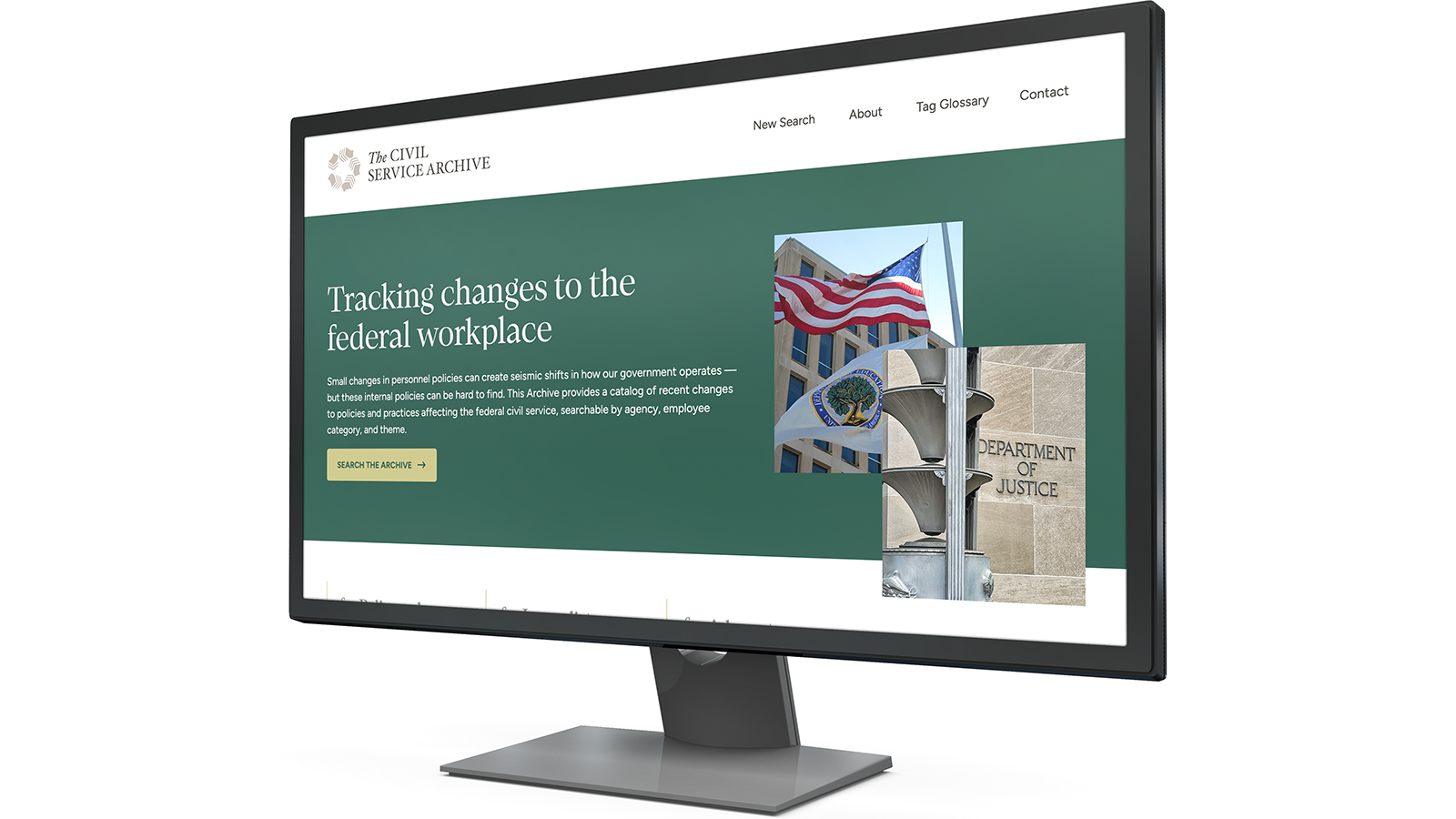
That’s why, in addition to fighting the Schedule P/C rule in court, we are unveiling the Civil Service Archive: an online searchable database that tracks changes to how the federal workforce works. This newsletter contains an explainer on the new Schedule P/C Rule, but you can also view the new regulation on the Archive, where you will find its full text, a plain-language summary that breaks it down, and a list of related changes that can help contextualize what is happening. The Archive catalogues over a hundred policy changes like this, and more are being added on a rolling basis. Sign up here to receive updates about new content on the Archive.
Breaking down the new Schedule P/C rule
Here are the basics: The Civil Service Reform Act (CSRA) creates employment protections for career civil servants, including a requirement that firing be only for cause. The law creates a carve-out from many of these protections for political appointees — what it describes as positions of a “confidential, policy-determining, policy-making or policy-advocating” character — to allow presidents and agencies to employ a modest number of shorter-term employees who share their policy priorities and are at-will employees who can be fired for any reason.
This carve-out is part of the balance Congress struck in creating a web of protections for civil servants: Most must be insulated from partisan hiring and firing, but the president also has loyalists to help advance the agenda he was elected to pursue, at least when that can be done consistent with law. But the Schedule P/C rule will upend that carefully-constructed system by expanding the number of people subject to the whims of the president and being fired for partisan reasons.
Here’s what’s happening now: We are currently in a period of time when the new rule is published but not yet effective — which means that Schedule P/C doesn’t technically exist yet, and no positions have been reclassified. The rule will take effect on Sunday, March 8, and OPM has announced that an executive order (which will presumably be issued after March 8) will announce the positions that are reclassified as Schedule P/C positions. This means we still do not know which positions the administration wants to move into Schedule Policy/Career.
Here’s what we’re doing to fight back: Protect Democracy and our co-counsel at Selendy Gay are challenging the new rule in court with plaintiffs Government Accountability Project and NARFE. Other litigation against the rule is also pending. The litigation has been on hold while the rule has been pending. It will rev back up soon, and you’ll be hearing from us with more details before long.
The Civil Service Archive: the what and why
As you all know better than anyone, Schedule P/C is but one of the Trump administration’s many attacks on the civil service. To keep these attacks from getting buried and to be able to undo them when the day for rebuilding comes, we have built a new tool called the Civil Service Archive. The Archive captures each change to how the civil service works in order to educate the public and policymakers so they can understand those policies and to help spot trends or themes in what these changes do.
This first release focuses on government-wide policies or practices, including some changes that affect multiple agencies but not the entire government. We plan to release agency-specific updates on a rolling basis, as they are ready. We aim to be comprehensive, but this is a work-in-progress. Instead of waiting for perfection, we are choosing to make public what we have now, as we keep working to gather and process more information.
Sign up here to receive updates when new content is added to the Archive.
The Archive will never capture every little thing related in any way to the federal government, however. The site catalogues policy changes concerning the internal workings of the federal executive branch bureaucracy. This means it includes changes to how the work is carried out — not what the work is. This also means the Archive contains policies or practices, not individual events. However, when a specific event (for example, a firing or an indictment) seems to imply the existence of a policy that is not otherwise tracked, we have tried to include it.
How can I find what I need in the Archive?
Information in the Archive is searchable by tag (note that if you select multiple tags it will narrow, not expand, the search). Each new policy is available as a PDF to preserve it and linked to the web page where it originated when possible. If you click on an entry in the Archive, you will also see a plain language summary of the policy change (written by humans with expertise in the civil service — not AI).


You can find an FAQ with more information on here. If you want to make sure we’re aware of a publicly available policy or practice that you think belongs in the Archive, you can email info@civilservicearchive.org. If you’re thinking of a document that is confidential, classified, privileged, or otherwise protected by law against disclosure, please do not send it to us. Bear in mind that we are leanly staffed, so we unfortunately cannot respond to each communication.
See also
This “tracker of trackers” | U.C. San Diego
Federal policy watch — Tracking how the Trump administration, Congress, and the courts are affecting workers’ quality of life | Economic Policy Institute
Federal harms tracker: the cost to your government — Tracking employee reductions across federal agencies | Partnership for Public Service
Worker policy watch — Tracking how federal policies are shaping workers’ rights—and what’s at stake for working people nationwide under the Trump administration | National Employment Project
What we’re reading
The purged | Franklin Foer, The Atlantic
220,000 fewer workers: how Trump’s cuts affected every federal agency | Emily Badger, Francesca Paris, and Alicia Parlapiano, The New York Times
Public service in America: a decade of danger and the choice to fix it | Isabella Ulloa and Abby André, Lawfare
Rise of the Trump loyalist | Anne Applebaum, The Atlantic
This publication should not be construed as legal advice on any specific facts or circumstances. The contents are intended for general information and educational purposes only, and should not be relied on as if it were advice about a particular fact situation. The distribution of this publication is not intended to create, and receipt of it does not constitute, an attorney-client relationship with Protect Democracy. This publication also contains hypertext links to information created and maintained by other entities. Protect Democracy does not control or guarantee the accuracy or completeness of this outside information, nor is the inclusion of a link to be intended as an endorsement of those outside sites.


And for those who think the Civil Service/Bureaucracy is unnecessary, please read "The Fifth Risk" by Michael Lewis. It's an excellent non-fiction book that explains how difficult and meaningful (as well as non-partisan) the work done by our civil servants is.
Trump is crazy to want to destroy it, but of course, we have known that all along.