


The $1.776 billion slush fund to reward those who break the law to aid Trump. The mid-cycle redistricting spree Southern states have embarked on to erase minority representation in the wake of the Supreme Court majority crushing the Voting Rights Act (VRA). The purging of dissent from the Republican Party. A throughline connects three developments dominating our politics this week: None of these moves are popular. None are smart politics. All of them are designed to hold power without winning public support — by overriding free and fair elections.
Jonathan Last at The Bulwark named it earlier this week: The president seems to have given up on popularity outside a narrow base within the GOP and is instead moving to lock in institutional power before voters can take it from him. And he’s building the architecture to do that, piece by piece.
Creating an illegal slush fund for political loyalty
On Monday, the Justice Department announced a $1.776 billion “Anti-Weaponization Fund” to compensate people who say they were politically targeted by the federal government. The fund was created in a purported settlement of the president’s collusive lawsuit against the IRS.
The slush fund appears blatantly illegal, for a host of reasons: There’s no actual controversy to settle since Trump is on both sides; Congress didn’t authorize funding for it; and the 14th Amendment prohibits payments in aid of insurrection. (Capitol Police officers who defended the building on January 6 have already sued to block it, calling it illegal and a sham.) The design of the fund is beyond alarming: The commissioners who decide who gets paid are appointed by the attorney general and can be fired by the president at will.
And at the same time, Trump has used the deal to declare himself, his family, and his businesses immune from audits by the IRS and off the hook if he didn’t pay his taxes.
The politics of the slush fund are also terrible for the president. It’s bad enough to raid money that belongs to the taxpayers to pay off his friends, family, and political loyalists. Doing it at the same time he gives himself license to avoid paying taxes adds a cherry on top. So it’s no surprise that the slush fund has provoked broad and bipartisan opposition. (Trump’s attorney general may have tried to sell Republican senators on the fund by hinting that they too could receive payoffs from it!)
But for Trump, popularity — or democratic accountability — is beside the point. He’s (for now) got a federal payment program of nearly two billion dollars inside the Trump Justice Department, with eligibility and amounts set by officials the president controls, in the lead-up to a federal election. Here’s why that matters: In 2020, the president called the Wayne County Board of Canvassers and asked them not to certify Michigan’s results, but he had nothing material to offer them in exchange. When he encouraged the January 6 insurrectionists to go to the Capitol, it was only with his megaphone. He has something material to offer them now.
Tilting the field with a little help from Supreme Court allies
On April 29, the Supreme Court gutted Section 2 of the Voting Rights Act in Louisiana v. Callais, removing the primary federal tool for challenging maps that dilute the political power of Black voters.
Corey Dukes and Alison Hirsh explained the consequences for 2026 earlier this week: Mid-cycle redistricting this close to an election is unprecedented, and partisan gain at the expense of fair minority representation is the point. Louisiana postponed its primary after voting had started. Tennessee and Florida enacted new maps. Alabama is using a 2023 map a federal panel found racially discriminatory. Candidates do not know which districts they are running in. Voters do not know where to cast their ballots.
Read more — This is not gerrymandering as usual
For decades, both parties had supported the Voting Rights Act as a seminal achievement in the history of U.S. democracy. President George W. Bush signed the VRA reauthorization in 2006, after it was enacted by overwhelming bipartisan majorities in Congress. The Trump administration, on the other hand, explicitly asked the Court to gut the VRA in Callais. Trump’s allies on the Court did just that. And they did it right in the middle of the midterms in ways that would clearly give the president a partisan advantage. And in the context of the president driving his partisan allies in states across the country to kick off an unprecedented mid-cycle partisan gerrymandering campaign to favor his party.
Our Authoritarian Playbook framework asks three questions to separate normal politics from a democratic threat. There’s a clear answer here.
How far does the action deviate from modern precedent? Gutting the seminal Voting Rights Act, combined with mid-cycle redistricting this close to a federal election is unprecedented.
With what frequency and degree is it happening? Simultaneously, across multiple states, on a calendar set by partisan advantage rather than ordinary process.
Does it present a systemic risk? Combined with Callais, yes again. The floor for fair representation is lower than it has been in 60 years, and the doctrine that previously upheld minority representation and checked the worst map-drawing is gone.
None of this is popular or follows any sort of political mandate. But put it all together and the strategy is clear: Tilt the playing field so that the president’s party can hold onto power, even as his popularity shrinks.
Purging those who have said no
On Tuesday night, after losing his Kentucky primary, Rep. Thomas Massie (a thorn in Trump’s side on various issues) told his supporters: “If the legislative branch always votes with the president, we do have a king.” Sen. Bill Cassidy was defeated in Louisiana after Trump sought to end his political career because Cassidy had voted to hold Trump accountable for January 6. Brad Raffensperger, the Georgia Secretary of State who refused to “find” 11,780 votes in 2020, lost his primary, too. When Indiana state Senators refused to bend the knee in anti-democratic mid-cycle gerrymandering, Trump decided to use his control over his party to take them out. These Republicans who said no, at moments when saying no mattered, will no longer be in the party’s elected ranks.
The same thing has happened inside the executive branch. Loyal civil servants and professional political appointees at the Justice Department, the Department of Homeland Security, the FBI, and across the intelligence community have been replaced by election deniers and political loyalists. In 2020, the acting attorney general refused to send a fraudulent letter to the state of Georgia. The personnel decisions made in the second Trump administration have been designed to ensure that the person sitting in that chair next time will write the letter.
Trump has also retaliated through his Department of Justice (DOJ). The cases the DOJ has brought against Trump critics, journalists, election officials, and former public servants vary, and some indictments look unlikely to survive. The Justice Department has tried three times to indict Letitia James: once successfully, before a federal judge threw out the indictment, then twice more before grand juries that refused to charge her. And still, new criminal referrals on a different theory followed in March. The investigation into James is one of many. Some end without charges, but with substantial costs absorbed by the target. A very small number result in convictions. The administration does not need to win any particular case to make the cost of resisting high, and discourage the next official who is considering whether to say no.
The president has sufficient power in his party (and controls a substantial enough war chest) that he can pull this off in GOP primaries and within the executive branch he controls. Usually, with an election approaching, a party would seek to broaden its appeal and pull in more people. But democratic legitimacy is not the point; instead, it’s about weaponizing the power of government to limit the chance for democratic accountability.
The endgame
The administration is not trying to win over American voters. Rather, it is trying to make those voters irrelevant. Which federal funds can be grabbed to pay off loyalists, which districts exist and whose votes matter, which voters can register, which officials count the ballots, which agencies investigate the process: the Trump approach is that if these are all beholden to him, then politics doesn’t matter.
Viewed one way, it’s a very dark story. But we’re not writing this to cause despair. The reason the administration is moving openly is that it is losing the contest over public support, and it knows it. We’ve outlined in other parts of this series and the Executive Override report all the ways that courageous people across our country are standing up for the rule of law, for our rights, and for free elections where eligible voters can vote and have their votes counted. Notwithstanding the President’s increasingly desperate efforts, at the end of the day he doesn’t get to control how our elections are conducted — that’s up to state and local officials around the country.
The president’s override strategy depends on officials not following the law. We the people will make sure they do.
This is part of our Executive Override series on threats to the 2026 election and how to combat them. You can see all editions in this series here. If you’re not subscribed, make sure to do so and you’ll get future ones in your inbox.
The Trump administration is “investigating” the 2020 election
On Fox News Sunday, Acting Attorney General Todd Blanche claimed without evidence that “there’s a ton of evidence that the 2020 election was rigged” and that the Department of Justice has “multiple investigations going on in Arizona, in Georgia, in Fulton County, Georgia” focused on determining whether “the right people voted.” Blanche offered no specific evidence to support the claim, acknowledged that the investigation has taken more than five years because supposed election-riggers are “very good at hiding what they’re doing,” and declined to provide any timeline for results.
No court, audit, or law enforcement investigation — including those conducted by officials appointed by and loyal to the Trump administration — has produced credible evidence that the 2020 election was stolen or rigged. What makes Blanche’s statement distinct from prior disinformation is its source: it is the sitting head of the Department of Justice, using the authority of that office to validate claims the legal system has repeatedly rejected.
The administration has made election denialism official federal policy — using investigative and enforcement powers to manufacture the appearance of fraud and flood the public with disinformation designed to erode confidence in the 2026 midterms. Blanche’s Fox News appearance fits squarely within that strategy. Conspiracy theories and bogus investigations serve not only to deceive voters now, but to lay the groundwork for the administration’s final gambit: contesting or overturning 2026 election results that the administration doesn’t like. Lending the DOJ’s institutional credibility to election disinformation accelerates both goals simultaneously.
See the Authoritarian Action Watch.


Well, that was depressing.
My hope lies with the PEOPLE who seem to be finally realizing that this guy cares only about himself making money and staying in power.
Hopefully it's not too late to assert our control over our country's future.
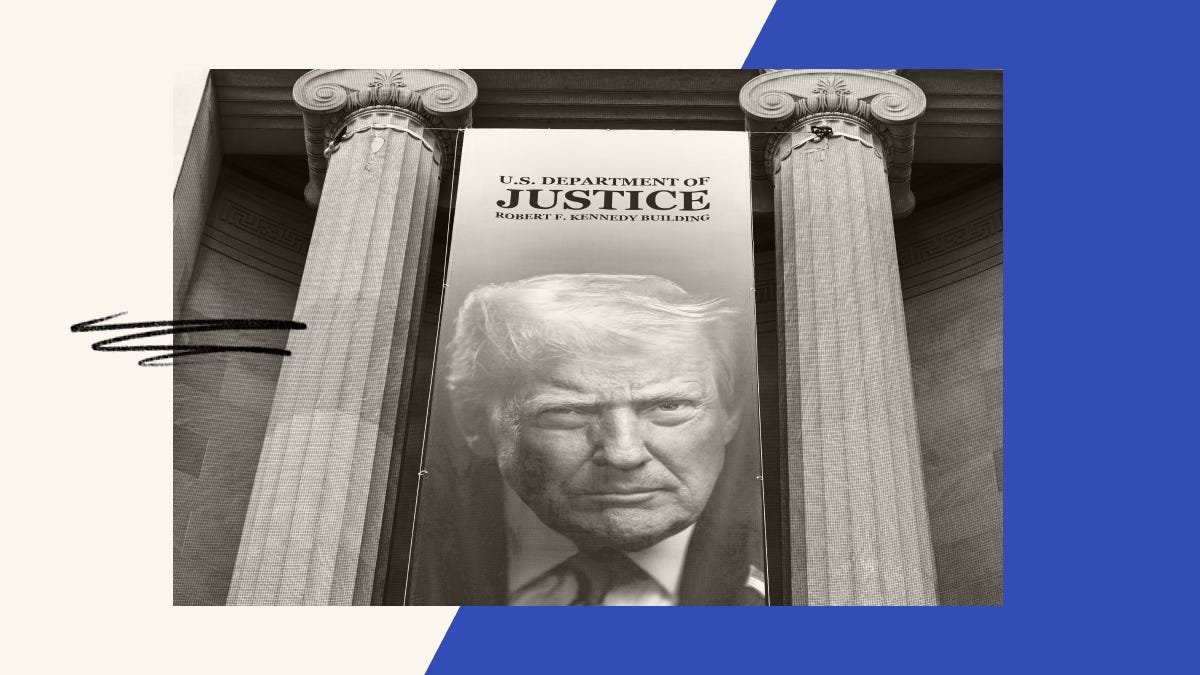
Money blown on banners of Dear Leader. North Korea.
But we have no money to feed children, elders, and disabled.
This is not the America my father fought for.