



With less than seven weeks to the midterm elections, a million and a half Missourians spent almost a week not knowing who they would be voting for.
First, the state’s Republican leadership forced through a new, more gerrymandered map that dismantled Kansas City’s district to try to squeeze out another seat. Then the Missouri State Supreme Court struck down the new gerrymander because of a state constitutional requirement allowing a referendum on the change first. Then the U.S. Supreme Court declined to intervene, seemingly preserving the original maps. Then a different federal court ruled in Republicans’ favor on a different issue, allowing them to implement the new gerrymander. Finally, the U.S. Supreme Court stepped in again and forced Missouri back to the 2024 maps.
As this partisan legal drama played out, more than 1.4 million Missourians were stuck in the crossfire. Christian Johnson, Drew Penrose, and I looked at the census data, and that’s exactly how many people stood to be moved to a new district under the new maps. That means that not only were they stuck in limbo for any campaigning and organizing, but for months they faced the prospect of picking from entirely new candidates on their ballot.
(In a separate issue, the primaries were held under the new, illegal gerrymander, which means those 1.4 million voters saw different candidates on their primary ballots than they will in the general.)
Many of those voters had been represented by Emanuel Cleaver, a Democratic former mayor of Kansas City, for more than two decades. Untold numbers had relationships with him, campaigned for him, worked with him. And suddenly they weren’t his constituents anymore. And then they were again, and then they weren’t. And then they were again.
Imagine putting up a yard sign for your preferred congressional candidate. Then having to take it down, then put it back up, then take it down again, then back up. All because the gerrymandering wars, kicked off by Donald Trump, had consumed your congressional district.
Talk about whiplash.
In our new paper released on Sept. 17, Christian, Drew, and I find that those 1.4 million Missourians are not alone. Not by a long shot. All told, 34.8 million Americans got booted from one congressional district to another between the 2024 and 2026 elections. Roughly twice that number are now voting in a district that looks little to nothing like the ones they were in two years ago.
If you tabulate all the individual casualties in the gerrymandering wars, it comes out to 1-in-5 Americans. That’s how many people had their representation severed and reassigned as part of the battle to control the maps.
Plus, most disturbing of all, things might only be getting started.
Maximalist, mid-cycle redistricting may be here to stay
When Christian, Drew and I set out to calculate how many people experienced gerrymandering whiplash in the redistricting wars, we also wanted to know why perpetual, mid-decade redistricting is such a real threat — and why it’s so enticing to both parties.
Unfortunately, there’s a grim logic to it. Three dynamics encourage ongoing, mid-decade redistricting:
Gerrymandering is a time-bound phenomenon. As voter preferences shift over time, the effectiveness of gerrymandered maps will fade. Maps that deliver a clear partisan advantage in one election will not necessarily hold up a decade later. Redrawing maps more regularly will likely be more effective at locking in consistent partisan advantage than gerrymandering once every decade.
There’s a two-party doom loop to redistricting. Now that both the Republican and Democratic parties have embraced gerrymandering as a political strategy, the logic of escalation implies a trend towards maximalist redistricting. Even if regular re-draws may produce diminishing returns, neither party wants to risk being the one that fails to maximize their advantage.
Partisan gerrymandering has a margin of error. In the past, partisan gerrymanders have usually included a buffer to protect the party in power from elections that swing against them (otherwise, gerrymanders can quickly become “dummymanders”). But if map-makers only need to account for possible election results six months in the future — instead of six years — they can be much more aggressive with their gerrymandering. Redrawing more regularly with greater confidence about likely election results allows for narrower margins.
So are we stuck? With Georgia, Washington, Colorado, New York, Maryland, Virginia, and New Jersey all hinting at or even openly exploring possible 2028 redraws, is this just our life now? Do we live in the United States of Redistricting where every election we wait for the partisan map makers to tell us who we get to vote for?
Maybe. Unless we change it.
Proportional representation prevents gerrymandering whiplash. Period.
Constant, all-consuming gerrymandering is, to put it bluntly, no way to run a democracy. It is and should be a national embarrassment.
But it’s also not the only way. We can demand something far better. And no, I’m not talking about halfway measures like a ban on mid-cycle redistricting or on partisan gerrymandering beyond certain parameters.
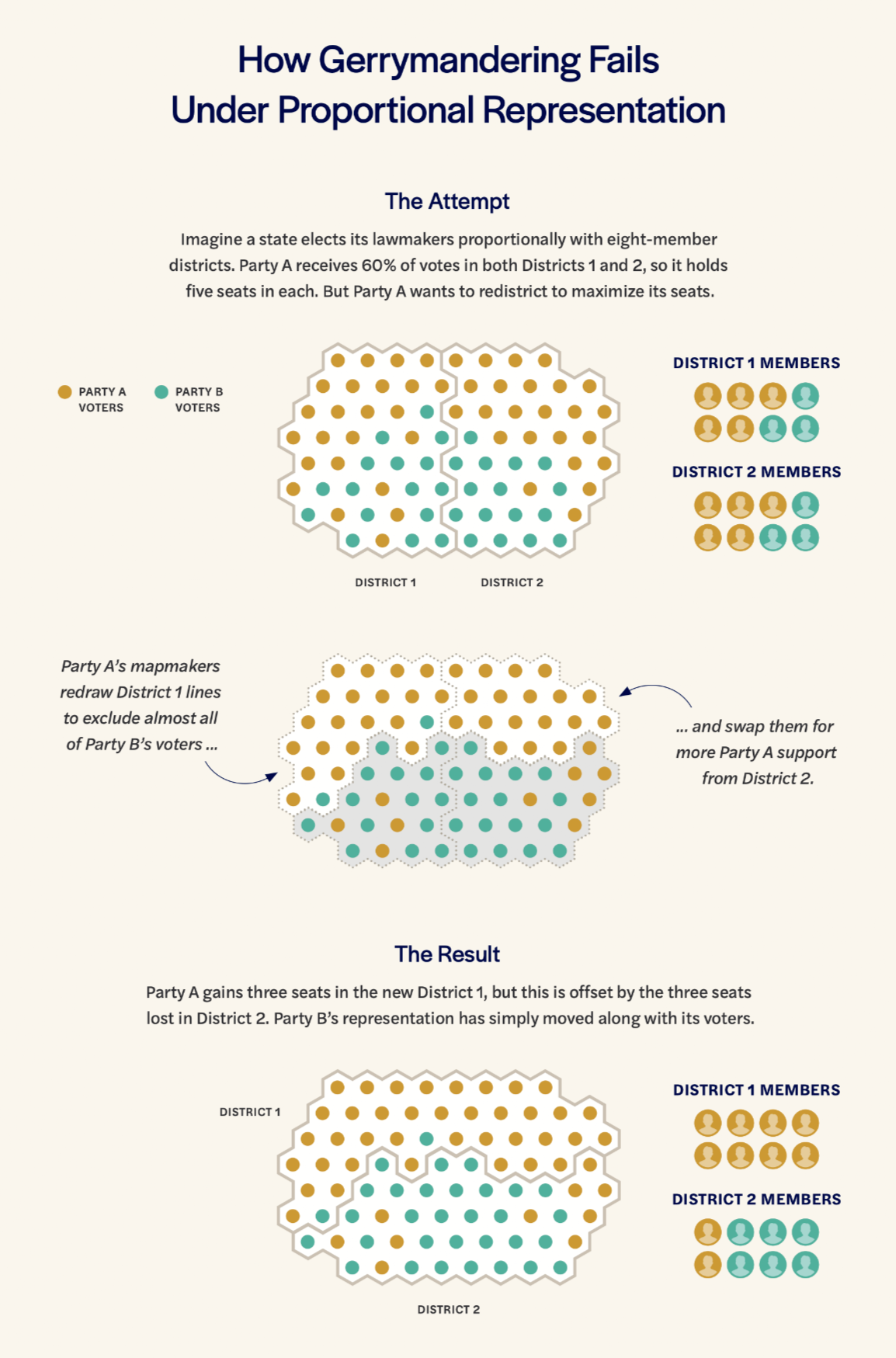
If the United States moved from single-member districts to multi-member districts with proportional representation, essentially no American would ever get whiplashed like this ever again.
Proportional representation prevents gerrymandering — but not just legally. Mathematically.
As Grant Tudor, Farbod Faraji, and Cyrena Kokolis explain in When Maps Don’t Matter, multi-member districts and proportional representation make gerrymandering functionally impossible for two reasons:
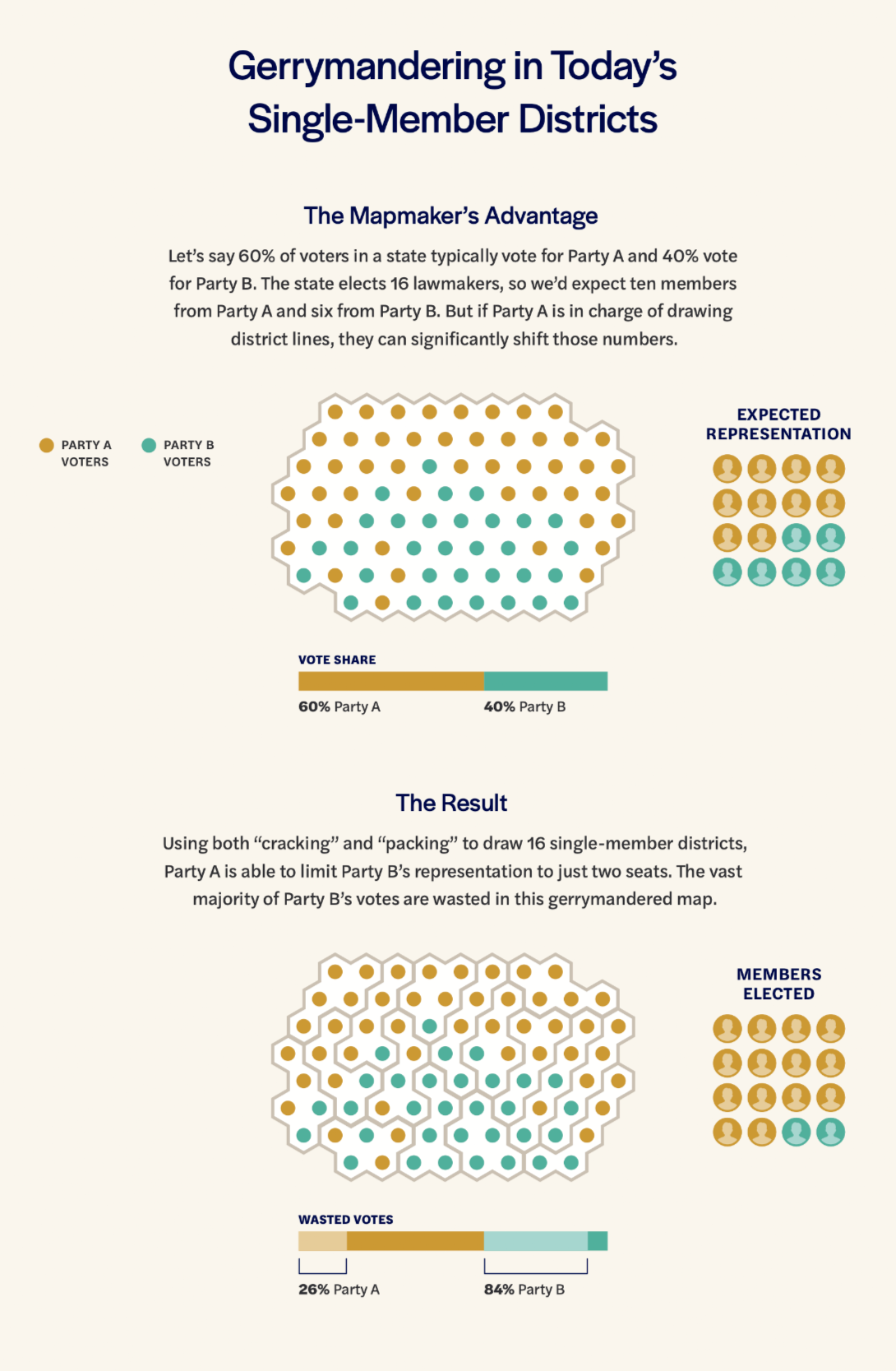
Proportional systems minimize “wasted votes” — the raw material of gerrymandering. Proportional systems use multi-member districts instead of single-member districts and allocate seats in proportion to votes received. This minimizes the wasted votes that make packing and cracking possible. Votes contribute to representation regardless of where those casting them are geographically concentrated, dramatically impairing the ability of district boundaries — or the party drawing them — to distort electoral outcomes.
Manipulating multiparty landscapes is too complex. Proportional representation also tends to foster multiparty competition, since the threshold of support needed to win any one seat is reduced. With more parties contesting elections, would-be gerrymanderers are deprived of the predictable two-party landscape that makes electoral engineering easier.
Here’s a visual explanation:
Compare that to what things look like under proportional representation:
It doesn’t have to be this way.
We should pick our politicians. Not the other way around.
Read Christian, Drew, and my paper on the cost of the gerrymandering wars: Gerrymandering Whiplash.
And read Grant, Farbod, and Cyrena on why proportional representation can’t be gerrymandered: When Maps Don’t Matter.
Were you whiplashed in the redistricting wars? Let me know in the comments. How has it impacted your community?
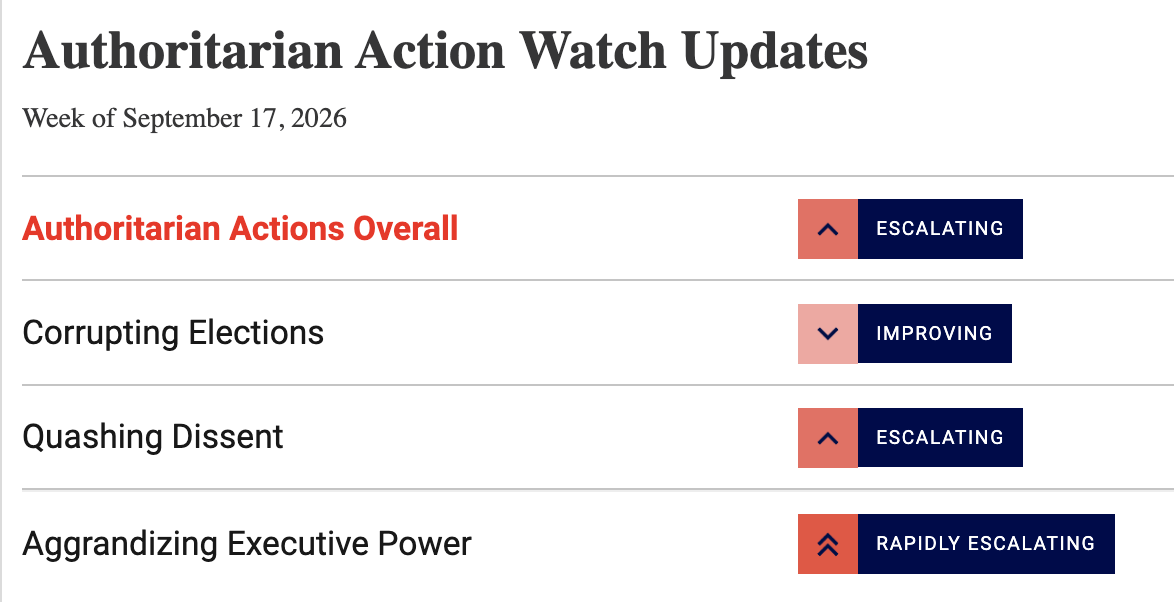
Three updates this week.
First, the Supreme Court did not allow the Trump administration’s U.S. Postal Service rule affecting mail voting to go into effect, the latest in a chain of losses for them around election interference. For that reason, Corrupting Elections is IMPROVING.
Second, and less positively, the Trump administration continues to target ABC and Jimmy Kimmel in particular, this time over an interview with Texas Senate candidate James Talarico. Because of those ongoing attacks, and their apparent effectiveness, Quashing Dissent is ESCALATING.
And finally, the Trump administration has continued to obscure its AI framework from the public, so Aggrandizing Executive Power is RAPIDLY ESCALATING.
See all the updates in the Authoritarian Action Watch here.
How you can protect democracy #102:
Voting rules vary by state, and knowing the details before Election Day keeps you one step ahead. Protect Democracy has put together clear, accessible voting guides for six key states ahead of the midterm elections. Whether you’re voting for the first time or just want to make sure you have the latest information, each guide covers everything you need to know — from registration deadlines and ID requirements to early voting periods and mail ballot rules.
What you can do:
Find your state’s guide and share it with friends, family, and community members — especially students, first-time voters, and anyone who has recently moved or changed their name:
Don’t see your state? Use the Fair Elections Center’s interactive map to find your state’s voting guide.
See all of the more than 100 ways you can protect democracy.
I agree with proportional representation in principle, but have some concerns about implementation. How do you protect the representation of people in sparsely populated areas, when you lump them into the same district as the big cities? In your example with 8-member districts, even the 8th most popular candidate from the metropolitan centers is likely to get more votes than the top candidate from a rural region.
By the way, I also support Ranked Choice Voting (RCV) and a complete revamping of the primary election system, perhaps even eliminating primaries altogether. Taxpayers shouldn’t be funding political parties’ (quasi-private membership organizations) process for selecting candidates. And if RCV is used, it could all be done in one general election, no primaries needed.
I’m really interested in analyses of how proportional representation and RCV could work together.
This is an excellent empirical analysis of gerrymandering. You have demonstrated what a scourge it is on American politics and a principal reason why so few Congressional elections are actually competitive.