



A short, mid-week explainer of an important lawsuit my colleagues filed today.
Beyond the USPS mess (which I wrote about last Thursday), there’s another part of the March executive order on elections that’s arguably just as important: The federal government is now attempting to build and distribute a massive database of personal information on hundreds of millions of Americans.
As I write this, the Department of Homeland Security, the US Citizenship and Immigration Services (USCIS), the Social Security Administration, and the State Department are working to compile all of our information into one massive federal database that they plan to distribute back to states. All of our information — including potentially sensitive data, like Social Security numbers — would be consolidated in one place.
The goal, of course, is to create election chaos. How?
The Trump administration plans to send all this compiled data to election officials in all 50 states in the form of “State Citizenship Lists” and attempt to have them use those lists for the November election. “Not on the list? Well, sorry. Take it up with DHS.”
Like with USPS, it’s a delusional plan and extremely unlikely to work (for one, it’s very illegal — see below). But you can probably see all the different ways even a good-faith version of this database would be a disaster:
Election chaos like you can’t imagine: Coordinating individual data across all 50 states is a herculean effort. It took about 20 years for state and federal governments to roll out REAL ID. And here the Trump administration wants states to implement a completely new voter roll process — “here, review, edit, and implement this list of eligible voters based on our garbage data” — barely 60 days before Election Day. It would make the DOGE chaos look like a well-oiled machine in comparison.
Errors! Errors! Horrifyingly, DHS has admitted that the data that it intends to use is full of inaccuracies that could wrongly flag eligible voters as ineligible to vote. Google your own name, right now. How many other people have the same first and last name as you? What if one of them isn’t an eligible voter and DHS gets the two of you mixed up? (This sort of record-keeping is much harder than it seems.) Or did you get married in recent years? Move addresses? Are you a recently naturalized citizen? There are dozens, if not hundreds, of different ways data errors in this database could lead to lawful citizens losing their constitutional right to vote.
A whole-country data privacy vulnerability: There are something like 240 million citizens over 18 in the United States. I don’t think it needs to be said that putting all of our information — including potentially Social Security numbers — into one big database and then distributing that information to the more than 10,000 election jurisdictions across the whole country is a very, very, very bad idea.
Federal control over elections: This database would give the federal government unprecedented power over elections. A list of eligible citizens may seem like a simple thing — after all, noncitizen voting is already illegal and, by every credible measure, basically nonexistent — but the list itself would be a powerful tool that could be weaponized against states. What happens if the administration attempts to overrule state voting rights restorations and exclude whole categories of voters? Or what if this list becomes a vector for the ongoing quest to overturn birthright citizenship? Control of voter lists is control over elections, period.
A powerful vector to attack election officials: The scariest part of this plan may be what happens if the federal database says you’re not eligible (beyond just you potentially being disenfranchised). DHS has threatened to investigate and prosecute states and election officials who “issue Federal ballots to individuals not eligible to vote.” If the lists disagree — if state data says you’re eligible to vote but DHS says you’re not — they may try to put your election officials in jail for it.1 In other words, this whole plan may end up being a trojan horse to directly attack the people who run free and fair elections.
Last week, DHS claimed it found 15,903 noncitizens on the Nevada voter rolls. Asked for the list, it produced just 185 names — with no explanation of its supposed 15,718 others.2
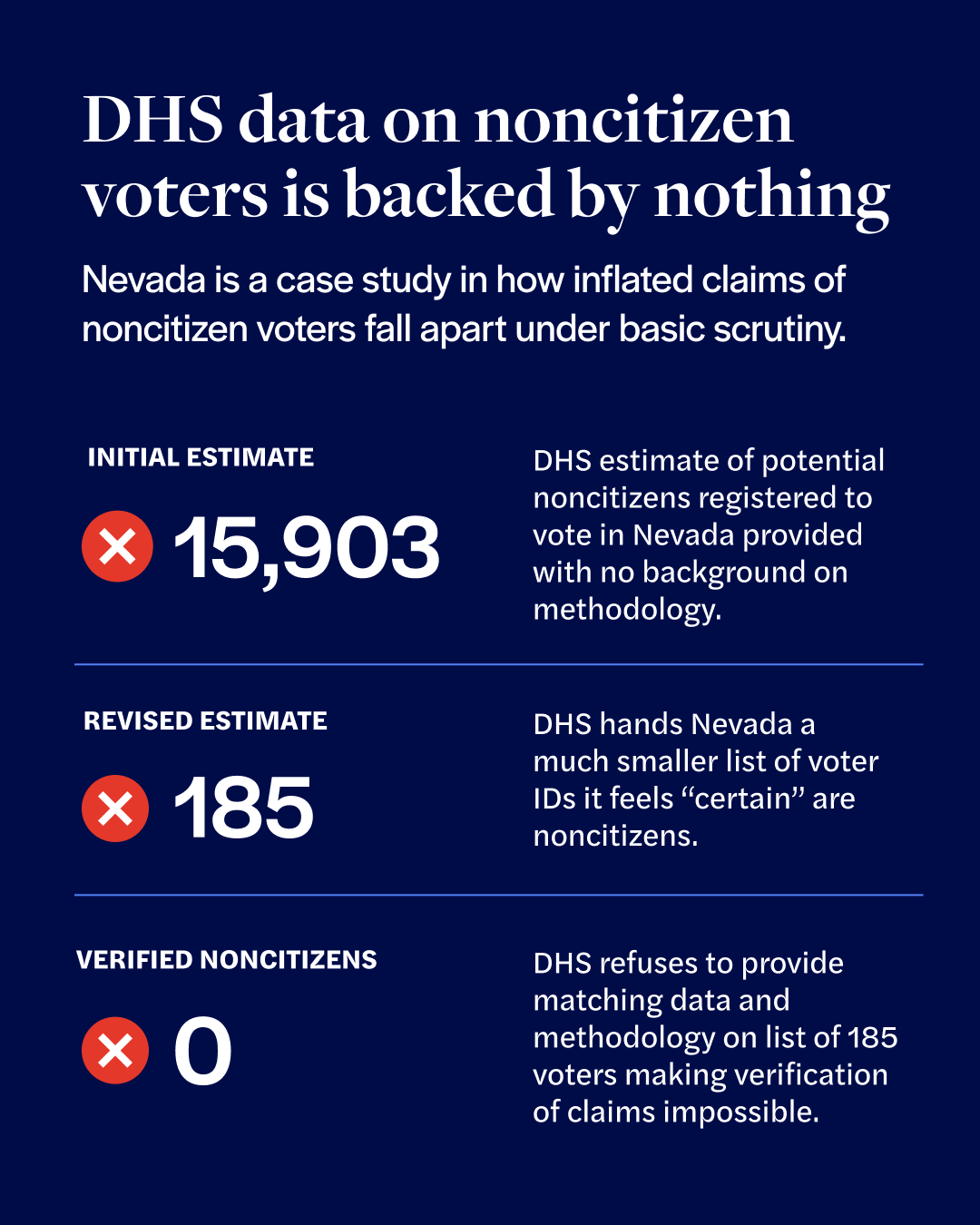
This plan would not go well.
The master database is as illegal as it would be disastrous
Today, on behalf of the Electronic Privacy Information Center (EPIC), Protect Democracy and Citizens for Responsibility and Ethics in Washington (CREW) sued the Trump administration over this master database.
Said John Davisson, deputy director and director of enforcement at EPIC:
In the United States, we have limits on how government agencies can collect and use sensitive personal data—limits this administration is blatantly ignoring… Building a database containing the identities, social security numbers, addresses, and citizenship information of every U.S. citizen is an extraordinary illegal overreach by the federal government. This is precisely the nightmare ‘Big Brother’ scenario that the Privacy Act exists to prevent. We hope the court will block this effort immediately and protect every American’s fundamental right to privacy.
The lawsuit argues that this plan is illegal in three different ways:
It’s an unconstitutional power grab. The Constitution is clear: “The Times, Places and Manner of holding Elections for Senators and Representatives, shall be prescribed in each State by the Legislature thereof; but the Congress may at any time by Law make or alter such Regulations.” You don’t need a law degree to see how there’s nothing in there about the president having any say over who can and can’t vote.
This plan violates federal privacy laws. To make these lists, the administration wants to pool Americans’ sensitive personal data — your sensitive personal data, my sensitive personal data — without notice, without consent, and without any way for us to correct errors. Federal privacy laws, including the Privacy Act, were written explicitly to prevent this kind of unauthorized data consolidation and disclosure. The government simply can’t play fast and loose with data like this.
This scheme threatens to disenfranchise eligible voters and sow chaos ahead of the midterms. Finally, most practically, it’s illegal in its likely effects. The government has admitted the data behind these lists is riddled with errors. The same flawed data has already led to eligible voters being wrongly flagged as ineligible. With state officials pressured to use these lists just weeks before Election Day, the result could be widespread confusion, wrongful purges, and eligible Americans turned away from the polls. Illegal, illegal, illegal.
Read more about the case here.
Would love help spreading the word. Send this to people in your life who care about privacy. And/or give us a re-post? 👇
To be clear, assuming you were in fact eligible, the prosecutions of elections officials would almost certainly fail. But even unsuccessful prosecutions could be very harmful to elections officials.
The list of 185 names is almost certainly still exaggerated — many estimates find even smaller numbers than this — and even if that number is accurate, these sort of cases tend to be registration accidents where the person never ends up even intending to vote. Even the Heritage Foundation’s extensive search for fraud identifies just 100 cases of noncitizen voting in the last quarter century. That’s, on average, four cases per year nationwide. Noncitizen voting is simply not a thing.
Federal allegations of voter fraud will come from this and be the basis for Trump declaring a national emergency and voiding elections/refusing to certify. They act first regardless of legality and they get their way, then pass laws that further entrench their power. Autocrat playbook. The ONLY CHANCE PATRIOTIC VOTERS HAVE TO AVOID THIS IS TO VOTE IN DROVES AND WIN BY MARGINS TOO LARGE TO DISPUTE.
Thank you for revealing/explaining this horrendous scheme. What worries me is that while their scheme might not be finished in time for the midterms of '26, it could be completed by Nov. '28, and THAT would be the final blow to our democratic system of free and fair elections.