


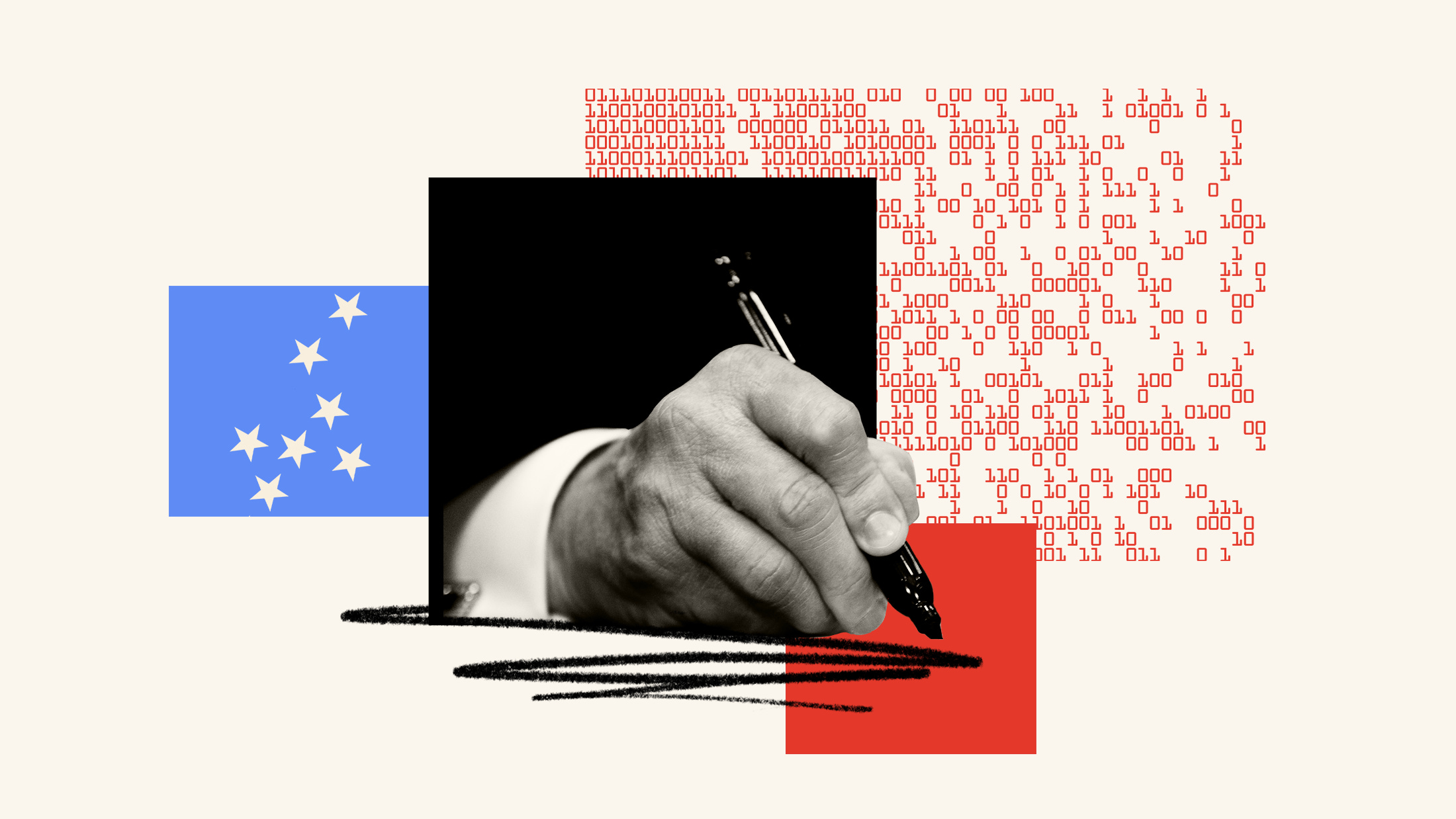
In Franz Kafka’s classic The Trial, the protagonist is arrested, tried, and imprisoned for an unspoken crime.
The conceit of the novel — and of its alienating bureaucratic absurdity for which Kafkaesque is now shorthand — is that neither the reader nor the main character ever knows what law was ostensibly broken. The entire process of judgement and punishment happens within a black box.
Of all the rules in America today, the ones governing artificial intelligence may be the most important and consequential. While we can anticipate some of the possible risks of this new technology, it’s not an exaggeration to say that no one knows for sure what tail risks AI may bring.
In this context, the Trump administration claims to have set up a system of processes to evaluate new AI models and either approve or quarantine them. But here’s the Kafkaesque twist: No one outside the White House — and possibly a small group of AI companies — knows what these rules and processes are.
It may be the most important rule in America today. And it’s a black box.
Are their criteria sufficient to seriously evaluate and prevent the worst risks of AI? Is Donald Trump making these decisions personally or are there, you know, real AI experts involved? Are they taking into account risks of things like mass surveillance, job displacement, and propaganda? (We can probably guess on that one.) Do specific rules or criteria even exist — or is the White House just winging it?
I don’t know. Almost no one does.
And, somehow, it gets worse than that. Because not only was this secret purported regulatory process set up without any legislation or specified legal authority, but it also presents a world-historic opportunity for abuse and corruption.
The biggest technology power grab in American history
Over the summer, the Trump administration rolled out an ostensibly “voluntary” framework to review certain AI models before they are released to the public. So far, the administration has described the framework only in general terms and has not disclosed any details.
But is this process really voluntary?
Short answer, as Deana El-Mallawany and Justin Florence explained last month, is no.
On June 2, 2026, the White House issued Executive Order 14409, “Promoting Advanced Artificial Intelligence Innovation and Security,” which claimed to create a “voluntary” pre-release review program for frontier models. In reality, it established what Dean Ball, former Trump administration AI policy advisor now leading frontier AI policy at OpenAI, described as “a de facto involuntary licensing/preapproval regime.” And one that operates behind closed doors pursuant to undisclosed terms and murky legal authority.
The administration’s subsequent actions pursuant to the EO proved this to be true.
On June 12, 2026, the Department of Commerce ordered Anthropic to suspend worldwide access to two of its AI models, Fable 5 and Mythos 5, within ninety minutes, citing export-control authority in an unprecedented context. The Commerce Department later restored access to Mythos 5 for only a select list of undisclosed “trusted partner” organizations, before lifting the export controls entirely on June 30, 2026.
Then, on July 14, 2026, the White House, Treasury, the Department of Homeland Security, and the Pentagon jointly launched “GOLD EAGLE,” a standing industry-government coordination body with undisclosed power “to collectively identify risks, prioritize action, and strengthen the resilience” of AI systems, resting on no new statutory authority. Separately, OpenAI has agreed, through informal negotiation rather than any public order, to limit distribution of its own forthcoming models to government-vetted partners.
[O]n August 1, 2026, the White House stated that it had finalized a “voluntary” framework for reviewing advanced AI models before their release, while declining to disclose the framework’s contents, which companies have agreed to participate, or when the process will take effect.
[Read their whole piece: Autocratic capture comes for AI.]
Paying the mafia for protection is voluntary — you can absolutely choose not to, but there will be consequences.
Plus, this black box was set up without any public legislative or rulemaking process. Congress didn’t pass a law, no court ruled, there wasn’t even an administrative process. The president has simply asserted the right to approve new models, in secret, if submitted for review — or to block them if not.
Perhaps this outside-the-law secret rule is a good faith effort to manage fast-moving AI risks and a reasonable negotiated settlement between government and technology companies. Perhaps it isn’t. Without transparency, it’s impossible for us to know.
There are, however, very real risks that this black box could be easily abused:
The White House could use the secret process to exert enormous leverage over decisionmaking by AI companies, including over decisions like autonomous weapons and mass surveillance that were the subject of previous clashes.
The president could personally extort certain investors and employees for political and financial support — or punish others for perceived political opposition.
The administration could force AI companies to incorporate politicized stances into models, as Elon Musk’s apparent “white genocide” Grok manipulations famously demonstrated. As Amanda Carpenter put it: “They’re gonna ‘Truth Social’ AI.”
Yesterday, my colleagues filed suit to try to force the White House to open the black box. We’re asking the courts to force the administration to turn over basic information about their process and participants. Read more about the lawsuit here: Uncovering the Trump administration’s secret rules for AI model release.
To get a sense of the importance of the case, check out the declarations from various tech luminaries and policymakers.
Maybe there’s nothing in the box. But I doubt it. That’s not how Kafkaesque tends to go…
The broad appeal of proportional representation
Most people think about electoral reform as a path to systemic change — and I think it is — but in America as it is today, there’s also a strong case for proportional representation from a basic governance point of view. Proportional representation could provide small-c conservatives and others with alternatives to the status quo, with surprising benefits.
I loved how Jen Dresden, one of Protect Democracy’s resident political scientists, explained the appeal on Linda Chavez’s podcast this week:
Three notable shifts in the watch this week.
Considering everything above about AI, we rate Aggrandizing Executive Power as RAPIDLY ESCALATING.
In Quashing Dissent, Donald Trump’s attempt to send the FCC after Meet the Press host Kristen Welker — after she suggested on air that the president has a mixed endorsement record in Republican primaries — was one of the more egregious instances of press censorship yet. We rate it ESCALATING.
Corrupting Elections is also ESCALATING as DHS attempts to build a massive database of all “citizens” for the purpose of disrupting the midterms. (Read more: Trump’s master database of “citizens”)
See all the ratings on the Authoritarian Action Watch.
How you can protect democracy #81
Understand how AI affects our democracy: Artificial intelligence is changing nearly every part of daily life, including how we get information, how governments make decisions, and how democratic institutions function. Most people encounter AI through chatbots, search results, or social media feeds — but AI is also quietly reshaping the conditions that make democracy work.
AI makes it easier to create and spread convincing fake content, like fabricated videos or AI-generated news stories, that can mislead voters and erode public trust. It can also be used to surveil and target communities in ways that chill free expression, and justify replacing the human oversight and institutional checks that keep power in balance. But AI also holds genuine promise by helping people identify false information faster, strengthening election security, and making it easier for citizens to engage with their government.
The question is not whether AI will shape our democracy. It already is. Protect Democracy’s AI for Democracy Action Lab works to defend against AI’s risks while finding ways to put it to work for civic good — and there are concrete steps everyday people can take to stay informed and engaged.
What you can do:
Read our article, Democracy in the Time of Artificial Intelligence, for a look at how AI is already affecting democratic life, with real examples from the U.S. and around the world.
Review the Brennan Center’s explainer on how to spot AI-generated election misinformation while reading news online.
Explore our AI for Democracy Action Lab to see the work underway to hold AI accountable in the public interest.
Share what you learn with people in your life — understanding AI’s role in democracy is something everyone has a stake in.
Extra Credit: Want to go deeper? Explore our Shortlist: Generative AI Platform Recommendations to see what guardrails AI platforms should have in place to protect elections.
There are dozens more ways to help: How you can protect democracy.
Most interesting: "real AI experts." The clown loves to disqualify news media by calling them "fake news." What if they called themselves "fake news?" What if they openly admitted they were fake?
The A in AI stands for artificial. It's not real, and certainly not real intelligence. It tells you that itself.
I had a patient today, and she does oncology-related management. She talked about how AI misreads X-rays and scans. There are adolescents who get themselves overinvolved in AI, which, when they type about how miserable they are, being adolescents and all, encourages them to consider suicide. No mental health professional on earth would encourage an adolescent patient to consider suicide. Only some system using a mindless and phony -- artificial -- algorithm would do that.
There are no "real AI experts," because AI isn't real.
Handy tip: Never believe a known pathological liar! #Politics