


You’ve probably read or heard the words “immigration enforcement” hundreds of times in the last several months, used reflexively to describe the Trump administration’s deployment of ICE and Border Patrol to wage an assault on American communities.
When faced with an authoritarian takeover of a democratic society, the specific words we use to describe the authoritarian’s actions matter. Whether you’re a journalist for a national news organization or a concerned citizen with a social media account, there are other Americans who listen to you, and you have the power to help them reckon with the threat we face.
The power we all have in a democracy comes with a responsibility to choose our words carefully and ensure we are not carrying any water for the authoritarian coalition.
At this pivotal moment, we all have a responsibility to stop calling the Trump administration’s deployments of DHS forces to American cities “immigration enforcement” operations when they’re really violent crackdowns.
It’s not (just) about immigration
While immigrants and Black and brown communities have been primarily impacted by aggressive and unlawful DHS tactics, we know these DHS deployments are not strictly about immigration, and immigrants are not the only ones who’ve been subject to brutal violence and harassment by government forces.
All the way back in October, a ProPublica investigation found that DHS forces had already detained more than 170 American citizens. And throughout last fall, numerous stories emerged about immigrants who were taken into custody while attending regular check-in meetings with immigration officials in an effort to stay on the right side of the law.
Read more: Arrested for following the law.
Despite Trump’s campaign rhetoric about focusing the administration’s deportation efforts on the “worst of the worst” immigrants who had convictions for violent or drug-related crimes, according to an internal DHS record, less than 14% of those deported in the first year of the second Trump administration had violent criminal backgrounds.
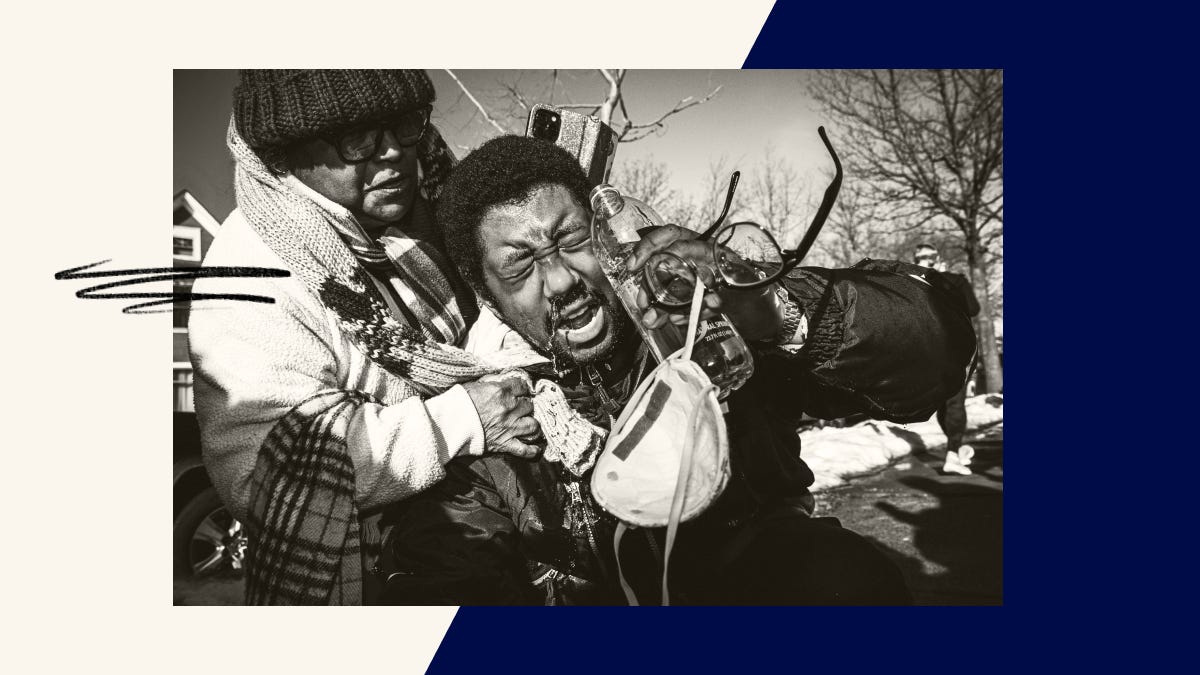
Numerous bystander videos (many highlighted in court rulings) show DHS agents pushing, shoving, tackling, and using chemical weapons against protesters and legal observers, from Chicago to Charlotte to Minneapolis.
Pair the actions of DHS officials with the words they use to describe their mission, and it becomes clear that the deployments are about intimidating and punishing certain communities, imposing extraordinary suffering on immigrants (many of whom have legal status) and U.S. citizens alike.
In a video of DHS agents staging their terror campaign in Los Angeles, former Border Patrol commander-at-large Greg Bovino described the “orders all the way to the top”: “Everybody f—ing gets it if they touch you.” After telling the assembled agents that he was procuring “tractor trailers full” of nonlethal weapons like tear gas and rubber bullets, he added, when prompted by an officer, “This is our f—ing city!”
In Chicago, Kristi Noem gave a “pep talk” to DHS agents before they attacked a peaceful protest outside the ICE facility in Broadview: “Today, when we leave here, we’re gonna go hard. We’re gonna hammer these guys.”
In Minneapolis, DHS agents have threatened observers that they will suffer the same fate as Renee Good, who was shot and killed by DHS agents. Similarly, in Chicago, an agent drove by a combat veteran who was standing on the sidewalk observing a protest, pointed his handgun at him, and said, “Bang bang. You’re dead, liberal.”
These deployments are also operating in an intentionally theatrical way. Officials have reportedly been instructed to capture video footage for DHS social media posts, and groups of DHS agents have posed for photo shoots in cities where they’ve carried out these crackdowns. The administration is seeking to disseminate images that project DHS power and strike fear in everyday Americans. Serious immigration enforcement doesn’t require a massive investment in a propaganda apparatus, but intimidation does.
If there were any doubt remaining, the shooting deaths of American citizens Renee Good and Alex Pretti by DHS agents and the administration’s escalatory response confirmed that the intimidation and the suppression are the point.
Read more: Free speech, ICE, and free elections in 2026.
The administration attempted to justify the killings of the two Minnesota protestors by smearing them (and their fellow protesters) as “brainwashed,” part of a network of radicals, domestic terrorists, “agitators,” and “rioters,” intent on “doing maximum damage.” All simultaneously serving to form more pretext to come down harder on future dissenters.
And it all goes back to the upcoming midterm elections. Amanda Carpenter explains:
The attempts to brand dissent into “domestic terrorism” and make observers into “conspirators” are strategic smears to intimidate and silence those who challenge the president’s overreaches and ultimately, compete against those policies in future elections.
Those who wish to protect our elections must be firm: Free speech is the prerequisite for a free election. The Trump administration sees a dual purpose in deploying federal agents in such massive numbers to blue states and cities. Trump’s immigration crackdowns have morphed into free speech crackdowns, too.
And it’s definitely not enforcing the law
That brings us to “enforcement.”
When we say “enforcement,” that implies it’s about upholding our laws, when in fact this administration, including and especially ICE and Border Patrol, are acting lawlessly and expressing outright contempt for the law.
Last year, Ben Raderstorf wrote about the administration’s anti-legalism:
Anti-legalism is one of those trends that once you see, you can’t unsee it.
It’s a pattern that ties together almost all the Trump administration’s disparate actions — from the destruction of the East Wing and the apparent graft and bribery scandals, to the spending abuses and censorship campaigns, to the attempts to politicize previously apolitical institutions, like the Department of Justice and the military.
It’s not just that Trump and his administration routinely break the law. It’s that they seem to delight in doing so. That they are openly contemptuous of any suggestion of limits, guardrails, or rules. And when challenged on the law — by courts, by Congress, by civil servants, by national security leaders — they lash out with undisguised fury.
Vice President JD Vance and Stephen Miller, the president’s top advisor, have both wrongly asserted that DHS officials have “absolute immunity,” seemingly assuring agents that they can violate the law with impunity.
The administration’s anti-legalism is particularly on display in their hostility toward the judiciary and noncompliance with court orders.
In a new report for Politico, Kyle Cheney showed that:
[T]he Trump administration has slow-walked or outright defied judges’ orders demanding the release of people scooped up by Immigration and Customs Enforcement at an increasingly rapid clip.
Last month, the George W. Bush-appointed chief federal judge in Minnesota, Patrick J. Schiltz, found that ICE alone had violated nearly 100 court orders.
In addition to noncompliance with rulings, the president and members of his administration have called judges “rogue” and “deranged,” investigated and threatened to prosecute them, and even characterized the executive branch’s relationship with the judiciary as a “war.”
Then there’s the president and his allies’ penchant for untruthfulness — even in court. Last fall, Protect Democracy and our partners brought litigation against DHS officials on behalf of journalists, clergy, and protestors who had been brutalized by DHS agents in Chicago for exercising their First Amendment rights. In her ruling, Judge Sara Ellis laid bare the overwhelming untrustworthiness and dishonesty of the Trump administration. Judge Ellis found that the government and its agents (including former Border Patrol chief Bovino) lied repeatedly in their testimony and filings before the Court.
Likewise, a new report from The New York Times reveals that prior to the DHS killings of Good and Pretti, four criminal prosecutions of people who were shot by DHS agents “fizzled after evidence emerged that contradicted the administration’s initial description of events. The charges were either dismissed or prosecutors dropped the case.” Numerous other criminal cases against protesters and observers have been dismissed by federal prosecutors or have ended in acquittal because of faulty evidence.
Of course, the excessive violence of DHS agents alone proves that their efforts are not legitimate attempts to enforce the law.
Telling agents they can violate the law with impunity, bucking court orders, threatening judges, lying in court, and the widespread use of violence against law-abiding members of the public are not the actions of a good faith effort to obey the law — let alone enforce it.
Here’s how to talk about it
The term “immigration enforcement” is not only inaccurate, but it also enables the administration’s authoritarian abuses by helping insulate them from public backlash.
Referring to DHS deployments this way gives the casual observer the false impression that what’s happening is normal and a legitimate exercise of federal law enforcement to execute the administration’s immigration policy agenda. It inadvertently suggests that the essence of what DHS officers are doing is the hum-drum, routine business of administering the law and that the stories the public is hearing in the news about violence and intimidation are rare exceptions to the general rule. Yet we know the inverse is the reality. This phrasing falsely minimizes and marginalizes the brutality DHS is inflicting by implying that these efforts are principally focused on immigrants, or as the White House has characterized them, “criminal aliens,” — not law-abiding residents and citizens.
Euphemism doesn’t do us any good in this moment: We need clarity and specificity.
DHS isn’t doing “immigration enforcement.” These are DHS deployments to American neighborhoods. They are carrying out violent crackdowns.
Describe discrete DHS actions as what they are — unjustified uses of force, physical assaults, reckless violence against Americans peacefully exercising their rights, violations of court orders and long-standing protections for peaceful protest and assembly. Then, connect the dots. Expose the larger strategy: The goal is to intimidate Americans into silence, to prevent us from exercising our core First Amendment rights and participating fully in our democracy and to drive immigrants out of the country, whether or not they have legal status. To keep us from resisting the administration’s attempt to entrench itself in power, particularly during the upcoming midterm elections.
Here’s the good news: Public visibility into DHS’ conduct has shifted public opinion, which suggests that the American people are in fact open to changing their views about the legitimacy of DHS conduct when they’re presented with the truth.
The one thing all of us can do, starting right now, is refuse to lend even our words to the service of an authoritarian government. No permission structures. No sane-washing. No “immigration enforcement.”
Is Congress now back in the oversight business?
The early months of Trump’s return to power were marked by a complacent Congress: His nominees were almost all confirmed, there was little meaningful oversight, and virtually no effort by the opposition party to use its limited leverage to check him. It seems the tides may be turning.
As we’re seeing play out with ICE and Border Patrol, an unaccountable, unconstrained pseudo-military force is ripe for weaponization. That’s why it’s crucial, particularly ahead of the midterms, that Congress curb DHS abuses. And encouragingly, Democrats are unified in their pursuit to secure key constraints in exchange for funding ICE and Border Patrol.
But this is just one example of a newly reinvigorated legislative branch. Last night, six House Republicans voted with Democrats to block the president’s Canada tariffs, part of his signature economic policy. An increasingly skeptical Congress will have a chance to vote to repeal more of the administration’s unilaterally imposed tariffs in the coming weeks.
Congressional committees in both chambers have held tough oversight hearings this week to question key Trump administration officials, including Attorney General Pam Bondi on the DOJ’s handling of the Epstein files, Commerce Secretary Howard Lutnick on his ties to Epstein, and top DHS officials on their violent crackdowns in American communities.
Too many members of the president’s party continue to ignore their institutional responsibilities out of loyalty (or fear) toward him. But this week brought encouraging signs of a key check starting to wake up and do its job — perhaps inspired by the public’s growing rejection of autocratic abuses. We’ll need much more of that as the president works to further entrench himself in power.
What else we’re tracking
Momentum continues to grow for state-level accountability measures for federal agents who violate citizens’ rights. This week, Protect Democracy’s Jane Bentrott testified in favor of Maryland’s version of a universal constitutional remedies law (UCRA), which Governor Wes Moore seemingly touted in his state of the state address. Also this week, Massachusetts lawmakers introduced their own version of the UCRA.
Read Irina D. Manta for The UnPopulist on Czechoslovakia’s lesson for America: Lawyers are key to peacefully defeating authoritarianism.
Grand juries are also key to defeating the retaliatory prosecutions that authoritarians use to intimidate and punish opponents. Former Minnesota prosecutors explain why in The Minnesota Star-Tribune. For more, check out our educational resource: Constitutional gatekeepers: The history and role of grand juries.
And we’ve seen the importance of grand juries this week as the DOJ tried — but failed — to indict members of Congress for speaking out on national security issues. Likewise, a judge ruled in favor of Senator Mark Kelly, blocking DOD’s attempt to punish him for this protected speech. As we explained in our amicus brief on behalf of dozens of retired senior national security leaders, Judge Leon recognized that allowing DOD to punish veterans for exercising their First Amendment rights would “impoverish public debate on critical issues relating to our military and its role in domestic and foreign affairs.”
A powerful story in The New York Times this week features a few of our plaintiffs in our challenge to ICE’s unlawful, widespread use of tear gas and pepper balls to quell protests in Portland, Oregon. Our plaintiffs offer courageous personal testimony, detailing the horrific physical and mental health harms of being repeatedly subjected to chemical weapons in their homes, which are directly across the street from an ICE facility.


Thank you for this clarity. I don't know anyone who actually thinks that what ICE is doing is about immigration or law enforcement but it's still important to name what's happening properly. We--average citizens---are under attack by our own government and we need to know that so we can try to prepare for it. Our own tax dollars are being used to pepper-spray us, to assault us, to incarcerate us in torture camps. That's where we're at.
While we're dispensing with euphemisms, these "immigration crackdown" are *also* about racial cleansing [1]. According to FactCheck.org, only 31.8% of those arrested by ICE have criminal convictions as of Oct 2025 [2]. Furthermore, "nearly 43% of those detained had no convictions or charges, according to publicly available ICE data".
The violent crackdowns serve two goals for the regime: to throw red meat to the white nationalist faction of the MAGA movement and to intimidate those who might protest the rise of fascism in the United States. Expensive detention center -- really, concentration camps -- are in the works; the administration will seek to fill them and will not readily tolerate opposition to them.
[1] https://indivisiblesf.org/blog/2026/1/27/no-more-euphemisms-for-racial-cleansing
[2] https://www.factcheck.org/2026/01/as-ice-arrests-increased-a-higher-portion-had-no-u-s-criminal-record/