


As the gerrymandering wars accelerate, we’re watching a key pillar of democracy — a legislature that actually represents voters’ views — unraveling in real time.
What’s driving this crisis?
Our new explainer video shows how America’s winner-take-all election system creates the very incentives for map manipulation. Switching to proportional representation could make gerrymandering irrelevant.
Today, very few House races are competitive, with most winners decided by map lines rather than voters. This isn’t an accident — it’s the inevitable result of a system where politicians don’t need to earn votes because gerrymandered districts guarantee they can’t lose.
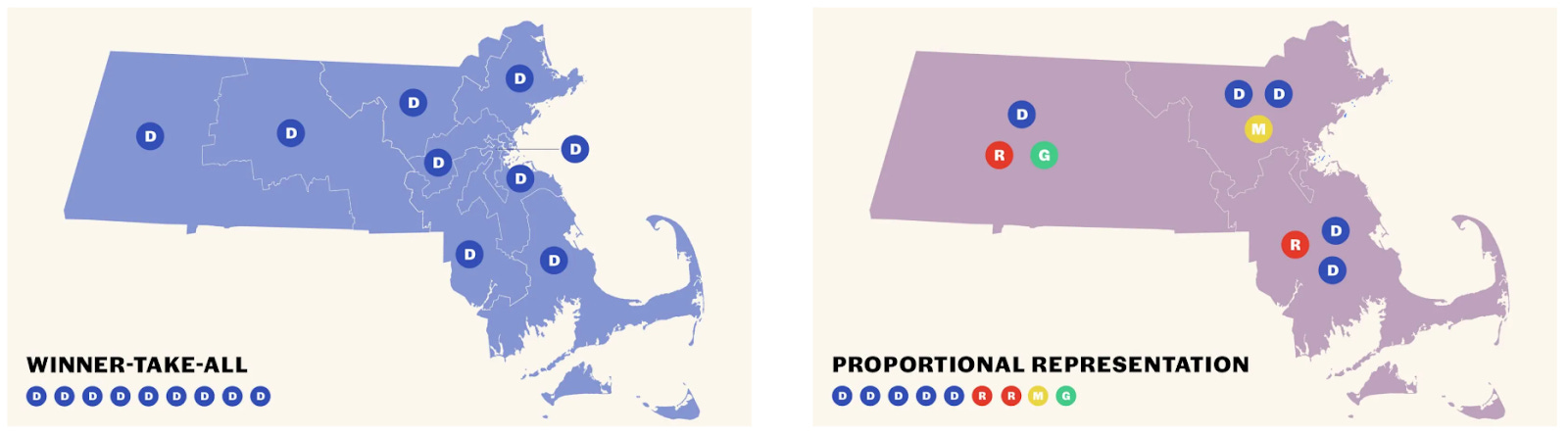
The video presents an electoral system called proportional representation as a comprehensive alternative: multiple representatives elected from larger districts, where the percentage of votes equals the percentage of seats. Every vote counts regardless of geography, forcing parties and politicians to compete for diverse coalitions rather than safe partisan bases. This system is the norm in many diverse democracies worldwide.
As American faith in democracy hits historic lows, this timely explainer examines how most other democracies avoid these problems and how the U.S. could do the same (without a constitutional amendment).
Everything else you need to know about proportional representation:
Proportional representation, explained — a summary of the system and its details.
Advantaging Authoritarianism: How the U.S. electoral system favors extremism — our comprehensive report on the links between escalating antidemocratic extremism and the U.S. electoral system
The next era could come sooner than you think by Grant Tudor and Lee Drutman — why we could be approaching a reform window of historic proportions.
Proportional representation will bring young people into politics by Oscar Pocasangre and Dustin Wahl — why our current system encourages older representatives.
Multipartyism in a multiracial democracy by Deborah Apau — why a two-party system is such a poor fit for a multiracial democracy.
What if we could increase voter turnout by 10 percent with one change? by Deborah Apau — why voter turnout is so much higher in proportional representation systems.
Can proportional representation create better governance? by John M. Carey and Oscar Pocasangre — why proportional systems tend to have better policy outcomes and more stability.
How to end the forever redistricting wars by Ansley Skipper and Drew Penrose — why our current system is so vulnerable to gerrymandering.
How to change the channel on House drama by Sohini Desai — why congressional dysfunction is a product of winner-take-all systems.
Proportional representation and polarization — why proportional systems tend to be less polarized.
The invisible roots of dysfunction by Ben Raderstorf — why no one in Congress seems to work together anymore.
The case for multiparty presidentialism in the U.S. by Scott Mainwaring and Lee Drutman — why proportional representation works even in a presidential (not parliamentary) system.
The “goldilocks zone” of political parties — how proportional representation can create more parties, but not too many.
Party systems explain everything around me by Ben Raderstorf — why we should design reform around party systems, not just politicians.
History’s lessons for reform advocates by Ben Raderstorf and G. Michael Parsons — the surprising and largely untold history of proportional representation in the U.S.
How would constituent services in American multi-member districts work? by Anne Meeker and Lee Drutman — how casework would be the same and different.
Why would Viktor Orbán, the self-proclaimed champion of illiberal democracy, find inspiration in the U.S. electoral system? by Farbod Faraji and Lee Drutman — how a Hungarian autocrat emulated our winner-take-all system.
Trapped in a two-party system by Steven L. Taylor — why our politics are much more complex than just two sides.
What would proportional representation look like in a state legislature? — why the system works just as well (if not better) at the state level.
Proportional representation and the Voting Rights Act by Nicholas O. Stephanopoulos — why proportional representation can provide additional mechanisms for ensuring the fair representation of minority communities.
A practical path to ending the two-party system by Jennifer Dresden — why fusion voting can be a bridge to proportional representation.
Why do we need political parties? — why reforms that focus on parties are essential for the “building blocks” of democracy.
How open are Americans to electoral system reform? — a poll on support for reform.
It is clear that our winner-take-all system — where each U.S. House district is represented by a single person — is fundamentally broken.
-Letter to Congress from more than 200 political scientists, The New York Times.


