


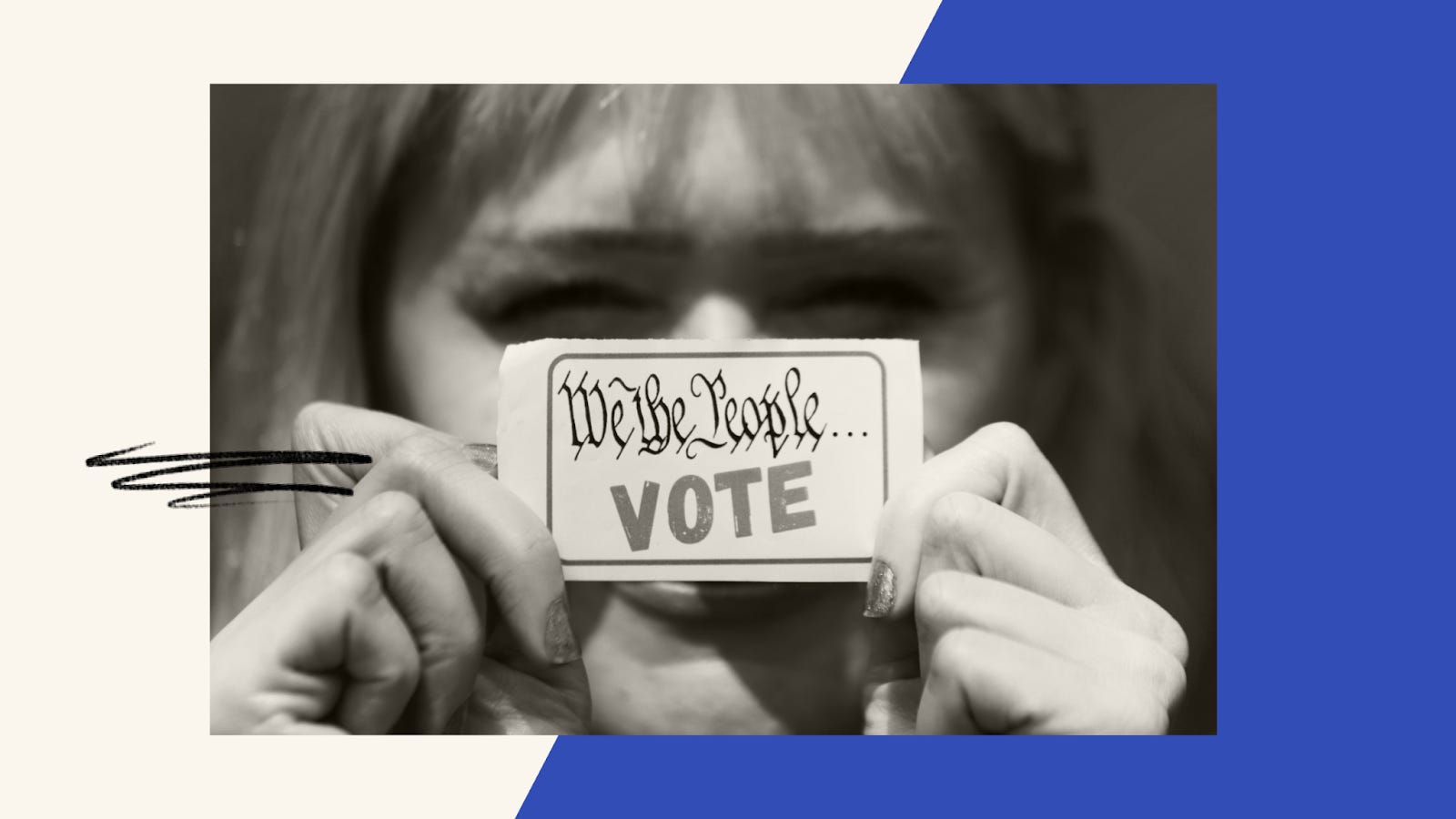
“When you think of it, we shouldn’t even have an election.”
That’s what President Trump told Reuters’ James Oliphant in an Oval Office interview Wednesday when confronted with the prospect of Republican losses in this year’s midterm elections.
The president is obsessed with the midterms for one simple reason: They are the main and most important institution holding up our democracy. Between now and the swearing in of the next Congress a year from now, everything the administration does, every news story and every development, should be seen through this lens. The authoritarian movement is consolidating power and cracking down on the opposition in order to position themselves to corrupt the election — so they can stay in power and repeat the cycle indefinitely.
Everything rests on the midterms.
As he promised he would, Trump spent his first year attempting to dismantle institutional checks and balances, to varying degrees of success. Congress has become a shell of itself, unwilling to check the president except in rare cases. The Supreme Court has significantly expanded presidential power, even granting Donald Trump in particular immunity for criminal deeds while in office. Meanwhile, the Justice Department has become nakedly partisan, pushing questionable — even trumped-up — prosecutions of the administration’s adversaries while brazenly running legal interference for the president. Independent institutions, above all the Federal Reserve, are under assault. And federal law enforcement, especially under the Department of Homeland Security, is acting increasingly like a private presidential paramilitary force. Meanwhile, many non-governmental institutions essential to a functioning democracy — from the media to business to universities to social media platforms — have capitulated to various degrees.
Still, the infrastructure of elections — how they are run and how we vote — is, as of right now,1 notably unscathed by Trump
The reason why is simple: In our federal system, elections are decentralized. They are run at the state and local level, which makes them much harder for an authoritarian president to corrupt.
Harder… but not impossible.
Read more: Deceive, disrupt, deny.
The next Congress will be sworn in on Jan. 3, 2027. Over the next 12 months, expect the Trump administration to use every tool at its disposal to try to sow doubt about and interfere with the midterms.
Here are some of the things that we can expect the federal government to attempt this year:
Continue pushing allies in state governments to gerrymander even more aggressively before the 2026 maps are final (especially if the Supreme Court gives them an assist by further eviscerating the Voting Rights Act in a bad Louisiana v. Callais decision).
Use unprecedented executive orders that have no legal basis to do things like “ban” voting machines or mail-in voting, which would not succeed,2 but could still sow chaos and confusion.
Deploy federal law enforcement (e.g., ICE) or military forces to highly contested congressional districts in an attempt to create upheaval, intimidate voters, illegally interfere with counting and certification, and even violently disrupt any part of the process. (This could include invoking the Insurrection Act — see below).
Use the DOJ to try to intimidate and meddle with local election officials (such as attempting to “seize the voting machines”), instead of performing the federal government’s traditional role of supporting local election officials and combatting foreign interference.
Misinterpret or misrepresent the voter data they’ve demanded from states as a way to remove eligible voters, suppress votes, and manufacture “evidence” of fraud.
Otherwise spread lies about the election — e.g., “that noncitizens are voting” — to try to discredit the opposition and create a pretext to reject the results.
Use “zombie lawsuits” to try to get partisan judges to overturn results that they don’t like after the fact.
Coerce state and local election officials into tampering with or falsifying election results (à la “I just want to find, uh, 11,780 votes” in Georgia).
Finally, if all of those fail: brazenly ignore the will of the voters and try to install a Potemkin Congress by fiat instead of seating the people’s representatives.
(And that’s just what we can easily see coming. They will surely do other outlandish things beyond what we can reasonably predict.)
Impending chaos, however, is neither cause for despair nor complacency. The power of the federal government is vast, but ours remains intact. So let’s use it. Pushing back will require all of society — from protesters and grassroots organizers, to lawyers and judges, to faith leaders and business leaders, to veterans and state and local law enforcement, to journalists and storytellers — coming together with one voice to defend free and fair elections.
Here are some of the things we all can do, starting now:
Discredit, discredit, discredit. Nothing this administration does on elections can be given a presumption of legitimacy. A drumbeat of outrage, in advance, describing their goal clearly and in unstilted terms — “they want to corrupt the midterms so they can stay in power” — is key to inoculating our elections system against efforts to undo it.
Show up and participate. None of us can stay on the sidelines and no one role looks exactly the same. We are each uniquely positioned to do our own part to support — and to enable our neighbors, communities, and fellow Americans to take part in — the electoral process. Whether that’s by attending a rally, holding a sign, making a campaign donation, volunteering as a poll worker, observing the election, or showing up to vote. But more importantly than any partisan activity, mass nonviolent protests and other grassroots mobilization to support the principle of free, fair, and nonpartisan elections will almost certainly be necessary.
Focus on your sphere of control. When there are concrete things you have the power to do, do them. We’ve all got different roles and opportunities. If you have a media platform, share reliable information. If you have some sort of official authority, exercise it wisely. Organize a community or constituency. Get to know your elected officials. Become the person in your group chat who can explain what’s going on. Show up for a rally. Double check the voting rules in your state and cast a vote that would be nearly impossible to challenge. All of these things contribute to a vibrant democracy.
Stay confident. The coming attack on the 2026 midterms may end up being more outrageous and audacious than our imaginations can currently conjure. They are attempting to do what should be unthinkable, and they are doing it in plain sight. That should make you very angry — but it should also make you feel very confident that this is a winnable struggle. Everything is on our side: our history, the Constitution, morality, the law, reality, and basic facts. It will not be easy, but with the strength and courage each one of us has, we can and will win.
The American people do not want a dictatorship. The vast majority of our fellow citizens, even those who plan to vote for the president’s preferred candidates, do not want their vote to be ignored.
Trump threatens to invoke Insurrection Act
The president is threatening to invoke the Insurrection Act as he continues to escalate and stoke tensions in Minnesota.
Here is everything you need to know about the law and what would happen next: Demystifying the most ominous law in America.
According to our colleague Rebecca Lullo:
The Insurrection Act is not the blank check for escalation that the president portrays it as. There are serious legal questions and courts could block yet another politicized deployment. Invocation wouldn’t suspend the Constitution, impose martial law, or otherwise exempt the military from applicable state and federal laws.
Do federal officers have “absolute immunity”?
In the wake of Renee Good’s killing, the White House has loudly (and ominously) insisted that ICE and CBP officers have “absolute immunity” for their violent attacks on the people of Minneapolis and other American cities.
This is wrong. States can prosecute them and, under the right circumstances, achieve convictions. Protect Democracy’s explainer on why and how: Why federal officers don’t have absolute immunity.
The contours of the governing law are messy but the question of immunity likely turns on whether the prosecuted officer had a reasonable belief that federal law authorized or required the acts for which he is being prosecuted. It’s ultimately up to the discretion of a judge — or on appeal, multiple judges or justices — to determine whether the officer can be shielded from charges.
What else we’re tracking:
Kristy Parker and Samantha Trepel write in The Guardian about how cities and states must hold ICE accountable for violence. “As former federal prosecutors, we know an incident like the Minneapolis shooting must be followed by a credible inquiry.”
The Times’ Jim Rutenberg has a must-read feature on how the FCC has used obscure regulatory powers to crack down on networks: The MAGA plan to take over TV Is just beginning.
A number of important legislative proposals moved forward this week, including Sen. Murphy and Rep. Crow’s NOPE Act and several states’ Universal Constitutional Remedies Acts advancing in California, Maryland, and New York. Ben Raderstorf explains their significance: A grand unified strategy to uphold the Constitution.
Colorado Governor Jared Polis is reportedly considering clemency for Tina Peters, the election denier former County Clerk serving a nine-year sentence, after a sustained pressure campaign by Trump. Our colleagues Max Potter and Beau Tremitiere explain why that’s such a bad idea in The Denver Post: Clemency for Tina Peters endangers us all. (While you’re at it, read this similar argument from Stephen Richer, former Republican Maricopa County elections chief in The Bulwark.)
January of 2026. For example, the 2025 elections were free and fair.
Again, the system is decentralized. The federal government has very little control over elections.


Thank you for reminding us that everyone has a role to play. From the vantage point of a DC resident, my role is to work to retain what little home rule DC has, and to hope we can get statehood before our whole country crumbles.
No need to "protect" democracy! The Founding Fathers explained carefully to us that democracies have always been disastrous. They wrote the Constitution carefully to avoid letting the citizenry vote on anything whatsoever, except for the fact that they wanted the flavor of the citizens' thinking to be reflected in the House of Representatives; therefore, they wrote: "...chosen by the people of the states..." as a clear indication that they expected the states to conduct plebiscites in choosing their Federal House Representatives. We have steadily--and for the most part, unconstitutionally--modified our federal government to make it more "democratic." The resulting trends have produced a growing divide within the body politic which is so serious that many people expect or republic to implode and be replaced by some form of dictatorship. This topic needs much discussion. The state governments made the Constitution and hold the final say on any change to the wording of it; therefore, they morally, legally, and literally "own" the U.S. Constitution. They can be, and must be, awakened to the fact that their letting the federal government arrogate unto itself ownership of the Constitution amounted to unconscionable dereliction of duty on their parts. Read up on "Marbury v. Madison," which is presumed to have been the key stroke regarding the states' loss of power to prevent the federal government from becoming an ever-growing cabal of tyranny over the people and their God-given rights.