


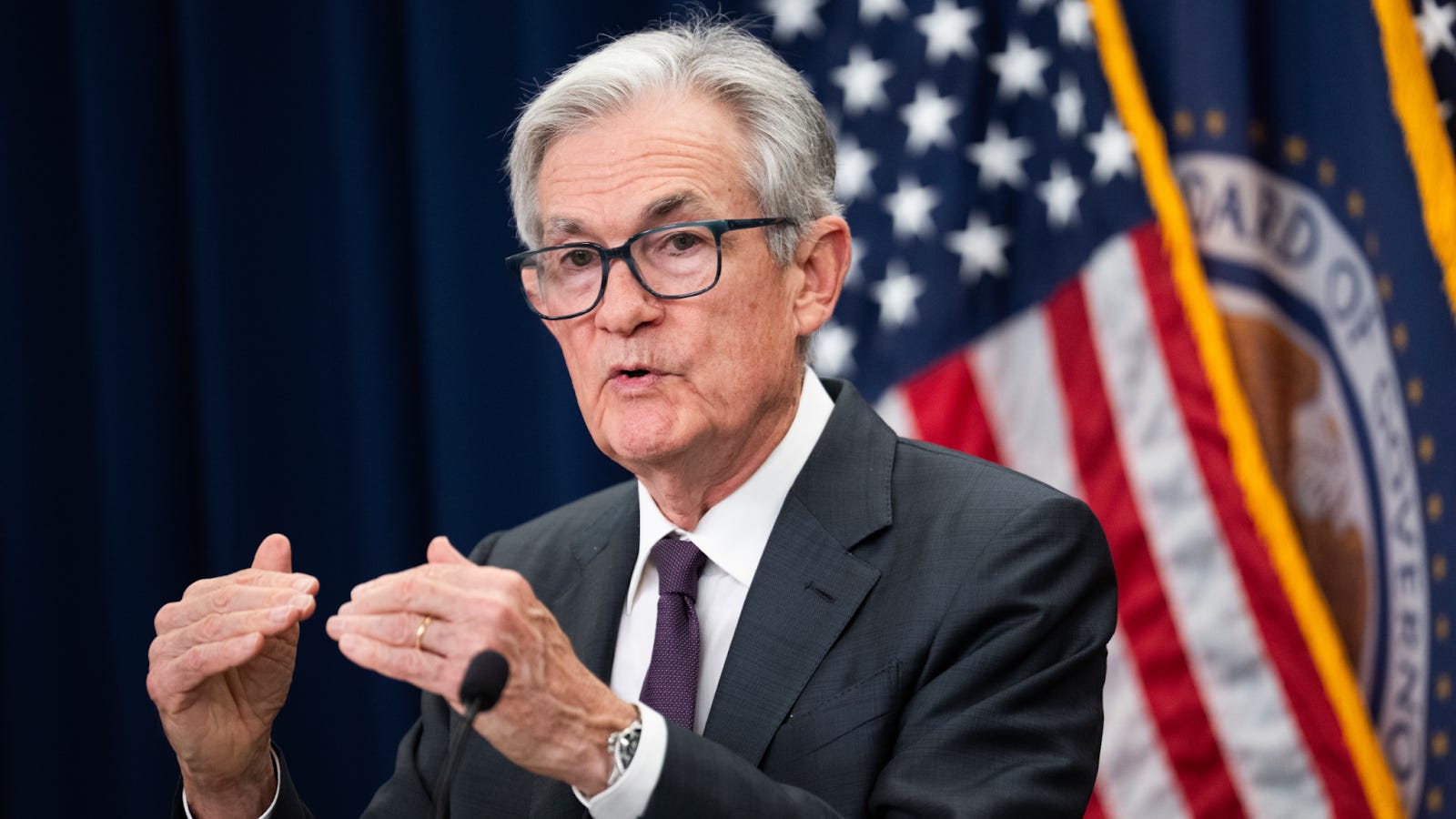
Jerome Powell is an unlikely social media star. The current chairman of the Federal Reserve is a serious, silver-haired septuagenarian attorney and former investment banker who sees his role as an apolitical one. But this weekend Powell made a video statement that quickly went viral. (It has one million views on the Federal Reserve YouTube page alone, as of publication.)
Powell’s less-than-two-minute statement is a stunningly clear indictment of the president’s thinly veiled attempt to weaponize the Justice Department against federal officials who don’t obey his every command:
This unprecedented action should be seen in the broader context of the administration’s threats and ongoing pressure.
This new threat is not about my testimony last June or about the renovation of the Federal Reserve buildings. It is not about Congress’s oversight role; the Fed through testimony and other public disclosures made every effort to keep Congress informed about the renovation project. Those are pretexts. The threat of criminal charges is a consequence of the Federal Reserve setting interest rates based on our best assessment of what will serve the public, rather than following the preferences of the President.
This is about whether the Fed will be able to continue to set interest rates based on evidence and economic conditions — or whether instead monetary policy will be directed by political pressure or intimidation.
To be sure, at first glance, a president demanding lower interest rates sounds like a populist win — who doesn’t want cheaper mortgages? And “Fed independence” seems like an abstract, stuffy tradition. The status quo certainly hasn’t been working for all Americans. But history and economics tell a grimmer story. The independence of economic policymaking isn’t an end in and of itself. Independent institutions create policies based on, as Powell put it, “what will serve the public,” not the personal preferences of politicians.
When autocrats control economic policymaking, the result isn’t a booming economy; it’s a broken one. And the people pay the price.
Independent institutions guard against an economic sugar high
For politicians, the incentives will always be to run the economy hot and make short-sighted decisions that sound good to their citizens and boost their allies’ business opportunities.
Meanwhile, the bad economic consequences may not be immediate. It’s not clear that the stock market will, in the short term, punish Trump for nuking Fed independence. The economic damage of politicizing the central bank may temporarily be clouded by the economic sugar high of lower rates.
In fact, this delay — between politicization and its consequences — explains why Fed independence is so important. Politicians are often willing to risk long-term consequences for short-term gains. But someone has to focus on the long term.
Economic experts who are insulated from political pressures make decisions based on evidence and that prioritize stability. In the long run, these decisions result in better outcomes for citizens. As Georgetown University professor Andreas Kern wrote:
[A] large body of economic research makes it quite clear: Placing monetary policy into the hands of an independent central banker, who bases decisions on evidence and data instead of populist ideals, leads to lower inflation and greater economic stability – key ingredients of a strong economy.
This is precisely why independent economic policymaking institutions (especially independent central banks) have long been the norm here and in other modern democracies abroad.
In the past, American presidents — including Ronald Reagan, Richard Nixon, and George H.W. Bush — have tried to influence the Fed’s decision making, and Lyndon Johnson even explored firing the Fed chair back in 1965. But President Trump’s attacks on Fed independence have been relentless. Beginning in his first term, Trump regularly criticized the Fed’s policymaking and referred to Powell as an “enemy,” “clueless,” and a “bonehead” because he was not cutting interest rates. Trump started exploring ways to remove Powell as chair back in 2019, just two years after Trump himself had nominated Powell for that post.
In his second term, Trump has doubled down on pressuring the Fed. In July, for example, Trump showed House Republicans the draft of a letter attempting to fire Powell. And in September, the DOJ opened an investigation into Fed Board of Governors member Lisa Cook as Trump unlawfully tried to remove her under the pretext of mortgage fraud allegations.
Beyond the Fed, the president has also expanded his scope to other important economic policymaking bodies. Most notably, the Federal Trade Commission: In April, the president illegally attempted to fire FTC Commissioners Alvaro Bedoya and Rebecca Kelly Slaughter without cause before the end of their Senate-confirmed terms.1
As Slaughter put it:
The Federal Trade Commission catches scammers, prevents monopolies, and stops landlords from padding your rent bill with junk fees. We make rules that require tech companies to protect children’s privacy online. We promote competition in the pharmaceutical industry to drive prices down. And we can do all of this because the FTC can’t be bought with campaign contributions or bullied by politicians.
A roadmap for two million percent inflation
Similar efforts by autocrats around the world have had disastrous consequences for the average citizen — including causing inflation to skyrocket.
In Turkey, President Erdoğan’s insistence that high interest rates cause inflation (an economic flat-earth theory) led to the firing of multiple central bank governors. The result? A currency in freefall and inflation that peaked near 85%.
In Argentina, a current MAGA fixation, decades of political interference in the central bank have turned a once-wealthy nation into a cautionary tale. The inflation rate at the end of last year was 31.5%, which represents the lowest year-end figure since 2017.
In Venezuela, Hugo Chavez took control of the Central Bank in 2007. As economists feared, by 2014 Venezuela’s inflation was among the highest in the world, eventually reaching 2,000,000%. I’ll say it again: two million percent.
Trump’s push for lower interest rates has even been tried (and failed) here at home. President Richard Nixon famously bullied Fed Chair Arthur Burns into keeping rates low for the 1972 election. This shortsighted decision helped trigger a decade of “Stagflation” — high unemployment paired with spiraling prices — that took a brutal recession in the 1980s to fix.
Congressional oversight is crucial
Even if Trump fails in his head-on assault — if he is not successful in the unprecedented and unlawful removal of Powell, the current chair — the threat of a politicized Federal Reserve does not go away. Powell’s term as chairman expires in May (although he remains on the board until 2028). Trump gets to appoint his replacement.
This is where “checks and balances” becomes less a platitude about the novel design of American democracy and more the crucial safeguard between an autocrat hell-bent on dominating monetary policy and the American people, who will pay the ruinous price if the checks fail.
Any nominee for Fed chair must be approved by the Senate, where some Republicans have expressed concern about the president’s Fed power grabs.
Senator Thom Tillis, a member of the Senate Banking Committee, vowed to block any nominee for the Fed until the investigation is resolved, stating that “It is now the independence and credibility of the Department of Justice that are in question.”
And Senator Lisa Murkowski offered a strongly-worded rebuke:
[I]t’s clear the administration’s investigation is nothing more than an attempt at coercion… The stakes are too high to look the other way: if the Federal Reserve loses its independence, the stability of our markets and the broader economy will suffer.
Additionally, a bipartisan group of former Fed chairs and Treasury officials issued a forceful condemnation of the investigation against Powell. And more and more Republican members of Congress are expressing their opposition (to varying degrees of forcefulness).
It’s an encouraging sign that the investigation has drawn the ire of more than the typical crowd of Republican Trump critics. For the sake of the long-term strength of our economy, the Senate needs to exercise its oversight authority to block any future Fed nominees without a demonstrated commitment to independence. Otherwise, we may follow autocracies abroad down the road to ruin.
Track other retaliatory actions
Jerome Powell is only the latest retaliatory target of the Trump administration. Keep tabs on the others with our tracker here.
My colleagues at Protect Democracy have represented Slaughter in litigation that is now before the Supreme Court. Read more about the case on our website.
Not defending this action against Chairman Powell - its purpose is to launch yet another salvo to collapse the old world order and usher in a new global tyrannical state - but with regard to the Federal Reserve itself, it hss 'absolute zero' levels of legitimacy:
"If the American people ever allow private banks to control the issue of their currency, first by inflation, then by deflation, the banks and corporations that will grow up around them will deprive the people of all property until their children wake up homeless on the continent their Fathers conquered.... I believe that banking institutions are more dangerous to our liberties than standing armies...." -Thomas Jefferson
Since its spurious inception in 1913, the "price stability" mandated FED has looted 98+% of the US dollar's value. This means impoverishing innocent children. This means elder widows. This means you.
Money creation belongs to We the People, not to a private bank masquerading around as a government agency (the word 'Federal' is used to trick us), that first counterfeits and then lends that money to us at interest to be repaid to them while inflating away (leaching) its value.
"Permit me to issue the currency of a nation, and I care not who makes its laws." -Rothschild
Rothschild said this because he who controls the money spigot, controls the root of all evil, and as such the minds of most men.
In addition to the examples you gave, in a best case scenario, a captured Fed leads to 1970s America with 20% interest rates to tamp down runaway inflation. In a worst case scenario, your country turns into Weimar Germany in the 1920s, pushing wheelbarrows of cash to buy one loaf of bread.
Also wrote about this recently. We definitely can't afford autocracy - thanks for writing this!