


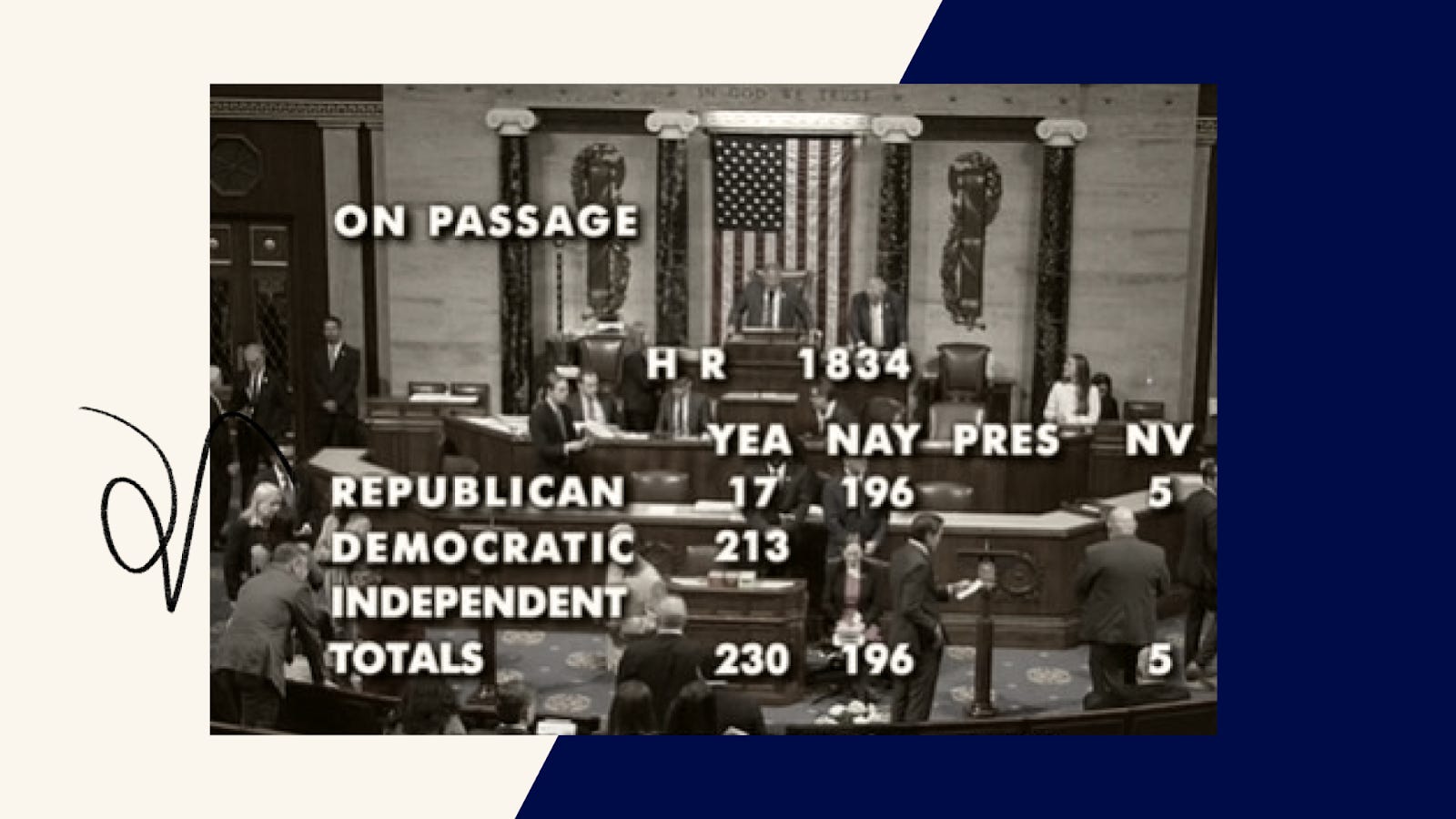
Yesterday, the House of Representatives did something strange.
Even though the chamber is currently controlled by a Republican majority, they passed a substantial bill — extending health care subsidies under the Affordable Care Act — supported mostly by Democrats. 213 Democrats and 17 Republicans voted for the bill.
The vote was only possible because of a little-known congressional procedure, albeit one that has recently been getting more attention: the discharge petition. This formerly rare procedure has been used successfully a number of times this Congress to allow votes on bills that the speaker of the House otherwise refused to advance. Examples include Rep. Anna Paulina Luna’s parental proxy voting plan, the Epstein files bill, and now the ACA subsidies bill (which was voted on yesterday).
Discharge petitions are often described as a procedural “safety valve” — a method by which a majority of the House (typically bipartisan) can bypass the speaker and bring legislation directly to the floor. The increased use of discharge petitions has therefore fueled speculation that Speaker Mike Johnson is losing control of the House. But we believe that’s not really the right way to think about the issue.
Power has been increasingly concentrated in the speaker’s office, but the use of that power to severely limit what legislation gets a vote has frustrated what may be a growing number of “hidden majorities.” The increase in use of the discharge petition has allowed only a handful of those majorities to have their say.
Put differently: The speaker may not be losing his power; the members may be struggling to regain some of theirs.
For the House to truly represent the American people, majorities must be able to act, even if — and perhaps especially if — those majorities are bipartisan, and even tilted towards members of the minority party (in today’s example, the Democrats, but equally true when Republicans are in the minority). The increased use of discharge petitions is a positive development. It signals a willingness of members to engage in bipartisan legislating, even at the cost of defying their party leaders.
But make no mistake: Congressional partisanship and gridlock are still at levels once considered extreme. We should not just encourage the use of existing tools to overcome gridlock; we should be looking for ways to streamline and strengthen the discharge petition process. And we need to consider new procedural tools for identifying dormant majorities in Congress and empowering them to act.
For more on what those tools can look like, read: The counterintuitive way to fix Congress.
Congress may have many hidden majorities
There may be any number of bills that could get a majority if put on the floor for a vote, but only a select few ever get that opportunity. That’s because one of the key procedural powers in the House is the ability to call a bill up for a vote — a power that rests primarily with the leader of the majority party, the speaker of the House.
Use of the discharge petition “safety valve” is becoming more and more common precisely because speakers of the House have accumulated increasing power over the agenda and have exercised that power to refuse consideration of bills that cross party lines — despite having increasingly narrow majorities. In earlier periods of congressional history, control over the agenda was more decentralized. But in today’s House, the speaker chooses the majority members of the Rules Committee, and the Rules Committee has almost unlimited authority to bring bills to the floor in any form. The speaker further possesses sole authority to recognize members to bring up bills by suspending the rules. Furthermore, there is an informal understanding that the speaker is expected to block legislation without clear support from a majority of their party even if those bills are supported by the majority of the House — effectively shutting out many potentially bipartisan proposals.
The Epstein Files Transparency Act revealed a massive hidden majority
The story of the bill to release the Epstein files is illustrative of the dynamic that exists between the gatekeepers and the hidden majorities that they are shutting out.
Last summer, the Epstein bill seemed to be going nowhere. The committee of jurisdiction didn’t take it up, the Rules Committee refused to bring the bill to the floor, and the speaker himself declared his opposition. With the usual gates all closed, supporters of the bill turned to the method of last resort: the discharge petition.
The discharge petition requires an outright majority of the House (218 members) to sign the petition in order to force a floor vote on the underlying legislation. And for a long time, it seemed that a majority of the House did not want to consider the bill. In September, the petition received its 217th signature. Any member could have signed at that point to bring the bill to the floor. None did.
That changed when Democratic Rep. Adelita Grijalva was sworn in on Nov. 12. She immediately signed the discharge petition, thus confirming for the first time that a majority of the House did at least want to consider the bill. Once that point was reached, opposition to the bill seemed to melt away. When the final vote was tallied, the bill passed not only with a sizable majority, but almost unanimously, 427-1 (with five members not voting). Evidently, there was a hidden majority in favor all along.
With almost total unanimity on the substantive question, why was it so difficult to achieve a majority on the procedural question of taking up the bill at all? Part of the answer is that a scheduled vote is a powerful thing — it forces members to actually consider their position on an issue in a setting where they may be held accountable to their constituents. As long as party leaders have a near-monopoly on the agenda, many issues will go unaddressed.
With increasing partisanship and narrow majorities, there are some signs that the current concentration of power in the office of the speaker is becoming untenable. Speakers have lost votes on special orders from the Rules Committee. They have had to hold votes open, sometimes for hours, in order to twist arms and make whatever concessions they need to secure a majority. When majority party leadership doesn’t have the votes, it simply cancels planned legislative activity.
With the committee system all but defunct and the speaker increasingly losing control of the majority caucus, it is no wonder that members have been turning to the discharge petition as an outlet for their legislative ambitions. But the House cannot run on discharge petitions alone. The procedures are too cumbersome and it is not, fundamentally, the most effective process for finding hidden majorities — because it requires proactively assembling a majority before the process can even begin.
Hidden majorities point to a path to overcoming gridlock
What the House needs are new procedural mechanisms that allow different sub-majorities to test the will of the House and discover which bills can garner a majority and which cannot. Committees no longer perform this function and the rationales for limiting floor access to the speaker alone are no longer persuasive. Partisan speakers routinely stifle bipartisan bills that would easily get majorities if allowed on the floor.
A more decentralized system for floor access would engender a healthy competition among the various factions in the House (Blue Dogs, Freedom Caucus, Progressive Caucus, etc.) to see which policies can attract majorities. Members would have more agency to pursue their legislative goals, and voters would have a more robust legislative record with which to assess their representatives.
The key to such a system would be to give these groups (which we’ve called “sub-parties”) some formal mechanism to get legitimate proposals on the legislative agenda. We are currently working to develop a variety of options for how a portion of the agenda could be set aside for sub-party proposals (proposals that may surface hidden majorities). In doing so, we take inspiration from the fact that there are many examples of legislatures that operate much differently than the current U.S. House.
Consider that:
Many state legislatures have used a process whereby any bill that passes through a committee is automatically scheduled for a vote by the full legislature.
Each session, the Canadian parliament allows some individual members, by lottery, to offer one piece of legislation for a vote. An hour is set aside each day for such votes.
Even the U.S. House itself was once far more decentralized and has experimented with a number of ways to provide additional access to the agenda. For example, a now-defunct process set aside time on Wednesdays (“Calendar Wednesdays”) for committee chairs to bring legislation up for vote.
The point here is not that we should directly copy any of these suggestions but rather that there are a variety of ways to restore the legislative process. For too long, most members of Congress have been sidelined from their legislative duties, instead deferring heavily to their leaders in the hope that that will help them win all-or-nothing battles with the other party. The result has been gridlock, dysfunction, and an ever-increasing public disapproval of Congress.
Members need to open up the process, remove the partisan gatekeepers, and allow more hidden majorities an opportunity to act.
If the system requires months of effort to bring bills to the floor — bills that are ultimately supported by overwhelming majorities — that’s a clear sign that the system needs to change.
Senate grows more assertive on war powers
In another example of a hidden majority, Congress’ efforts to rein in the White House’s abuse of war powers are gaining steam. POLITICO reports:
The Senate on Thursday voted to advance legislation that would force President Donald Trump to seek congressional approval before taking any new military action in Venezuela, a stunning rebuke for the White House in the first big test of GOP unity since the U.S. capture of President Nicolás Maduro.
GOP Sens. Rand Paul of Kentucky, Lisa Murkowski of Alaska, Susan Collins of Maine, Todd Young of Indiana and Josh Hawley of Missouri backed the measure to check Trump in a 52-47 vote.
Read more: The founders gave the first branch war powers for a reason.
Momentum grows to close legal loophole that protects ICE agents from accountability
As Ben Raderstorf wrote this week, the behavior of ICE officers — in Minnesota and elsewhere — is partially explained by a quirk in our legal system: Federal officers are much harder to sue for violating constitutional rights than state and local ones:
This loophole in federal law, where victims or their families can sue local police, but not federal officers, for violating their constitutional rights is one of those frustrating legal realities of our system.
But it doesn’t have to be that way. And it also wouldn’t take federal legislation to close the loophole. Minnesota could, on its own, pass a law giving Minnesotans a cause of action to sue any and all government officials for violating their constitutional rights. This fix, generally known as a “universal constitutional remedies act” or a “converse-1983” cause of action is widely believed to be both effective and legal. It simply would close the loophole, through state law, and subject federal officers, including ICE, to the same standard legal liability that the vast majority of law enforcement in the United States currently operates under.
State governments are moving quickly to close this loophole.
Yesterday, Governor Kathy Hochul announced that she will propose a Universal Constitutional Remedies Act in New York. In California, Sen. Scott Wiener’s bill to do the same is advancing in the state legislature.
For more, read: The Universal Constitutional Remedies Act, explained.


"But it doesn’t have to be that way. And it also wouldn’t take federal legislation to close the loophole. Minnesota could, on its own, pass a law giving Minnesotans a cause of action to sue any and all government officials for violating their constitutional rights..."
And what's so sad is that you'll never see a dime spent on advertising this to Minnesotans (or the nation for that matter). (Although anyone with money could do it, online, offline, TV, etc.) You'll have candidates routinely spend tens of millions to endlessly decimate another humans reputation for their own personal gain. But these same individuals and organizations won't spend a single penny to let millions of citizens know that they can pass a bill granting them the right to hold corrupt government workers accountable (and it sure as hell shouldn't even me a loophole to begin with).
This shows you how broken the system is. It's COMPLETELY NORMAL and fully expected to have your future government officials continuously spreading HATE and trying to tear each other down.
Yet it's completely unheard of for them to encourage your civic engagement in an effort to broaden your rights as a citizen.
What an absolute joke.
Some information on discharge petitions.
"A discharge petition is a parliamentary procedure in the U.S. House of Representatives that allows members to bring a bill out of committee and to the floor for consideration without the committee's approval, typically requiring signatures from a majority of House members. This process is used to bypass the majority party's control over the legislative agenda, but successful petitions are rare.
- A bill must sit in committee for at least 30 legislative days before a discharge petition can be filed.
- A total of 218 signatures from House members (435 total) is required to successfully discharge a bill. In 1935 the House raised the threshold from one‑third of the chamber (145 signatures) to an absolute majority (218).
Historically, they are rare; from 1931 to 2003, only 47 out of 563 filed petitions succeeded. That's a measly 8.4% success rate. Recent years have seen a slight increase in their use, reflecting divisions within the majority party.
Discharge petitions are often employed to challenge the majority party's control over the legislative agenda. They can be a strategic tool for minority party members to force votes on issues that may not align with the majority's priorities."
Also: the "[Read the full piece]" link in today's email says you guys linked to a private page.