


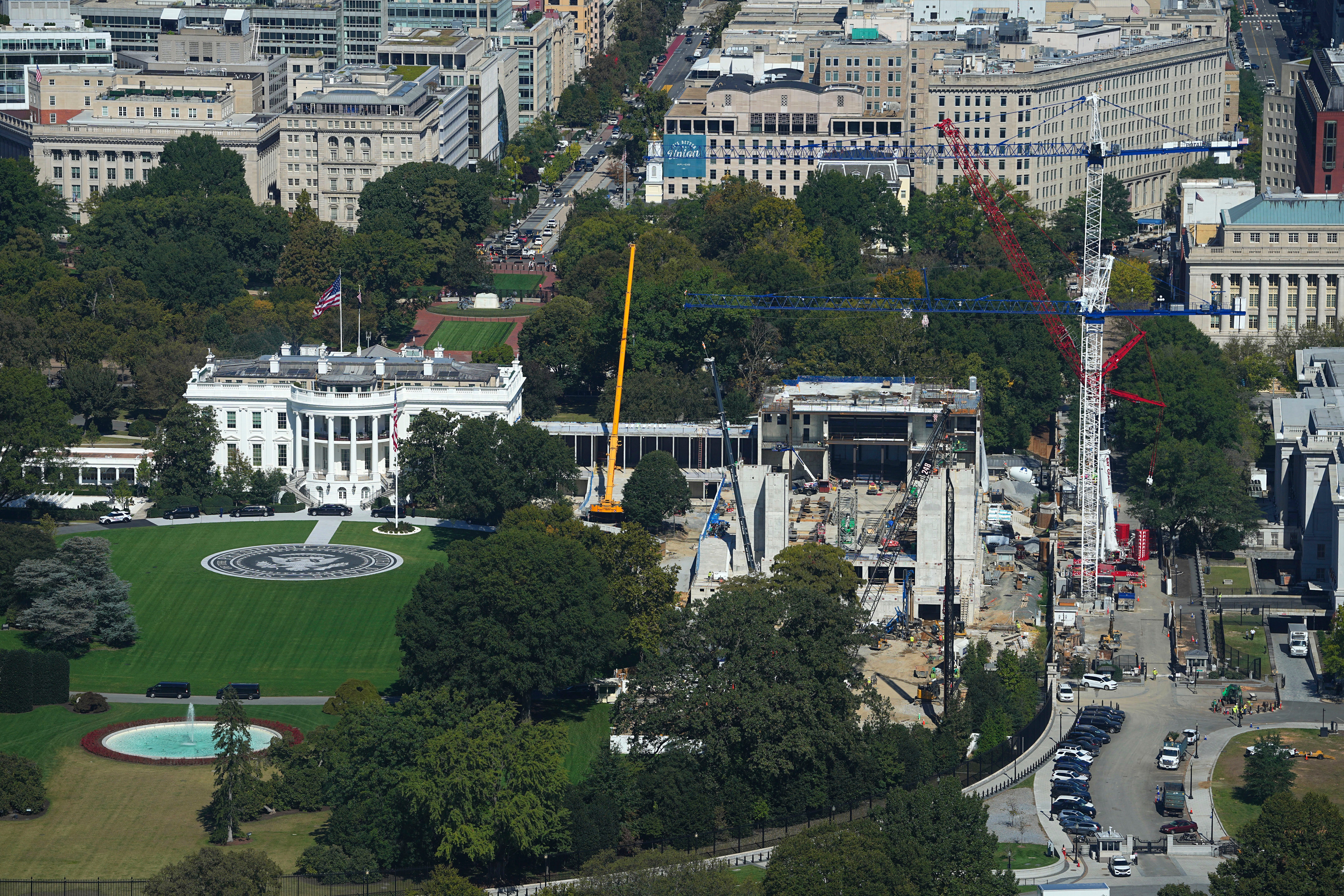
When you consider all the outrageous things President Donald Trump has done in his second term, you might be tempted to think his big ballroom project doesn’t rate high on the scale of his most authoritarian offenses—that, at worst, it’s another expensive monument to his vanity; at best, it could include some features useful to national security.
No.
This is an enormous separation-of-powers problem that, if left unresolved, essentially renders one of Congress’s major functions meaningless. Put aside the president’s deep-seated desire to host state dinners in a gilded bunker and start with one basic question. How is this bunker-ballroom—which has morphed into a six-story subterranean complex complete with a military hospital, facilities for unspecified research, and a rooftop drone port—being funded?
Funny story: No one really knows!
That’s not good, especially considering the White House already has a previously secret, nuclear-proof underground facility built during the Obama administration, and Trump is steamrolling ahead to build a “ballroom” that dwarfs the actual White House in square footage. Many people should be able to tell us. Five hundred and thirty-five, to be exact, because Congress’s job is to pass legislation that says how the government spends money.
Now, you may be confused, because Trump said at the outset of the project that no taxpayer money would be used to construct the ballroom—it was instead going to be a “gift” to the country fully funded by private donors. (Hold this thought.) His exact words were that it would be “taxpayer free,” that “We have no taxpayer putting up 10 cents.” This turned out to be a bald-faced lie, but the gambit served its purpose: It bought him time to break ground.
As soon as mounds of dirt began piling up, Trump began making noises that finishing the ballroom would require taxpayer funds after all, specifically to pay for the accompanying national security support. Just like the “free” Qatari plane that turned out to require a bit of extra money—nothing too serious; “less than” $400 million—in order for it to be “maxed out” with security upgrades. After the attempted shooting at the White House Correspondents’ Dinner, Republican Sens. Lindsey Graham and Charles Grassley began taking up Trump’s requests and introduced bills to set aside the required funds. Those efforts, however, failed. A bipartisan group of senators stripped ballroom funding from a spending bill after opposing taxpayer funding for the project.
In other words, Congress has already said no to taxpayer funding for the big, beautiful ballroom, and this should have been a stop order on the project. Because, again, if Congress doesn’t fund a president’s pet project, how does he get taxpayer money for it?
Answer:
by stealing it from other programs. Investigative reporting by the Washington Post revealed that the White House and the Office of Management and Budget diverted $352 million intended for Secret Service recruitment and training—which covered a big chunk of the ballroom’s overall price tag, considering that for a long time, Trump claimed the total cost would be $400 million. That number was double the figure the White House set out when first announcing the start of construction in July 2025, but, hey, who’s counting?
Well, someone needs to, because the cost has now ballooned to $900 million. Members of the media are still working to piece together what other coffers the president might be raiding. Because, again, Congress, the body that is constitutionally required to authorize government spending, has no idea.
Oddly enough, Congress originally created an “apportionment” process that gives OMB a role in doling out authorized and appropriated money to federal agencies to ensure they stick to their budgets. But over time, OMB has sometimes misused this process, instead using it to thwart rather than implement Congress’s spending laws. A notable example of this dubious behavior was when Trump 1.0’s OMB illegally held up funds intended for Ukraine, leading to his first impeachment. In the aftermath, Congress passed legislation during the Biden administration requiring OMB to post publicly whenever it uses this process, but Trump 2.0’s OMB is resisting that directive.
To ensure everyone can find apportionments, including ones that may withhold funds, my colleagues at Protect Democracy created a searchable public website, OpenOMB.org, to help people find and analyze these postings. After Trump officials took the records offline, Protect Democracy sued to restore public access to them and won, keeping OpenOMB.org functional and helping congressional staff, members of the media, and other watchdogs monitor how OMB directs taxpayer money. But that victory is under appeal, with a hearing due in just a few weeks.
Meanwhile, the Trump administration continues to defy Congress’s power of the purse by other means. In addition to spending money in ways that Congress did not authorize, the Trump administration is using OMB to cancel money through a mechanism known as a “pocket rescission.” A growing number of senators are calling this move “illegal,” and the Government Accountability Office characterizes it as “unconstitutional.” Even the Trump administration’s new America.gov AI chatbot describes pocket rescissions as “not allowed.”
But the Trump administration seems not to worry about acting unlawfully. To check these flagrant, repeated abuses, Congress has to do more than express concern. Real, concrete action is needed to reclaim and defend its spending power, but the Republican-controlled Congress under President Trump has shown little interest in doing so.
If the upcoming midterms result in Congress seating a new majority that is willing to check the executive branch, it should do three things.
First, follow the money. Congress must fulfill its oversight responsibility and follow the money trail to find out how this ballroom and many other projects are being funded. What is the expense to other programs? Whose budgets are being raided? And who is responsible for stealing that money from its intended purpose? Who made the transfers? And how much is Trump’s special-projects spree truly costing taxpayers? We need a full accounting. Congress should subpoena the contracts and communications to find out who is getting paid and how. Many private contractors, keenly interested in future federal contracts, are involved in these deals, and they should be willing to disclose the information.
As part of this oversight program, Congress also needs to find and follow the private money Trump has claimed is being used to fund the ballroom construction. How does that arrangement work? Well, the National Park Service has longstanding authority from Congress to accept gifts that support its mission “to conserve the scenery, natural and historic objects, and wildlife” in the National Park System so as to “leave them unimpaired for the enjoyment of future generations.” But does that authority really open the door wide enough to allow private individuals and corporations to shovel huge amounts of private money through it to construct a giant new building over a historic site that was destroyed to make way for it? Probably not. And how far is Trump stretching that gift authority for the ballroom?
Congress literally does not know. And it should.
Right now, the rules regulating the acceptance of private gifts are too vague. There is no current list of all federal agencies’ authorities to accept gifts or any estimate of how much and what kinds of gifts agencies are accepting. That is basic information, and a cross-partisan group of organizations has recommended that Congress demand it.
Another issue with donations is who gives them. These private funding arrangements for the ballroom project are not entirely public, but we do know donors include people with huge amounts of corporate business before the federal government, not to mention foreign entities and persons, and these present major vectors for corruption and national security risk. These entities are lining up to curry favor with Trump, though one prominent figure has spoken out against it. JPMorgan Chase CEO Jamie Dimon said he would not donate to the ballroom because “we have to be very careful about how anything is perceived and also how the next DOJ [Department of Justice] is going to deal with it. So we’re quite conscious of risks we bear by doing anything that looks like we are buying favors or anything like that.”
Several Democrats who could be holding committee gavels next year have expressed interest in investigating this. Appropriations are meant to include input, oversight, and control from Congress to avoid pay-to-play shakedowns for government projects like this (not to mention ensuring the building is safe). The lead ballroom architect, James McCrery II, resigned after Trump repeatedly dismissed safety codes, reportedly telling McCrery, “I am the code.”
Second, Congress should use its legislative powers to curtail the administration’s range of motion when it makes a grab for money that has been allocated for unrelated purposes, and to force it to respect the wishes of Congress as put forward in its spending bills. Appropriations riders are regularly used to prohibit funding or impose strong requirements on government projects and programs.
Third, if the president continues to defy the laws preventing construction of the ballroom, members should take Trump to court for a binding decision on what should be a straightforward constitutional matter. A previous Supreme Court ruling permitted construction of the ballroom to move forward, but it did not rule on whether the executive branch or Congress has the right to pay for and authorize the ballroom; the Court ruled only that the group bringing the suit lacked standing to stop construction. Congress has a strong claim to standing in this matter and a strong argument that Trump is overstepping his authority by pursuing it.
The power of the purse is Congress’s strongest check on the president. If a president can both spend money Congress refused to give him and refuse to spend money Congress ordered him to spend, Congress no longer has the spending power because the president has arrogated it to himself.
And once Congress gives up this fundamental purpose—deciding how the country will spend its money—it starts getting harder to see the point of Congress at all. Yes, it can keep passing laws, but what meaning do they have if Congress keeps letting the administration ignore them? Squat.
This is why the ballroom matters. Of course, it’s demeaning and absurd for a tacky presidential banquet hall to prompt a giant constitutional clash. But this isn’t about Trump’s vanity or dictator-chic decor choices. Trump has described the project as a “monument to myself,” but if built, it will also be a monument to congressional surrender.
This article was originally published in The Bulwark.

To invert and extend a quote by Mark Twain, “This is the worst Government money can buy.”
Thank you, Amanda. Resounding truths. But how will we ever hold T accountable when he has immunity granted by SCOTUS and pardon parole for his partners in crime?