



I’m back from paternity leave! I missed you all.
I spent the last 100 or so days trying hard not to think about elections and democracy. My first day back was 100 days until the midterms. From now until the next Congress is sworn in, it will be hard to pay attention to anything else. (For more on what Protect Democracy is looking out for, read: Deceive, Disrupt, Deny in full effect.)
And yet, those last 100 days have radically changed how I’m thinking about the next 100.
Not to get too personal, but — as any of you with kids know — parenthood is a universe-reorienting experience. My son will cast his first ballot in 2044. His generation won’t be able to run for the House of Representatives until 2052. The Senate in 2056. Realistically, they won’t take power until the 2060s or 70s.
I have no idea what the United States will look like in mid-century. I feel pretty confident that our democracy will exist, at least in some form. But that’s about all I am sure of. The future is very long and even more uncertain.
When was the last time you thought about our democracy on that timeline?
Authoritarianism’s short-termism trap
Living through democratic backsliding does something pernicious to the timeline on which we think and act. Because the threat is so acute, so immediate, authoritarianism consumes all our attention. Inevitably, the window of discourse shrinks until we’re living one step at a time. Vote-by-vote, EO-by-EO, decision-by-decision, election-by-election.
This isn’t to downplay the immediacy of the threat. People are in danger right now, as I type. And the midterms are absolutely an endgame moment; they’re Trump’s second-to-last opportunity to seize ultimate power away from the voters. If that’s not focusing, I don’t know what is.
There is, however, a real downside to this tunnel vision. When we only pay attention to the immediate, we end up in a sort of defensive crouch, one that it’s hard to get out of. Our only agenda becomes thwarting harm. It’s hard to imagine the day after because there may not be a day after.
We stop planning, designing, and fighting for the future. We’re too busy holding on to the present.
It’s like the soccer team that only plays to stop the other team from scoring. Yes, it’s the best way to defend the goal. But sooner or later, the ball will likely get through. Without a counterattack, playing only defense means you lose. As any coach will tell you, offense is the best defense.
So what can we do — even as we work to protect the critical junctures in front of us — to lift our gaze beyond the midterms? How do we look past the immediate threat to our democracy to the democracy our kids will someday inherit?
Every endpoint is a beginning
Here’s the mindset flip I keep coming back to as I watch my kid learn about the world: Defending a free and fair election doesn’t just defeat authoritarianism, it holds the door open for what comes next.
Action now makes future accountability possible. Defending the results creates an opportunity to fix the system so it can’t be so easily broken. We can build a democracy that Americans aren’t so willing to cast aside out of anger, hatred, and frustration.
If you missed it last week, I highly recommend Grant Tudor, Cyrena Kokolis, and Farbod Faraji’s piece: How to end the redistricting wars for good.

This is — in my opinion — the single most important and aspirational vision for American democracy right now. One simple reform, proportional representation, would end gerrymandering and unlock a new era of radically accountable, responsive government.
Last week, more than 500 scholars and election experts signed an open letter to Congress: End the Redistricting Wars by Adopting Proportional Representation.
If you watched PBS News Hour last night, you saw that the letter was covered extensively. Check it out:

At its core, proportional representation is very simple. Instead of electing House members using lots of small, single-member districts, we would use larger, multi-member districts to pick representatives in proportion to how many votes they receive.
It’s not that big a change, but the impact would be astounding. Almost like magic, proportional representation can’t be gerrymandered. Except it’s not magic. It’s math.
Look at these two eight-member districts. Regardless of how you draw the line between them, the outcome always reflects who the voters voted for. Except on the margins, the lines essentially don’t matter.1
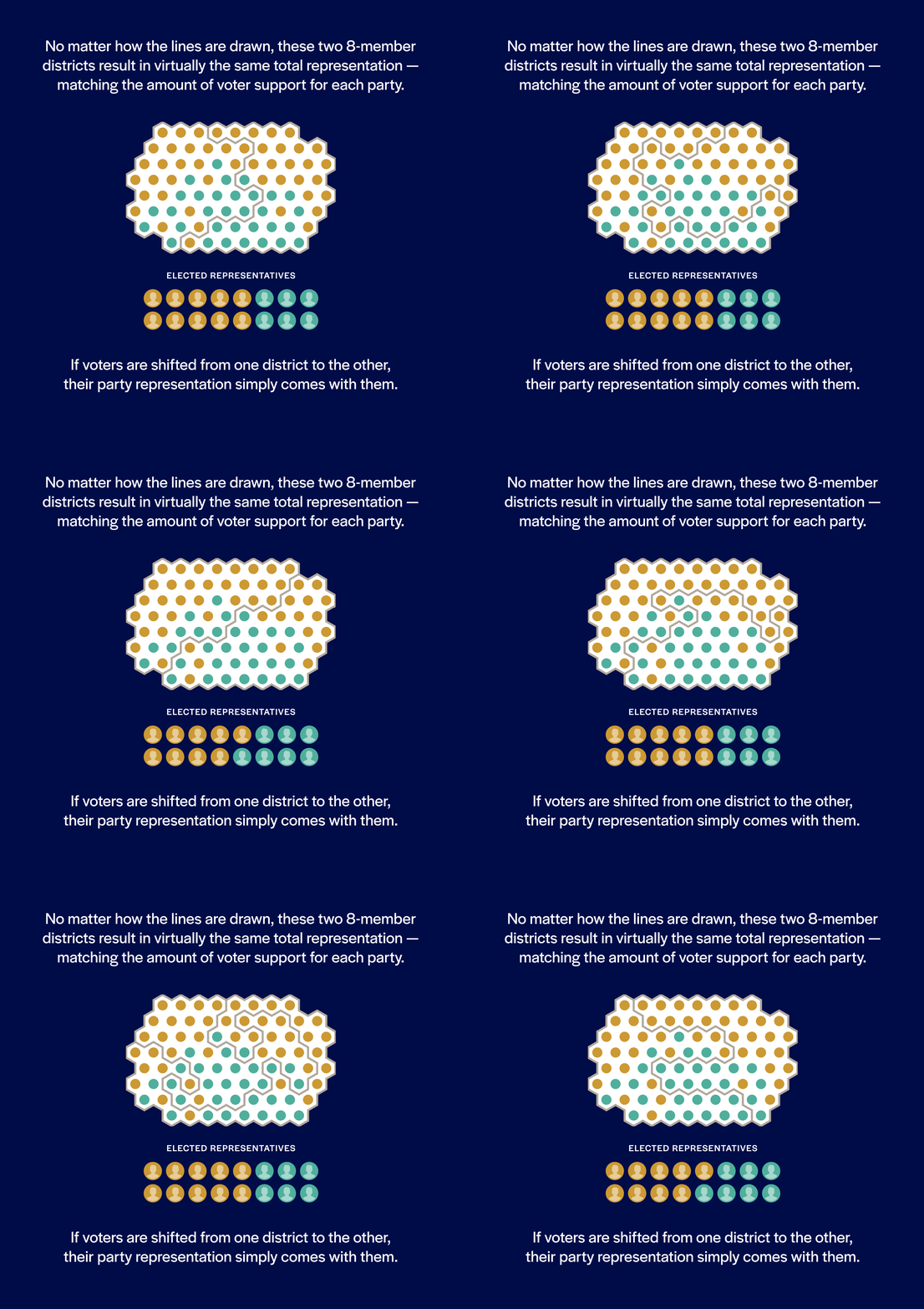
Read the whole report: When Maps Don’t Matter.
That’s just one example of a future-oriented reform agenda that hinges on a free and fair midterm election this fall. I’m sure there are other possibilities that you’re excited about.
Let me know in the comments what your vision for a better democracy, starting next year, could look like.
And as you’re thinking about that better future, re-read Anna Dorman and Aaron Baird’s list of the practical ways you can help defend the midterms: Our strategy to win.

Do you feel more motivated to do all those things? I do.
Every endpoint is a beginning.
Bipartisan pushback to FCC abuses
The FCC is conducting an “early renewal review” of ABC’s licenses, a move that’s just as censorious and threatening as you can guess.
A bipartisan coalition of former FCC officials is pushing back against what they call “an assault on free speech disguised as regulatory process.”
Read about it in USA Today: Former FCC leaders slam agency probe into ABC.
As the administration rescinds the Temporary Protected Status of hundreds of thousands of Haitians, ICE is expected to surge deportation activity among communities the president has scapegoated since the 2024 campaign. This comes just weeks after several ICE-involved shootings made national headlines, raising urgent questions about oversight and accountability as the agency prepares to expand its operations. The human cost is already visible: families are living in fear, with children afraid to go to school for fear of coming home to find a parent gone.
At the same time, Treasury Secretary Scott Bessent has announced plans to scrutinize the tax-exempt status of nonprofits the administration deems politically disfavored — many of which provide critical services to exactly the kinds of vulnerable communities being targeted. Together, these moves reflect a documented pattern of retaliating against people and organizations not for breaking the law, but for standing up to the government.
See The Authoritarian Action Watch.
Worth noting that this graphic understates proportional representation’s invulnerability to gerrymandering. Yes, the lines can be tweaked on the margins, but because those margins are so small it basically can’t be gamed in advance — even the best predictive models about how voters will vote aren’t accurate within the few percent necessary to know which of these maps would be marginally better for one party or the other. We as an electorate are too unpredictable. It’s basically a coin flip depending on who turns out and how swing voters break.
Can't we shift the focus of governance from the federal govt to the States? This shift would reduce authoritarianism and increase government responsiveness.
States are where democracy was supposed to flourish. The federal government wasn’t designed to be responsive, it was designed to provide for the common good (and not the will of the people, which is the responsibility of the states).
It just seems like we are re-arranging the deck chairs on the titanic with all these notions if we aren’t addressing the elephant in the room - the federal government can’t simultaneously serve the country’s interests and the people’s interests. This leads to dysfunction in any organization whenever an executive suite tries to be all things to all people.
Sounds somewhat like the statewide party lists used to elect half of the congress in Germany - the other half being elected by majority vote in each district.