


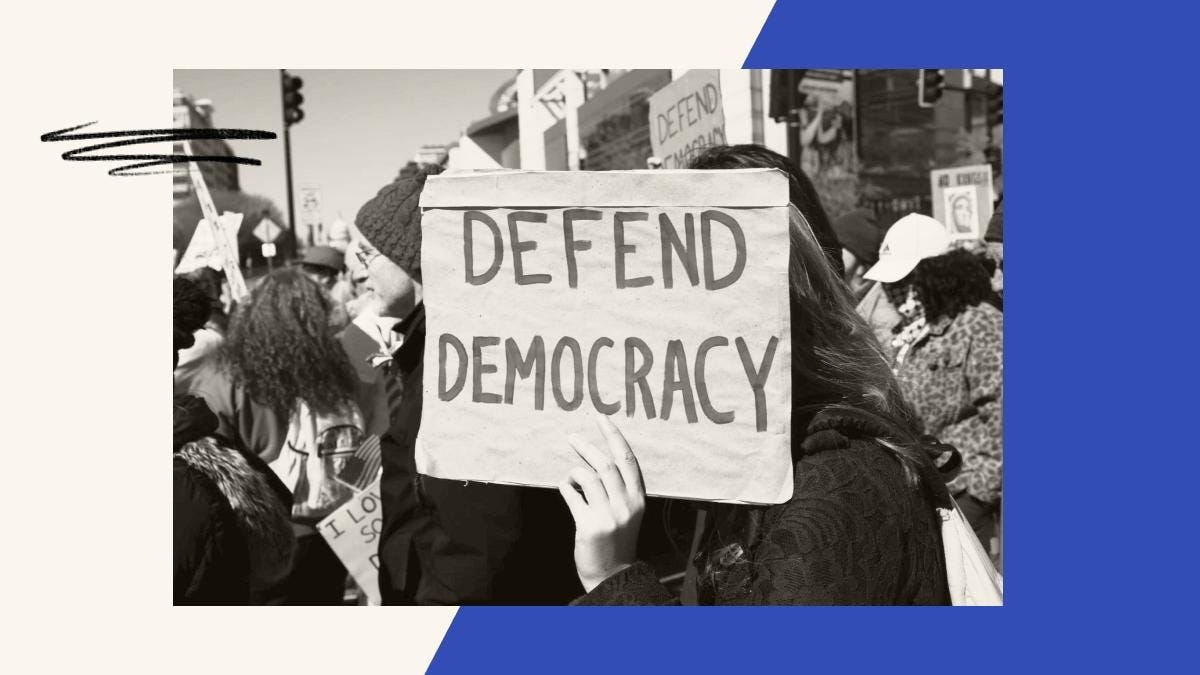
On the second Sunday in April of this year, some 50,000 Hungarians — about one out of every 200 people in the country — spent the day inside polling stations, watching votes get counted. They weren’t election officials; they were volunteers who signed up, took the training, and sat through the count because their movement asked them to and they said yes.
That night, Viktor Orbán conceded.
Of course, the monitors didn’t beat him by themselves. They were among the most visible components of a strategy months in the making in which nearly everyone had a job. For context, for the United States to match that effort per capita, it would take about 1.7 million people, including you.
The administration’s Deceive, Disrupt, Deny strategy is designed to feel overwhelming. But our movement has a strategy too, and most of what it asks of you is simple. What follows is the practical companion to everything this series has argued: the actions that matter most between now and November, organized by the job each one does. Think of it as the page to print out and stick on the fridge.
Read more — Deceive, Disrupt, Deny in full effect
Start close to home. You have the most influence over your own actions and your immediate community: your family, friends, coworkers, faith community or union. That’s where your effort goes furthest.
Find a lane and move. Many campaigns and groups are organizing to defend our elections, and every successful effort has used a wide range of tactics, adjusting as the facts changed. You don’t have to find the perfect tactic. Pick action over agonizing.
Bring what only you can. Your skills, relationships, and resources are the movement’s raw materials. Lean into the actions that fit your daily life and interests, because those are the habits you’ll keep.
With those in mind, here’s how we win.
Organize
Stop voter suppression and election sabotage, starting now. This is the counter to Disrupt.
Double-check your voter registration status, then send the lookup link to friends and family.
Check your state’s key dates and deadlines, and put them in your calendar or sign up for text alerts. Make sure you understand your state’s ID requirements.
Make a plan to vote early and in person, then make sure your community has one too.
Find your people. Once your friends and family are set, decide who you’ll engage over the coming months. Start the conversation about what you can do together.
Show up
Vote for the candidates of your choice. And as an act of solidarity, get out the vote everywhere. This is the counter to suppressed turnout, and the foundation for everything else.
Think through who in your community may need support to vote: a ride, a reminder, time off if you’re an employer, a young person voting for the first time. Set a goal to support as many people as you can.
Sign up to be an election worker. Competent, compassionate poll workers make an extraordinary difference in whether elections run smoothly and every eligible voter can cast a ballot and have it counted.
Sign up to help cure ballots. In most states, voters who make a minor mistake, like forgetting to sign the outer envelope, get a chance to fix it and have their vote counted. Cure programs reach those voters in time to do it (look for opportunities to sign up with the League of Women Voters or Lawyers’ Committee for Civil Rights Under Law in the fall).
Prove
Make the results unquestionable. This is the counter to Deceive.
Serve as a poll observer across the process: logic-and-accuracy testing (where election officials test the machines before voting begins), early vote, election day, mail ballot canvassing, and any audits or recounts. Then share what you saw, however feels comfortable. Firsthand accounts build trust in a way that can’t be replaced.
Be your community’s trusted source. Before and after the election, our communities will be flooded with misinformation about the election process and results. Decide now where you’ll get reliable information — Electionline and Votebeat are good places to start — and be the person who shares it. Learn more about how to combat disinformation here.
Hold the line
Make sure the winners take office. This is the counter to Deny.
The precise work of the post-election period will become clearer as the administration’s strategy plays out, and we will tell you about it as it does. Some of it we can predict now. The officials who certify results answer to our communities, so learn who yours are, and let them know, before the election, that you expect a lawful process. Sign up for updates and alerts so that if the moment calls for mass mobilization, you hear it early.
Everything above is preparation for this stage: a movement that fought, won, and is ready to hold.
Additional resources
How You Can Protect Democracy — our team updates this page every week with resources and priority actions from across the movement.
How to spot (and push back against) federal voter intimidation
Undoing Trump’s golden age of corruption
Protect Democracy’s Amanda Carpenter has a new piece in The Bulwark that is all about the president’s corruption, and how we can still get justice:
No one is allowed to keep the profits of ransacking the public trust. It does not matter if your name is Donald Trump or Bernie Madoff, the same rules should apply to everyone: You loot, you lose.
On July 16, President Trump used a primetime address from the White House East Room — a platform historically reserved for major national moments — to reiterate long-debunked claims about the 2020 election, alleging a “deep state” conspiracy involving Barack Obama and Joe Biden and accusing China of “sinister election meddling.” Experts found no credible evidence to support his claims, while several points merely exaggerated findings publicly released by the intelligence community years ago.
The speech brings into focus the administration’s organizing priority through November — to use disinformation that has the patina of legitimacy to undermine confidence in American elections, and the 2026 midterms more specifically. By raising these claims now, Trump and his allies are also laying the groundwork to, after Election Day, deny election results they don’t like. American elections remain safe and secure, even as the president works to undermine the confidence Americans have in them.


Thanks for this. I sent the Faith Communities Election Defense Toolkit to my parish community organizer.
Thanks for this very helpful report -- and especially thanks for (by its substantive means) helping me to feel at least a bit less frightened. I will, by means of some of your suggestions, help, too.