


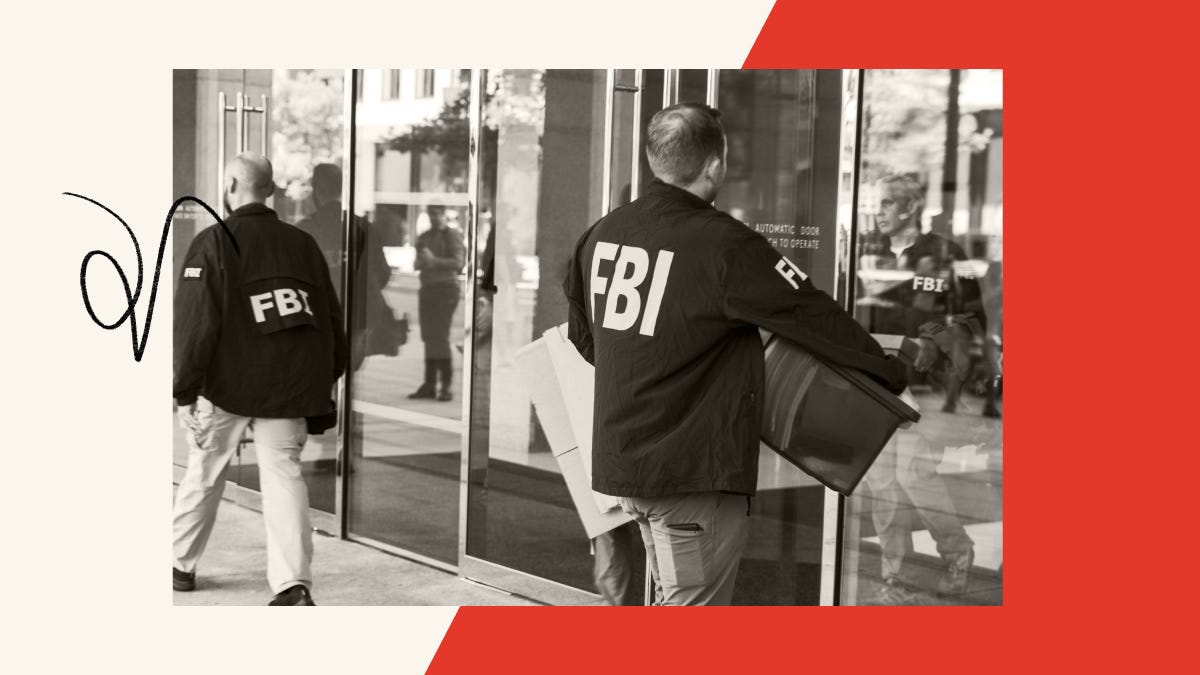
In April, federal prosecutors served Fulton County, Georgia with a grand jury subpoena. They wanted the names, home addresses, email addresses, and personal phone numbers of as many as 3,000 county employees, poll workers, and volunteers — even the drivers of mobile voting buses — who had worked on the 2020 election.
This is what it looks like when the federal government turns its investigative power on the people who run elections. It is not an isolated incident — it is just one example of a coordinated campaign that the administration is running through the Department of Justice (DOJ), the FBI, the Federal Communications Commission (FCC), and even the Pentagon — aimed at the president’s perceived political opponents, the civil society groups that support democratic participation, and the nonpartisan officials who run our elections.
Perhaps the largest shift between the first and second Trump administrations has been this weaponization of law enforcement. It is a core part of the administration’s strategy to disrupt elections by tilting the electoral playing field — one of the three legs of the “deceive, disrupt, deny” strategy that we describe in our Executive Override report.
Read more — How the Trump administration plans to interfere with the 2026 elections, and what you can do about it
The most visible form of the disrupt strategy right now is the rush to erase minority representation through extreme gerrymandering unfolding across the South (with the aid of the Supreme Court). That story is enormous — stay tuned for more on that soon — but it is not what we’re covering here. This piece is about another part of the disrupt strategy that is (understandably) getting less attention right now, but is also very much ongoing — the use of federal investigative, prosecutorial, and regulatory power to silence and sideline the administration’s perceived opponents. In the context of elections, this aspect of the disrupt strategy has three distinct categories of targets:
Political opponents and critics,
Civil society organizations that support democratic participation, and
The nonpartisan election officials who actually run our elections.
Each category serves a different purpose in the broader strategy — but together, they amount to a coordinated campaign to clear the field before a single vote is cast.
Targeting political opponents and critics
This year, according to NOTUS, the FBI created a unit internally referred to as the “payback squad” to pursue cases against the president’s perceived enemies. The name says the quiet part out loud.
The administration has deployed the Justice Department against political adversaries in ways that have no precedent in modern American history. This goes well beyond the traditional rough-and-tumble of partisan politics. We are talking about the use of federal criminal investigations and prosecutions — the most powerful tools the government possesses — as instruments of political warfare.
Time and again, we have seen the Department of Justice pursue Trump’s perceived enemies, sometimes at the explicit behest of the president. Former FBI Director James Comey is perhaps the most prominent example. After the administration’s first attempt to prosecute Comey was dismissed by a federal judge in November, DOJ concocted even more dubious charges. But Comey is not alone — former CIA Director John Brennan, New York Attorney General Letitia James, Sen. Adam Schiff, Minnesota Democratic officials, Federal Reserve Chair Jerome Powell, and others have been targeted by DOJ.
Another recent example: On May 6, FBI agents executed search warrants at the offices of Virginia state Sen. L. Louise Lucas — the state legislator who led efforts to redraw the state’s congressional map to add as many as four Democratic-leaning seats ahead of the midterms. The FBI says the search relates to an ongoing federal corruption investigation involving a cannabis business Lucas co-owns and that the underlying probe predates the current administration. Whatever its origin, the decision to escalate to a dramatic, public raid and the timing at least raise questions, particularly under an administration that has shown, again and again, that it is willing to use federal law enforcement as a political tool.
The weaponization of law enforcement is not confined to DOJ. Defense Secretary Pete Hegseth has now twice opened reviews of Sen. Mark Kelly — most recently on May 10, after Kelly publicly raised concerns about depleted U.S. weapons stockpiles. Hegseth has separately attempted to retroactively demote Kelly from his Navy rank over a video in which Kelly and other lawmakers reminded service members of their duty to refuse unlawful orders. A federal court has so far blocked the demotion.
Meanwhile, the administration has used the FCC to pressure broadcasters, imposed novel interpretations of existing rules to silence political commentary, and appeared to favor media mergers that would concentrate ownership among Trump allies. As we explained in detail earlier this year, this isn’t just about controlling the news — it’s about shaping the information environment heading into the midterms.
Read more — Free speech, ICE, and free elections in 2026
As the election approaches, we should expect continued law enforcement action aimed at discrediting prominent candidates, officials, or the Democratic Party as a whole. This could include investigations or indictments timed to coincide with the election cycle — designed not necessarily to secure convictions, but to dominate the news and tar candidates by association.
And of course, at the same time as federal law enforcement targets the president’s perceived enemies, it has protected or even compensated his allies and supporters. The pattern is not subtle: protection for the president’s allies, prosecution for his opponents.
Silencing civil society
The administration’s weaponization of investigative and enforcement authorities extends well beyond high-profile political leaders. It reaches into the civil society organizations — advocacy groups, voter registration organizations, nonpartisan civic engagement efforts — that are part of the fabric of American political life.
The administration began undermining nonprofits just weeks into Trump’s second term, but the assault accelerated sharply in September 2025 after the murder of Charlie Kirk. The president issued National Security Presidential Memorandum-7 (NSPM-7), which painted organizations on “the Left” as part of a network of dangerous extremists. A subsequent memo from Attorney General Bondi directed DOJ to create and maintain lists of these “domestic terrorism organizations” based on their ideological beliefs — and to map their “nodes,” “cells,” and “funders.”
This infrastructure for ideological targeting is particularly dangerous in an election context.
Nonprofit organizations play a lawful — and significant — role in registering voters, educating them about issues, and supporting get-out-the-vote efforts. The administration has already taken aim at voter-registration groups by barring nonpartisan civic engagement organizations (like the League of Women Voters) from registering new citizens at naturalization ceremonies. A legal challenge to this policy is now pending.
More recently, a federal grand jury in Alabama indicted the Southern Poverty Law Center (SPLC) — a civil rights organization with a decades-long record of investigating violent extremist groups — on wire fraud and money laundering charges built on a questionable theory that paying informants to infiltrate Klan and neo-Nazi groups amounted to supporting them. SPLC appears to have been singled out for retaliation because it has accused some Trump allies of promoting extremist ideologies. Even Rep. Michael McCaul (R-Texas), a former federal prosecutor and senior House Republican, has publicly said that SPLC is “being targeted for obvious reasons.”
But the attack on SPLC should also be understood as a warning to other nonprofit groups, including groups that work to protect the ability of eligible voters to participate in elections. Even if these charges don’t result in convictions, they create a climate of fear that risks deterring groups from participating in lawful voter-education and voter-registration activities.
That’s the point. The goal isn’t necessarily to win in court. It’s to make the cost of democratic participation so high that organizations stop trying.
Intimidating election officials
Perhaps the most dangerous category of targeting is the least visible: the campaign against nonpartisan election officials.
Trump signed an executive order targeting former Cybersecurity and Infrastructure Security Agency (CISA) director Chris Krebs for the crime of defending the integrity of the 2020 election. Then-Attorney General Bondi appointed a U.S. attorney to lead nationwide investigations of election officials — the same prosecutor whose office obtained the search warrant for the FBI’s January raid on the Fulton County elections warehouse. And DOJ has reportedly explored bringing criminal charges against election officials for failing to meet cybersecurity standards that the administration itself defined — based not on evidence of actual security failures, but on assumptions driven by conspiracy theories.
On March 31, President Trump signed an executive order that directs DOJ to “prioritize the investigation and prosecution” of election officials and others who issue federal ballots to anyone not on a new Department of Homeland Security-maintained citizenship list. The eligibility list is to be drawn from federal databases with well-documented accuracy problems. The order — which is the subject of multiple ongoing legal challenges — requires no showing of criminal intent.
Read more — The SAVE tool, explained
And as already mentioned, DOJ is demanding the names, home addresses, email addresses, and personal phone numbers of thousands of individuals who worked on the 2020 election in Fulton County, even in a volunteer capacity. In a motion to quash the subpoena, the county has described it as a campaign “designed to target, harass, and punish the President’s perceived political opponents.”
This playbook of targeting low-level election workers with threats and harassment is not new, but it is now being executed at scale by the federal government itself. And it is happening in multiple states that are central to Trump’s 2020 conspiracy theories. The FBI obtained a grand jury subpoena for records related to Maricopa County, Arizona’s 2020 audit in March, and the Milwaukee Journal Sentinel reported on May 9 that an FBI agent had interviewed Wisconsin Elections Commission deputy administrator Robert Kehoe about how Wisconsin runs its elections.
The effects are real and measurable. The Brennan Center’s 2025 survey of local election officials found that 59 percent reported fear of political interference in their ability to do their jobs. 46 percent were concerned about politically motivated investigations. In a 2024 survey, 21 percent said they were unlikely to continue serving through the 2026 midterms. The departure of experienced, nonpartisan election administrators is itself a form of election manipulation. It creates vacuums that can be filled by partisan actors more willing to go along with the wishes of election deniers.
And at the same time the administration punishes those officials who follow the law, it rewards allies who break it. In Colorado, Tina Peters — a county clerk convicted of four felonies for giving unauthorized access to voting equipment — was sentenced to nine years in prison. The Trump administration has sought to free her, with DOJ filing a statement of interest supporting her petition and Trump publicly declaring her innocent.
The message to election officials could not be clearer: Those who resist the administration’s agenda risk investigation and prosecution. Those willing to subvert elections in service of the president’s conspiracy theories will be protected and celebrated.
What can be done
The strategy works only if its targets stay quiet and isolated, and the rest of us treat it as business as usual. But neither has to happen. Here’s how targets can refuse to be isolated and how the rest of us can refuse to normalize it.
For civil society organizations: Prepare to fight back and build coalitions now, before the pressure arrives. The SPLC’s decision to plead not guilty and immediately go on offense — challenging false statements by the acting Attorney General and signaling a vindictive-prosecution defense — is the right model for individual responses. And, as we learned from studying how universities and law firms responded to Trump’s attacks, standing together is just as important. Shrinking back doesn’t buy safety; it buys ongoing servitude. For organizations looking to strengthen their own readiness, we have a Nonprofit Toolkit with primers covering government investigations; for organizations looking to strengthen the security and safety of collective action work, our comprehensive guide walks through the operational steps to keep you and your coalition partners focused on your mission.
Read more — A natural experiment in how to survive Trumpism
For election officials: The strategy only works if its targets are isolated. Fulton County’s public motion to quash — filed, deliberately, without seeking a seal — turned an attempted intimidation into a public defense of the rule of law. The multistate lawsuit against the March 31 executive order did the same thing: when 24 attorneys general file together, none of them is the lone target. Both are models to follow. Protect Democracy, the Brennan Center and others have resources and legal support available. You are not alone.
For members of the legal and law enforcement communities: Your professional responsibilities are not abstractions. The Justice Manual, the rules of professional conduct, your own oaths — these were built for moments like this one. Get sharp on what they require, and treat politicized directives with skepticism rather than the presumption of regularity to which DOJ used to be entitled. Hold colleagues accountable when they abuse the power entrusted to them, and support the ones who refuse — like the prosecutors pushed out in the fallout from the Comey prosecution and the other career federal lawyers across the country quietly saying no. They are paying a professional price for the rule of law, and the legal community owes them more than admiration. For those who have paid such a price, organizations like Justice Connection are there to support you. And the Committee for Safe and Secure Elections has resources for members of the law enforcement community who are looking for materials to understand how you can support and protect election workers and voters in this challenging environment.
For all of us: When an election official is threatened for doing their job, that is an attack on your right to vote. When a voter registration organization is sued for registering voters, that is an attack on your democracy. These are not someone else’s fights. We need to show up. The day of action this weekend in response to the attack on minority representation in the South is one place to start.
The disrupt strategy works by making people who run our elections — and the people who support them — feel alone. They aren’t. And the more clearly and loudly we say so, the less their strategy works.
This is part four in our Executive Override series on threats to the 2026 election and how to combat them. You can see all editions in this series here. If you're not subscribed, make sure to do so and you'll get future ones in your inbox.
The closure of Alligator Alcatraz is a meaningful victory
ICE has now formally set a target of 1 million deportations per year in its congressional budget justification. The pace of deportations reflects that ambition: through the first six months of fiscal year 2026, ICE carried out 234,236 removals — roughly 74% more than at the same point in either of the two prior years.
On May 12, though, news broke that one of the signature detention centers of the second Trump administration, “Alligator Alcatraz,” was set to close after rising costs, reports of inhumane conditions, and legal challenges. “Alligator Alcatraz” was more important for the administration and its supporters symbolically than as an actual detention facility, but that’s precisely what makes its closure so meaningful.
Even as the administration continues to target communities across the country in immigration raids, their state partners are facing the meaningful realities of keeping detention centers up and running amidst backlash from taxpayers wondering where their money is going. One facility closing does not change the overall picture, but it does speak to how unsustainable this aspect of the authoritarian project is.
See the Authoritarian Action Watch.
