


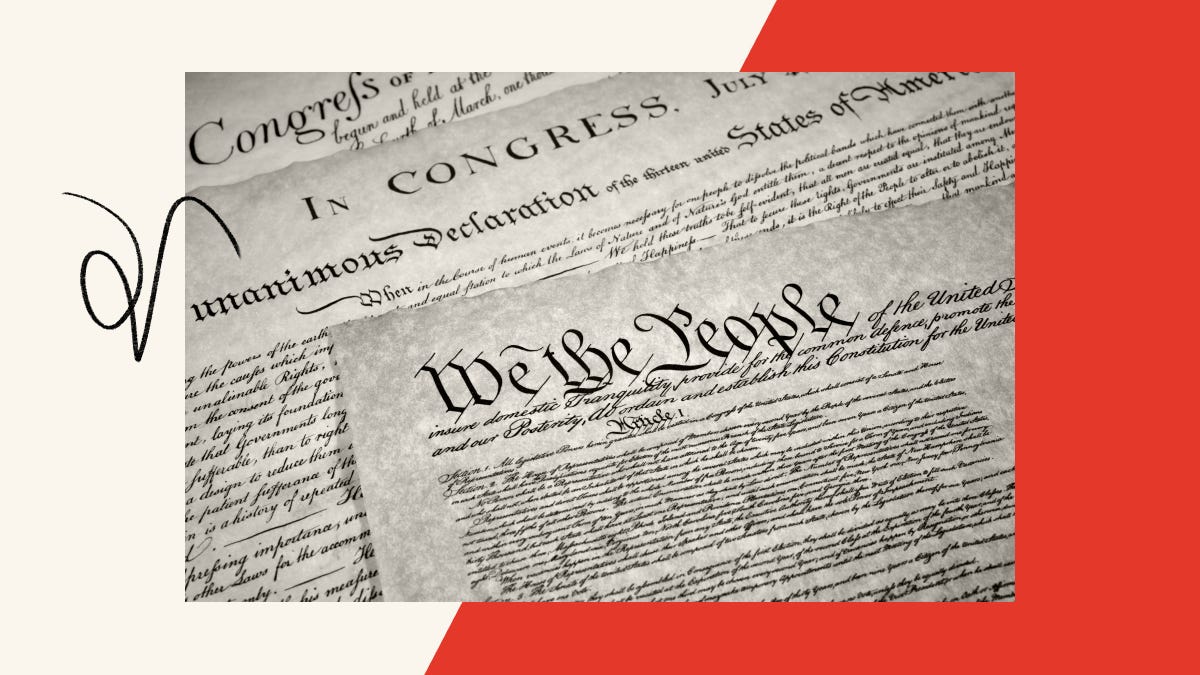
Governments derive their “just powers from the consent of the governed.” The founders’ approach to that promise was both brilliant and flawed. A constitution that excluded slaves and women from participation was nonetheless set up with the understanding that neither government nor its people are stagnant. We change. We grow. We amend. But a government that represents us was always the point. Two hundred fifty years in, it’s fair to ask whether that promise still holds.
The American people seem skeptical, to say the least. Poll after poll shows deep pessimism about whether our political system is working. Two-thirds think the Founders would be disappointed in the country today. Americans distrust every major political institution, with the possible exception of the military: Congress, the Supreme Court, local governments, the federal government. Clear majorities expect a future where we are more divided politically, have a worse standard of living, more economic inequality, and less freedom. A rapidly growing share feel that neither major political party represents them at all, with independent registration now outpacing both parties in much of the country.
And perhaps worst of all, we have lost our sense of agency. Nearly two-thirds of us feel we have little or no “direct or indirect role in what America becomes over the next 50 years.”
This is not ordinary economic anxiety or partisan midterm divides. It is a crisis of representation. A widening gap between our founding promise and the lived reality of a political system that an increasing number of Americans experience as something that happens to us, not something we get to shape.
The crisis has more than one author
One reason for this is obvious. Since first elected in 2016, Trump has aimed to remake our country in ways very few Americans want. He has only supercharged that effort in his second term, deploying his Project 2025 authoritarian playbook. Ignoring our checks and balances, he’s upended our economy, enmeshed us in foreign wars, ignored the law, and dismantled government programs that protect the health, safety, and finances of the American public. Although he’s a term-limited president, he behaves like a despot, insisting that he gets to make these monumental decisions, steamrolling Congress despite the fact that the Constitution specifically assigns it these powers.
In the face of plummeting popularity, he’s aiming to deny voters a meaningful chance to choose representatives who can hold him democratically accountable. Trump’s Executive Override strategy has weaponized the power of the federal government in an attempt to block our ability to exercise the ultimate check — throwing out those in Congress who are enabling Trump. Through deception, disrupting the conduct of our elections, and denying results he dislikes, Trump’s goal is not merely to win elections but to make our elections incapable of serving as a genuine check on his power.
Read more — How the Trump administration plans to interfere with the 2026 elections, and what you can do about it
Trump’s had plenty of help in this, and not just from his allies in Congress. His fellow partisans on the Roberts Court have spent two decades contracting the sphere of democratic self-governance: gutting the Voting Rights Act, enabling extreme gerrymandering, dismantling the government Congress created, inventing presidential immunity, and allowing unlimited spending to drown out the voices of ordinary voters.
Trump’s private-sector allies among media, tech, and AI oligarchs are spending hundreds of millions to prevent the public, through our representatives, from having any say over how those technologies are deployed. Decisions are now being made about artificial intelligence that will shape American life for decades, and they are being made by a handful of people accountable to no one but themselves.
And corruption runs through all of it. Starting with the first family and extending through government insiders and their well-connected allies, public office is being used to cut private deals, enrich the powerful, and foreclose accountability for those at the top. All this is being done at the expense of the rest of us; those who can’t fund the ballroom, buy seats at crypto dinners, or spend hundreds of millions through super PACS are given little say.
Add it up, and the pattern is clear: Concentrated power, across multiple institutions and actors, is systematically eliminating the mechanisms through which ordinary Americans exercise control over our collective future. No wonder so few people think their voices matter.
Not for the first time
We have been here before. The story of American history is one of possibility and hope. The Founders did not create a perfect democracy, and Americans have never been satisfied with what is. In every generation, we strived for what can be. Progress has been far from linear, but in each generation we have demanded and created a more fulsome democracy.
This fight started 250 years ago, when, facing destruction by the British army, the Founders didn’t just fight against the king — they fought for a government by and for the people. Articulating, for the first time with the force of law, that government must derive its legitimacy from the consent of the governed.
In the darkness of the Civil War, Lincoln understood that preserving self-government required expanding it: “In giving freedom to the slave, we assure freedom to the free — honorable alike in what we give, and what we preserve. We shall nobly save, or meanly lose, the last best hope of earth.” A month later, Lincoln signed the Emancipation Proclamation. And out of his charge came Reconstruction and the amendments that remain the constitutional jewel of American democracy.
In 1919, after 70 years of organizing, World War I made the contradiction between fighting for democracy abroad and denying it to women at home impossible to sustain, and Americans adopted the 19th Amendment to give women representation.
And in 1965, after decades of terror and struggle, the footage of state troopers beating peaceful marchers on the Edmund Pettus Bridge shocked the national conscience and gave Congress the moral obligation to finally pass the Voting Rights Act, making good on the promise of Reconstruction.
Read more — Why collective action is the only way
The pattern is consistent. Generations of Americans stood up to say: We must not despair in crisis, we must demand change. The question at 250 is whether our generation will do the same.
Working toward a government where we have a say
The road to a renewed political system that genuinely represents us will not be straight or short. But we know where it begins. Our charge over the coming months is to prevent Trump’s Executive Override strategy from denying the people a meaningful say in the midterms and a chance to decide whether those in power have our consent. Together, we can insist that in these midterms, eligible voters can cast ballots, have them counted, and see winners take office — without voter intimidation, without the machinery of the federal government interfering in the count, and without the president and his allies overthrowing results they dislike.
From there, we can build toward that fuller representation.
Where a Congress of elected representatives sets national policy on major questions, so that one man cannot unilaterally send armed forces into American cities, upend the economy by executive decree, drag the country into foreign conflicts without democratic authorization, or pilfer from the public to enrich his friends and family. And one in which the Supreme Court helps ensure a fair democracy as opposed to serving as handmaiden to its demise.
Where we have a genuine democratic process for deciding how artificial intelligence reshapes American life — a conversation conducted by the public and its elected representatives, not by a handful of autocrats and oligarchs.
Read more — A steel mill the president might not be able to seize
And where a new system of representation gives Americans meaningful choice, and translates votes into power with reasonable fidelity, so that everyone’s voice counts. That means moving toward proportional representation and reforms that would make our political system reflect the full range of views among the American people, rather than forcing them into a binary that fewer and fewer find adequate.
As we mark America’s 250th, our charge isn’t just to defend what we have been handed down — it’s to remember that we’re still allowed to want more, that questions as large as how we govern ourselves remain ours to decide together rather than have one man decide them for us.
Generation after generation of Americans, in moments darker than this one, insisted on that. They did not wait for the crisis to pass. They used it. Now it is our turn.


The current Supreme Court is responsible for much of the loss of our democracy. We have six right wing ideologues thanks to the Republicans and the Heritage Foundation, who is also the creator of the 2025 Project.
" A rapidly growing share feel that neither major political party represents them at all, with independent registration now outpacing both parties in much of the country."
This fact really irritates me.
Obviously, neither political party is perfect.
But the dreaded "worse standard of living, growing economic inequality and less freedom" are all consequences of Republican (and especially MAGA Republican) rule.
At some point, you've got to read some history. It is the Democratic party, and ONLY the Democratic party, that has fought against those issues. We're also the only major party that is pro-union, pro-diversity, pro-meritocracy, pro- CONSTITUTION and pro-RULE OF LAW.
Honestly.
Are people really still copping out of critical thinking by insisting that "all politicians are equally bad"?