


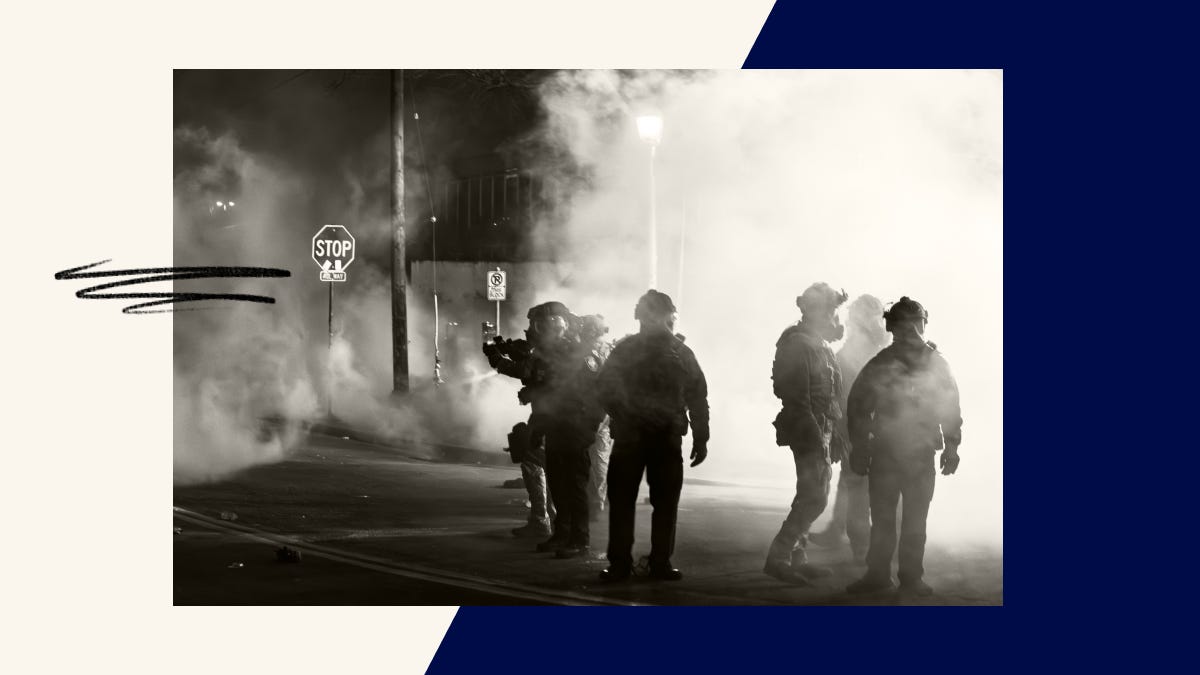
In late September of last year, President Trump declared that Portland was “war-ravaged” after Portlanders protested his deployment of the National Guard there. It wasn’t true.
That didn’t stop the Trump administration. To make good on the president’s claims of violence, the Department of Homeland Security (DHS) brought pro-Trump influencers and its own videographers to the Portland Immigration and Customs Enforcement (ICE) facility, where many of the protests had occurred. As the cameras rolled, DHS fired huge quantities of chemical munitions. When the influencers filmed the smoke-filled streets, it looked like a scene Trump had only imagined.
But the streets of Portland aren’t a movie set, and chemical munitions have real consequences. The toxins, released again and again at the ICE facility without real justification, caused grievous physical and emotional harm to community members, including families living in the affordable housing complex across the street.
Residents and their landlord sued to stop the rampant use of these munitions, represented by Protect Democracy and co-counsel. The judge who granted a preliminary injunction highlighted the shocking nature of this propaganda-creation behavior by law enforcement officers. A Ninth Circuit panel later stayed that decision, but the government has never contested that it deployed chemical munitions during this period for the sole purpose of creating content, including staged videos that DHS posted to its Instagram account, to support the president’s false story about Portland. On July 10, we’re back before the Ninth Circuit, asking that the injunction be reinstated so our clients can be safe in their homes.
Learn more — Challenging the federal use of chemical weapons against Portland residents
The government is now the superspreader
Portland is one example of a much larger operation. DHS has invited influencers on ride-alongs and inside ICE facilities in cities around the country. It has produced glamorized depictions of ICE raids, set to dramatic music and edited to omit footage of U.S. citizen children being detained. The White House has released videos depicting the war in Iran as a video game or a movie trailer, pointedly omitting any depiction of what happens when the bombs hit.
This strategy has a second half: suppressing the reporting that would undercut the story. The administration excluded local Portland press from the ICE facility while granting access to right-wing influencers. It adopted rules that exclude mainstream media outlets from covering the Pentagon. And the Federal Communications Commission, under Chair Brendan Carr, has repeatedly used threats of regulatory authority to push broadcasters toward the president’s preferred coverage — on the Iran War, and even on late-night TV.
We have been fighting election lies since 2021, when Protect Democracy launched Law for Truth to hold those who knowingly or recklessly spread election disinformation accountable for the damage they cause. But the biggest superspreader of election lies today is the federal government itself, assisted by authoritarian allies in state governments and by many of the same people who have been lying about elections since 2020. In fact, many of those people are serving in the administration to help it elevate these false narratives. Election denier Heather Honey now serves as DHS Deputy Assistant Secretary for “Election Integrity;” Harmeet Dhillon, who represented Trump in litigation to overturn the 2020 election, is now Assistant Attorney General for Civil Rights. (There are many more.)
As the administration works to ensure its preferred candidates take office after the midterms — regardless of who the voters choose — this propaganda machine will be aimed at the election. As we explain in Executive Override, the plan is to deceive the public about the legitimacy of the elections, creating a pretext to disrupt election processes and, eventually, to deny the results. Content that depicts a false version of events (or places real events in a false context), as in Portland, will be a key part of that deception.
Read more — Inside the federal campaign to sow distrust in elections
We know that Trump will claim fraud wherever his partisan allies lose, and that the pro-Trump ecosystem will back that claim up with manufactured content built on the lies already circulating about noncitizen voting and mail balloting. We may also see propaganda created to justify sending federal forces to key voting districts — showing they are needed to quell out-of-control protests or to control crime.
Rather than using the bully pulpit to persuade Americans, the administration seeks to control the information environment — a kind of manipulation that effectively bypasses the consent of the governed.
Every election lie falls into one of five categories
Knowing the playbooks is the best protection. Researchers at the University of Washington have found that election lies always fall into one of five categories:
False evidence: The rumor is based on fabricated or manipulated evidence, such as false statements, deceptively edited content, and synthetic (AI-generated) content.
Misinterpreted evidence: The rumor is based on real evidence that has been mischaracterized or misinterpreted to create a false impression.
Omitted remedies: The rumor highlights real or perceived issues with election administration but overlooks or obscures remedies, such as downstream security measures, to imply an untrustworthy process or untrustworthy results.
Exaggerated impact: The rumor exaggerates the impact of real or perceived issues with election administration to imply an untrustworthy process or untrustworthy results.
Falsely attributed intent: The rumor falsely attributes intention to real or perceived issues with election administration to imply voter or election fraud.
Once you know the framework, the recycling becomes almost comically predictable. The most common category is misinterpreted evidence, when the evidence is real, but its meaning is distorted. Think about the ordinary, effective use of Sharpies on ballots recast as a plot to disenfranchise in-person voters, or accurate vote totals shifting over the course of the count recast as proof of a steal. This year, AI will likely help false evidence become a more common category, so it’s worth reviewing best practices from our partners at the Brennan Center for evaluating potentially AI-generated election content.
2000 Mules, with subpoena power
In many ways, none of this is new. Remember 2000 Mules, the “documentary” released by election deniers that falsely portrayed footage of legal voting at dropboxes as evidence of a nationwide network of “ballot mules” stealing the 2020 election? Millions of people saw it, and it surely fueled mistrust in our election system — but it led to no prosecutions and had no legal effect on the election.
What is starkly different in 2026 is that the federal government itself is executive-producing the movie. Imagine the equivalent in 2026: The White House posts a video that it says portrays election fraud. Millions of Americans see the false allegation, at immeasurable cost to anyone shown in the footage. The Department of Justice will file criminal charges against those it decides to blame. The White House’s allies will seek to use the video in court and in Congress to fight certification of the election results. And they will use it to win in the court of public opinion.
Each of us can do our part. First, learn the five categories. And when the disinformation comes, name the category to your family, your followers, your readers, before the lie sets in. Keep consuming, paying for, and elevating independent media, so that the lies don’t go unanswered. And speak up now when you see government use its power to suppress speech from those who oppose it. Their playbook depends on duping Americans, but we don’t have to let that happen.
What we’re reading
On Courage: How to Be a Dissident in an Age of Fear, a new book from Julia Angwin and Ami Fields-Meyer, offers a roadmap to political courage with practical steps for anyone who wants to take collective action.
Together, we can work to save our multiracial democracy and reverse the cycle of capitulation that authoritarians need to thrive.
Supreme Court rulings extend the president’s control over federal agencies
On June 29, the Supreme Court overturned Humphrey’s Executor v. United States, the 91-year-old precedent that has allowed Congress to shield independent agency leaders from removal except “for cause.” In a 6-3 ruling, the Court found that Trump’s 2025 firing of Federal Trade Commissioner Rebecca Kelly Slaughter without cause was lawful. Writing for the majority, Chief Justice Roberts dismissed the precedent as “a result in search of a rationale” and declared that “subordinates who exercise the president’s power are subject to removal by him.”
The ruling’s reach extends far beyond the FTC. For decades, Humphrey’s Executor has protected roughly two dozen agencies designed to operate above partisan politics — including the FCC, the Nuclear Regulatory Commission, and the National Transportation Safety Board. Stripping their leaders of removal protections clears the way for a president to purge regulators who resist his agenda and replace them with loyalists, collapsing the independence that allows these institutions to police elections, markets, communications, and safety without fear of retaliation.
See the Authoritarian Action Watch.


Yes. My BS meter is very active.
Believe no one.
The FIX is in.