


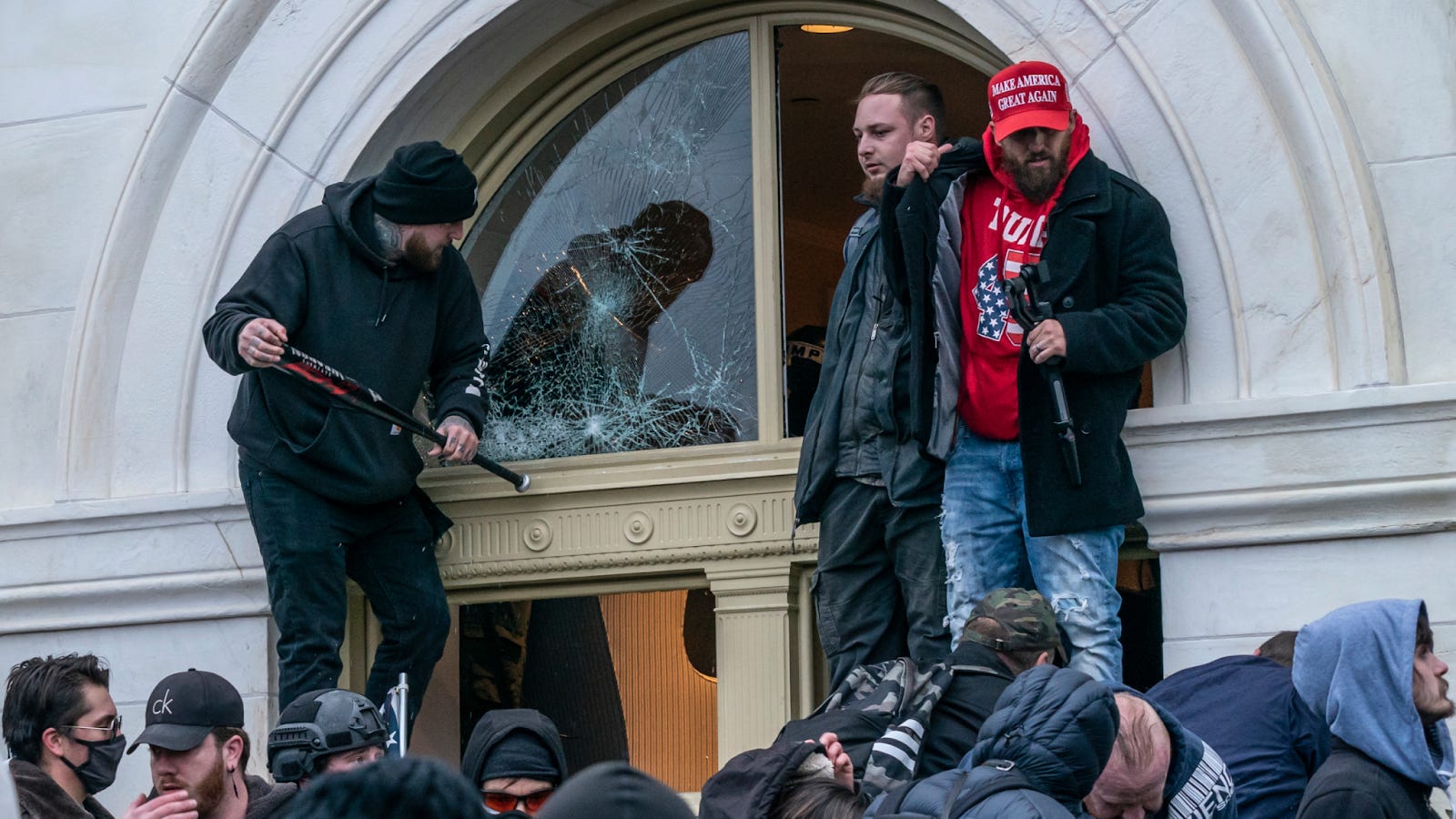
Three days ago, Donald Trump successfully deposed a head of state by force. Five years ago today, he tried and failed to do the same thing here in the United States.
I don’t want to over-interpret the parallels between the two putsches, one failed and one successful. Most obviously, Nicolás Maduro was himself a brutal dictator whose continued hold on power was illegitimate,1 while Joe Biden had recently been freely and fairly elected president by the American people. Together, though, the two events illuminate the core ethos of Donald Trump’s movement: that power alone should be what matters.
That the right to rule should belong to those willing and able to dominate others by force.
That might is right.
Stephen Miller, Trump’s most powerful aide, told CNN’s Jake Tapper yesterday:
We live in a world, in the real world, Jake, that is governed by strength, that is governed by force, that is governed by power. These are the iron laws of the world since the beginning of time.
Miller was talking about the White House’s new threats to illegally seize and annex Greenland from Denmark, an act of war that could destroy NATO and risk military conflict with our longest-standing allies. The logic, though, explains the entire worldview animating the authoritarian faction. Power is self-justifying.
To believe that strength is an authority in itself — that the right to rule comes simply from the ability to seize it — is, it must be said, contrary to our country’s DNA. The U.S. was explicitly founded as a rejection of the unbroken line of monarchical rulers, stretching into antiquity. All of those kings’ authority rested on their ability to dominate others through strength, force, and power. We sought to assert the opposite, to be “a government of laws, not of men” as John Adams put it.
Read the Declaration of Independence again. (I recommend doing so regularly these days.)
We hold these truths to be self-evident, that all men are created equal, that they are endowed by their Creator with certain unalienable Rights, that among these are Life, Liberty and the pursuit of Happiness. That to secure these rights, Governments are instituted among Men, deriving their just powers from the consent of the governed.
Emphasis on that key clause is mine.
Certainly, our country has struggled to live up to this founding ideal. That passage above excluded, explicitly, women and, implicitly at the time, people who weren’t white. We also have a long history of domination attempts and military coups abroad.
Through it all, though, the underlying ideal has always been the guiding principle. The north star to which our country aspires. Our Constitution was and remains a powerful assertion that might does not make right. That authority comes delegated, temporarily, from the people. And that the legitimacy of our rulers comes not from their ability to dominate the people, but rather from their acquiescence to the limited authority we the people have granted.
Every single president before Donald Trump respected (or at least claimed to respect) that principle.
If Trump and Miller get their way, if they tip the world back into the pre-democracy paradigm of raw power and conflict, hundreds of thousands, if not millions, will die. In fact, we are already seeing the carnage. As Oona Hathaway writes:
Last year marked the 80th anniversary of the 1945 United Nations Charter, a document signed by 51 nations at the close of World War II. The signatories pledged to act “to save succeeding generations from the scourge of war.” The great powers have not gone to war with one another since, and no U.N. member state has disappeared as a result of conquest.
But over the past decade, that peace has begun to unravel. Today, it is on the precipice of collapsing altogether. If that happens, the consequences will be catastrophic. We can already see the devastating cost: According to my calculations, from 1989 to 2014, battle-related deaths from cross-border conflicts averaged less than 15,000 a year. Beginning in 2014, the average has risen to over 100,000 a year. As states increasingly disregard limits on the lawful use of force, this may be just the beginning of a deadly new era of conflict.
At the same time, just because Trump and Miller believe that might is right, that does not make it so. There is a paradox to this view of power, one that makes this administration much weaker than it would appear — or claim — to be.
As much as the president aspires to rule through the right of force, he still does not. The Jan. 6 coup failed. We have reason to believe that similar coup attempts in the future would also fail (at least for now). Trump does not, even today, hold the sort of arbitrary power that he sought five years ago. Trump is in office because he won the 2024 election, not because he used violent force to try to take the 2020 election. This administration’s authority is still entirely on loan from the American people. It is still an administration, not a regency or dictatorship. Its authority comes from law, not force. (One small example: Recent legal wins blocking the administration’s use of force, particularly in Chicago, prove this to still be true.)
Donald Trump may have returned to the White House, but the broader effort to turn democracy into dictatorship is far, far from complete.
The real struggle is still ahead. The most important story of 2026 will be who decides the makeup of Congress starting next year: Will it be the American people, through lawful and democratic means, as it has been for two and a half centuries? Or will it be the people currently in power imposing their will on the rest of us, regardless of how we would vote?
This will be a difficult process. The administration is almost certain to use federal power to attack the midterm elections with the same lawless enthusiasm as the strike on Caracas. Their tactics will likely include — but not be limited to — armed law enforcement, National Guard, and federal troops.
The coming assertion of might over law and elections will only fail if it is resisted by a broad coalition of people committed to the principles of the Constitution.
Our task, the moral struggle of our time, is the same as it was in 1776. To prove that the power of law is greater than the power of men. To maintain our most precious heritage handed down, uninterrupted, for 250 years: a form of government where might does not automatically convey legitimacy. Where the people, not the king, are sovereign.
Good summary re Our Task 😎👍 Pee Wee German can kiss my ass
Thank you. Good luck in the coming years, to you and to the world.