


A week ago, the president unilaterally launched a full-scale war to kill Iran’s leadership and overturn the Iranian regime.
Our country’s founders would be horrified. The Constitution was designed to prevent an unchecked, imperial leader from dragging the country to war on a whim. Congress was supposed to share warmaking powers with the president to prevent exactly this scenario. (Read about why: The founders gave the first branch war powers for a reason.)
Our constitutional system of checks and balances over warmaking is functionally dead. With Congress abdicating on Iran, the president is unbound and acting like it. Donald Trump wants you to believe he is already an imperial ruler able to shape the world to his whim.
So are we — and our democracy — already screwed?
No.
The president’s projection of strength, his bravado in starting this war, is not just hubris. It is an illusion. In truth, this administration is currently weaker than it has ever been. And many of the most critical guardrails in our democracy — especially those around elections — are still (relatively) intact. Instead of the hard work to continue consolidating power, Trump instead just gambled his presidency on a quagmire in the Middle East.
Meanwhile, the authoritarian project, which had been stalling since last summer, is suddenly facing the most pronounced string of losses yet (for my whole list, read to the end).
We are still so far from safety. It’s still going to take all of us to ensure that democracy endures over the next three years. But, big picture, authoritarianism is losing.
The spectrum of hard and soft guardrails
How can Trump be so unchecked abroad and still not have consolidated autocratic power at home? It’s because not all limits on presidential power are the same.
Our democracy, like any democracy, has a whole bunch of guardrails. Some are hard and some are soft.
I think of soft guardrails as the things that a president “must not,” “traditionally does not,” and “legally isn’t allowed to” do. We often say a president “can’t” go to war without Congressional approval, unilaterally shutter agencies, or usurp the power of the purse — but really we mean he’s not allowed to do those things. They are against norms, against the law, or even against the Constitution. But unless there’s someone to stop him, semantically speaking, he can do them; the president can violate the Constitution.
Soft guardrails matter, but they’re the first thing to go on the slide to dictatorship.
Hard guardrails are actual barriers, not just rules. In order to abuse power, a president needs to literally have the manpower, resources, and capacity to carry out the abuse.
Or, alternatively, hard guardrails can be countervailing actors in a system able to firmly push back. The courts, the civil service, Congress when it does its job. States passing laws to protect their citizens. Protestors expressing their First Amendment rights who refuse to be intimidated.
Think of it as a series of defensive barriers that get increasingly less permeable as you go from “he’s not allowed to do that” to “no, he actually can’t do that.” An authoritarian obstacle course.
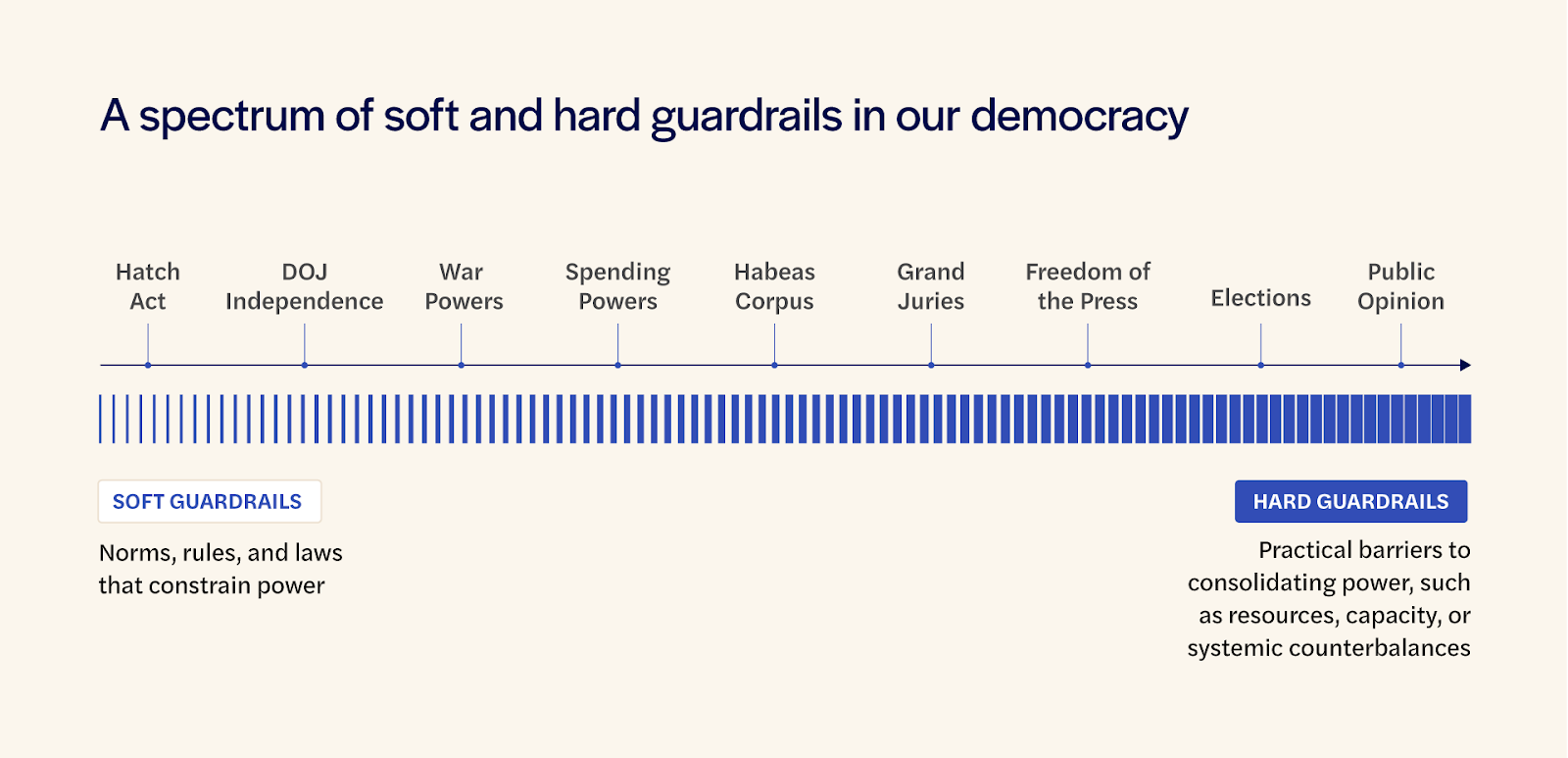
How far an autocrat is able to go from left to right, how far he’s able to get through the increasingly hard barriers, is ultimately up to all of us.
In the United States, we’re still only maybe halfway through the spectrum. Many of the most important hard guardrails are — as of March 2026 — still at least somewhat intact.
There are still many practical barriers to Trump interfering in elections
Consider the many hard guardrails that prevent a president from interfering in elections.
First, the federal government — which is the only thing the president has direct control over — has a very limited role in election processes. Elections are, per the Constitution, run at the state and local level.
Donald Trump cannot order your local elections officials to do anything because your local elections officials do not work for him. He cannot force them to break the law and he cannot fire them if they refuse. If the president tries to issue an order instructing local officials to interfere in an election, they will be legally required to ignore that order — same as you would be if the president tried to issue an order telling you to interfere in the election. And if they break the law, they could face criminal charges under state law (the consequences of which the president, who can only grant pardons for federal crimes, has no power to shield them from).
Yes, there are some areas where the federal government, by law, plays a role in elections. But it’s mostly defining baselines on security, setting standards on voting rights, and providing funding. Practically speaking, the president cannot nationalize, cancel, or otherwise upend an election because there is simply no pathway to him doing so.
To be clear, the White House may (and almost certainly will) still abuse the power that it does have to try to meddle in the elections process. Trump may try to do outlandish things, like unilaterally ban mail-in voting or mass-disenfranchise voters. He might even succeed in some of them. But it’s still a long, uphill battle for him to tilt or rig the elections against the opposition.
It is possible for an autocrat to overcome hard guardrails. It’s just… well, hard.
And if he does, I believe we can collectively ensure that other actors and institutions — the courts, the press, the business community, law enforcement, and yes, even Congress — push back. It’s one thing for the president to abuse his power to topple a foreign dictator, it’s quite another for him to attempt to end representative government in the United States. I’m not saying courts and Congress would never go along with election subversion schemes (after all, 147 members of Congress violated their oaths in voting to overturn the 2020 election), but it’s far less of a done deal than it is with something like war powers.
It’s not a done deal because of the last and hardest guardrail:
All of us.
In an autocratizing country (like ours), the last and hardest guardrail is convincing the public to go along.
That may sound contradictory — isn’t the point of authoritarianism that public opinion no longer matters? Yes, that’s true to a degree, but only after an autocrat has consolidated power. Before, it’s the opposite. Until it’s too late to turn back, modern competitive authoritarians desperately need to convince the populace to accept their authoritarian project.
It is still not too late for the United States. And Donald Trump is losing public opinion. Here is FiftyPlusOne’s tracker:

The White House is losing everywhere
Perhaps because of this deteriorating political standing, the White House lost across the board this week:
Under mounting public pressure and outrage, Trump was forced to fire one of his key officials: DHS Secretary Kristi Noem.
In the face of the Defense Department’s efforts to weaponize AI for domestic surveillance and autonomous weaponry, leading artificial intelligence company Anthropic told the administration to pound sand — and was promptly rewarded by becoming the top-downloaded app.
Faced with the growing reality that the unconstitutional campaign against law firms had failed, the DOJ raised the legal white flag (then, in an even more loser-like move, tried to backtrack on surrendering — presumably after the White House got mad).
Five Republicans on the House Oversight Committee voted to subpoena Attorney General Bondi as part of the growing Epstein Files inquiry.
We learned that the Justice Department also tried and failed to — incredibly — indict Joe Biden for using an autopen.
Lindsey Halligan, the loyalist lawyer who has become the face of Trump’s efforts to bring criminal cases against his enemies, is under investigation by the Florida Bar and could lose her license to practice law.
On the heels of the White House’s devastating tariff loss at the Supreme Court, a federal judge ruled that companies are entitled to tariff refunds.
Tuesday’s primary elections, far from showing a demoralized or cowed opposition, saw Democratic voters swamping their Republican counterparts almost everywhere. In Texas, significantly more people voted in the Democratic primaries than the Republican one, including in most of the districts that were targeted by the new gerrymander.
The effort in Florida to declare CAIR, one of the largest Muslim advocacy groups, a terrorist organization — one of those classic authoritarian tactics to target civil society — crashed headlong into the First Amendment.
And that’s all before the potential consequences of another disastrous war in the Middle East set in.
None of us know exactly where any of this is going. Likely it ends in some pretty dark places.
But this is not what consolidated autocracy looks like.
Welcome Checks & Balances to Substack!
Our friends at the Society for the Rule of Law have a new must-read newsletter. They’re an essential voice for principled conservatives, libertarians, and those without a clear ideological bent — all standing up for democracy.
Read Checks & Balances here.
What else we’re tracking:
Read my colleague Jennifer Dresden’s letter to the editor of The New York Times on the real reason why gerrymandering, widespread in the U.S., is so rare in other countries. (Hint: it all comes down to the electoral system.)
A group of 30 defense and policy experts are calling on Congress to investigate the “dangerous precedent” of abusing the Pentagon’s supply chain risk designation to blacklist one of America’s leading AI companies.
Read this excellent article from The Upshot on how the White House has abused spending power hundreds of times: Trump keeps finding new ways to withhold money even after 198 lawsuits.
The Supreme Court appears to be questioning some of the bedrock principles of the Voting Rights Act, the law that protects minority representation in the United States. Michael Later, Alicia Menendez-Brennan, and Farbod Faraji explain what needs to happen if the justices take such a damaging step: The Supreme Court questions the future of the Voting Rights Act — Proportional representation should be our answer. (You should also read the Brennan Center’s Jesse Wegman on how we got here: Chief Justice Roberts’s vendetta against the Voting Rights Act.)
How you can help:
Security is one of American civil society’s greatest weaknesses. Basic shortcomings — from failures to safeguard internal communications to lax device security — could leave a significant portion of American advocacy coalitions vulnerable to politicized retaliation or attacks by autocratic actors.
Protect Democracy’s new guide to operational security for coalitions summarizes basic security best practices for all advocacy coalitions and groups. It also includes key resources for understanding and responding to government investigations.

Please: Send this resource to anyone you know who works in advocacy or civil society. They may not think — or know — that they need these. Send it just in case.
See all of Protect Democracy’s toolkits for civil society facing government attacks here.
Does the president have the power to cancel elections during “ war time” ?
If so now we know why war?
NOBODY IS COMING TO SAVE US.
STAND UP!