


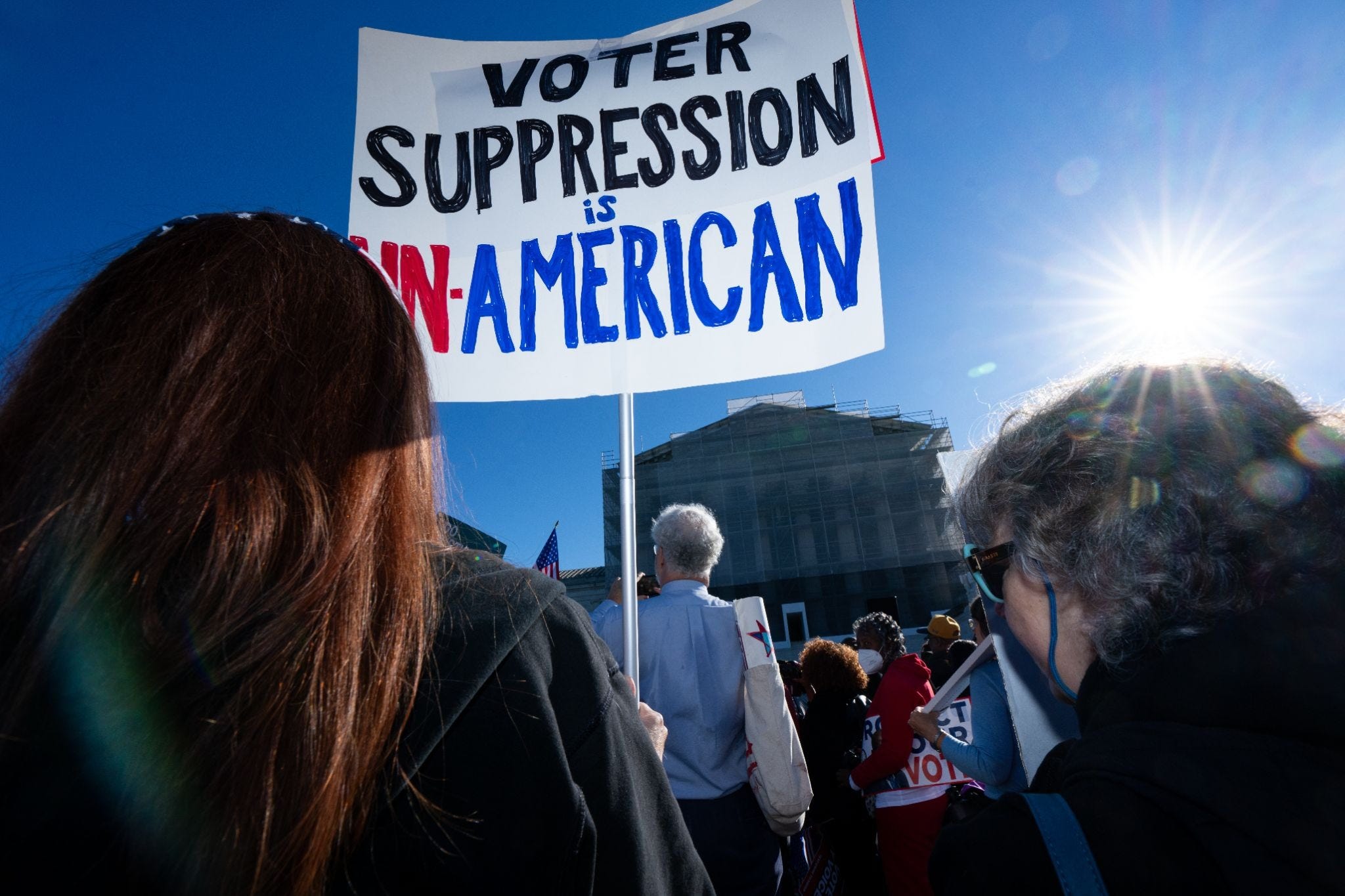
Recent observers of the Supreme Court are coming to terms with an ugly truth: a majority of the justices seem to be re-considering the legality of Section 2 of the Voting Rights Act (VRA). In the pending landmark case Louisiana v. Callais, the Court may decide that this key safeguard against race-based voting discrimination can no longer be enforced.
The stakes of this impending decision are even broader than they appear.
What many court-watchers may not fully realize is that further weakening Section 2 of the VRA not only undermines voting rights, but also debilitates a vital power-sharing system: compelling political majorities to include political minorities. To protect our democracy from this looming winner-take-all threat, we must consider a structural alternative — proportional representation.
End of an era?
For decades, Section 2 of the VRA protected voters of color from having their voting power diluted. It helped create “majority-minority” districts, ensuring that Black voters — who historically make up 20% to 40% of most Southern states — were no longer perpetually shut out of government by white majorities.
Callais threatens to dismantle this framework. The lawsuit centers on Louisiana, where Black residents make up one-third of the population, yet the state drew only one majority-Black congressional district out of seven. During arguments, several justices signaled that the majority-minority districts that have served as the primary remedy for Section 2 violations are no longer a valid solution to racial discrimination in voting.
However, as articulated in a recent Yale Law Journal essay, Callais Confusion, Power-Sharing, and the Inevitability of Proportional Representation, dismantling Section 2 destroys a key mechanism for ensuring that our democracy accurately reflects the racial and political diversity of our society.
Since the founding of the republic, constitutional scholars have warned about the threat that unchecked majorities pose to our political rights. For 60 years, the VRA has served as one of the few electoral mechanisms to protect against the “tyranny of the majority” and prevent large political factions from invading the rights of other citizens.
If Section 2 is struck down, it will be the end of an era. One in which the VRA was a key tool to ensure not just the right to vote, but the right for your vote to matter. Our efforts to ensure that every vote is meaningful reflect what voting rights scholar Lani Guinier called “second-generation fights.”1
The first generation fight got rid of poll taxes and literacy tests so that Black voters could finally cast a vote. The second generation wins made those votes count.
The proportional solution
If the Court continues dismantling our established voting rights regime, how do we ensure that political minorities still have a seat at the table? We look to a solution already used by 20 of the world’s 24 presidential democracies: proportional representation.
In short, proportional electoral systems ensure that the share of seats a party gets is aligned with its share of votes. So rather than 51% of voters get 100% of the power and 49% get nothing, all coalitions of voters (provided their group meets a minimum threshold) receive seats proportional to their votes.
We can achieve this by replacing our existing single-seat, winner-take-all system with multi-seat proportional districts and ballot structures that allow voters to pool their voting strength. So rather than 4 districts each electing one member of the majority, one district elects 4 representatives. If a minority of voters vote together and constitute 25% of a district, they elect one representative. If another group constitutes 50%, they elect two. Everyone’s vote counts equally.
Proportional representation is a great system in its own right: a large body of research demonstrates its effectiveness, especially its ability to better represent the full demographic and ideological diversity of society.2
Proportional systems also have a unique advantage when applied to the U.S. context: It is possible to achieve fair representation for voters of color without race-conscious districting. In fact, proportional representation makes gerrymandering functionally impossible if enough seats are elected per district. That also means that the practice of drawing district lines around racial groups is not necessary to secure representation for racial and ethnic minorities.
Because proportional representation is a race-neutral electoral system on its face, it doesn’t require the government to choose in advance who will get representation. This means it could withstand scrutiny from the Court’s majority, who have grown increasingly averse to race-conscious policies.
We need a new path forward
Proportional representation is not a consolation prize for the demise of the Voting Rights Act. The VRA was implemented after a long, bloody fight for recognition of full humanity and citizenship by and for people of color in the United States, and it served as a powerful tool to enforce those rights for the last 60 years.
What will come next must be informed by the VRA’s history and its powerful defense of rights for all Americans, especially those long excluded from power.
Proportional representation should be part of the answer. In the tradition of many generations of civil rights reformers, we must continue their tireless work and begin anew to secure democracy for all.
Guinier, L., 1991. No two seats: The elusive quest for political equality. Va. L. Rev., 77, p.1413.
See, for example, Hänni, Miriam; Saalfeld, Thomas (2020): Ethnic minorities and representation, in: Maurizio Cotta und Federico Russo (Hrsg.), Research Handbook on Political Representation, 1. Auflage Cheltenham: Edward Elgar, S. 222–235. Hänni, M., 2017. The Quality of Political Representation in Plural Societies (Doctoral dissertation, University of Zurich).


This is an interesting and worthwhile idea, although there would be some risk to the majority party of whichever state implemented it first, as it would likely prevent “monochrome” (i.e. single-party) states. For example, if Texas and California implemented it simultaneously, that could work. Otherwise, blue states would have to pass laws making implementation contingent on implementation of the same by another state that was the mirror image in terms of number of reps and proportion of support for each party.
I think you're kind of misrepresenting the Court's approach to Section 2.
They're not "re-considering the *legality* of Section 2 of the Voting Rights Act", they're reconsidering the *constitutionality*of "interpreting it to mandate racial gerrymandering". Nothing in the text of the statute mandates that interpretation, IIRC, it actually came as a surprise, the Act might not even have passed if people had expected it to be applied in that manner.
The Court has been gradually moving away from the idea of racially discriminating to compensate for past racial discrimination being permissible, more and more embracing the idea that "the only way to stop racial discrimination is to stop racially discriminating". That all the excuses for further racially biased policies have finally reached their sell by date, and the government is constitutionally required to pursue only race blind policies.
So, what's the difference between reconsidering race conscious measures, and reconsidering Section 2 itself? Section 2 is still available to prohibit actual racial discrimination. It's just that you'd have to demonstrate racial discrimination, rather than assuming it on account of disparate impact. And your remedy would have to be stopping the discrimination, not counter-discrimination.
I like PR, I think it's a great idea. I believe it is currently banned for federal office by law? You'd have to deal with that first, all those incumbents who don't want to risk being able to keep their seats under a different system. Similar issues exist at the state level, but in many states ballot initiatives are available to circumvent the legislature.