


All of a sudden, it’s everywhere.
Have you noticed it too?
A coworker in the break room, your neighbor at the dog park, your group chat of friends, a random phone call from your mom, a text from your uncle. Each time, the same questions. So many different people in your life are wondering about — or stressing about — the same thing.
“What’s going to happen with the midterms!?”
As the entire federal government, for the first time in American history, seeks to cast doubt on a federal election, tensions are understandably rising. In a hyped-up, algorithm-driven information ecosystem, real-but-manageable threats can start to feel overwhelming. The threat of ICE at the polls, propaganda ads on television, fears about mail-in ballots, the Insurrection Act, and all sorts of other worries on the spectrum from reasonable to unlikely. I am pretty sure you’re getting the same anxious questions because everyone I know is asking them.
The most important answer is pretty simple: Triple check your registration, make a plan (and back-up plan) to vote, and then talk to other people about doing the same. If you have questions about any of this call or text: 866-OUR-VOTE.
Usually, though, people want more than that.
So here’s my approach for how to engage with anyone worried about everything that could happen between now and January 3rd, when the new Congress is sworn in.
First, be honest about the genuine reasons for anxiety
I find it useful to start with an honest assessment of the threat. Almost everything that the Trump administration is doing to undermine the midterms fits into a three-part strategy to deceive the electorate, to disrupt the process, and to deny the results.
We can and should speak plainly about this, not just because it’s true, but because it’s close to self-evident. You’re not going to freak anyone out by pointing out the obvious. Instead, a patient explanation of how the pieces fit together is, if anything, reassuring.
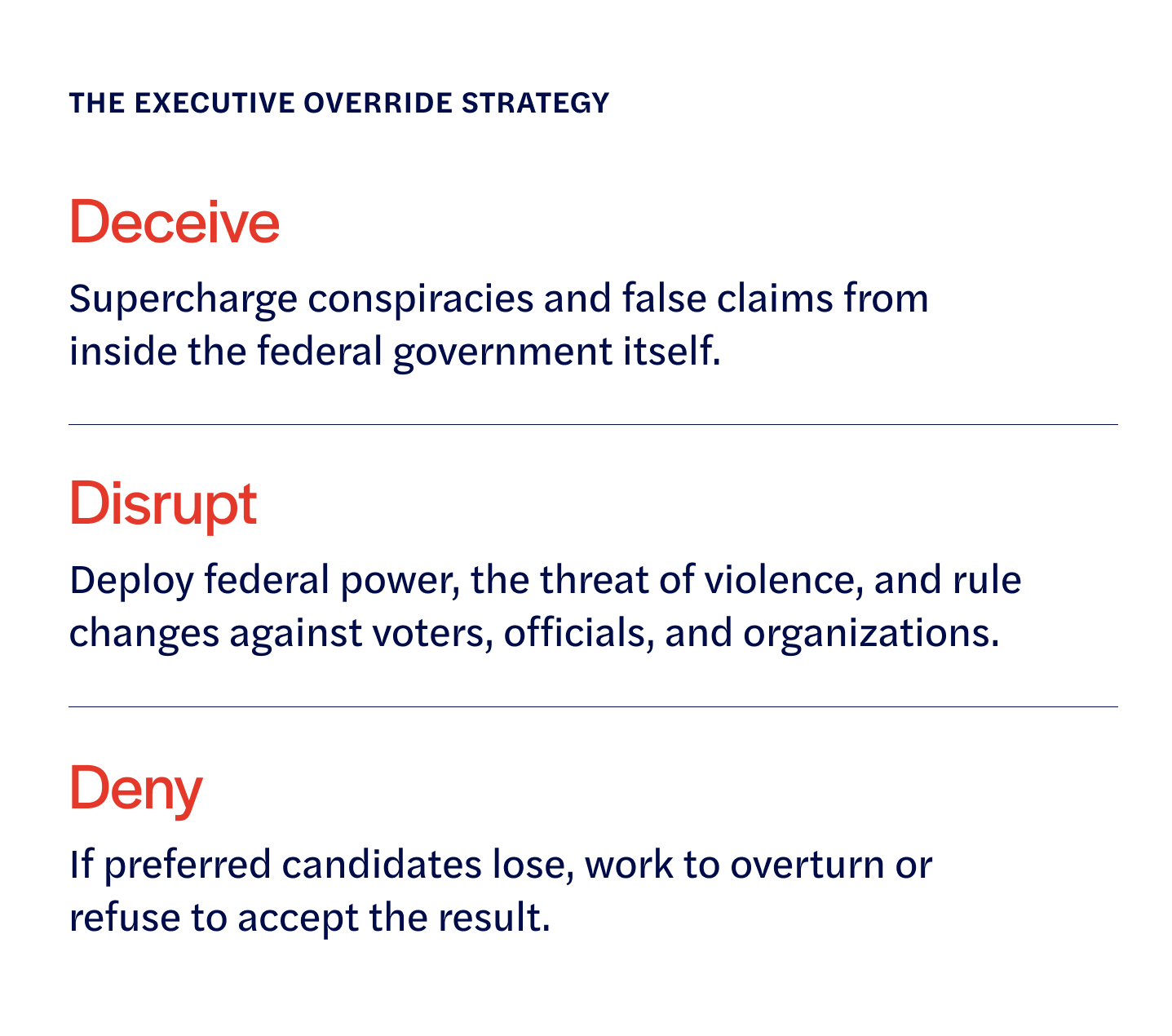
Heck, I am reassured when I remind myself of the framework. It makes me feel less crazy or overwhelmed by the constant bombardment of news.
The White House’s actions are a big deal, but they’re all tangible, they’re fairly easy to understand, and, most importantly, they are all likely to fail.
Second, emphasize that the system is very much still working as designed
Polls close in four weeks. But the election is already happening right now.
As I type this, 2.9 million Americans have already cast their ballots. It’s likely more by now. Check the latest numbers here.
So far, the election process itself is going as it should according to law.
The White House’s efforts to deceive, to disrupt, and to deny are, so far, failing across the board. In part that’s because of all of us — you, me, everyone — working hard to defend free and fair elections.

It’s also because our system remains resilient to these sorts of attacks. The White House (and the entire executive branch) has basically no role in the elections process. The worst Donald Trump and his administration can try to do is mess with the process from outside.
There are real threats here — see here for the eight scenarios we’re most worried about — but none of them are anything close to a layup for Donald Trump. They’re each more like a falling-backwards, left-handed heave over four defenders from well behind half court.
(Forgive the sports reference. Basketball is back this week.)
And with every day that passes, the metaphorical hoop here gets smaller and further away. With every ballot cast or returned (and confirmed), the election gets even harder to mess with.
If they have specific questions, here’s Protect Democracy’s: Frequently asked questions about the 2026 midterm elections.

Third, focus on action
There’s usually a point, in an anxious conversation, where we settle on an uncomfortable agreement about what’s happening and the state of our democracy. Yes, the president is likely to do everything he can to undermine the midterm elections. No he’s not likely to succeed. But where does that leave us as a country?
That’s where I ask questions:
What’s your plan to make absolutely sure you’re able to vote?
Who in your life needs your support to be able to vote easily and safely?
Who in your life trusts you as a source of information and reassurance? How will you share accurate information about the election with them?
What aspects of the election process — and the safeguards around a free and fair election — would it be helpful to know more about?
There are hundreds of things all of us can be doing. You only have to pick one or two. Turn the conversation to action as quickly as you can.
See our database of priority election resources and actions: How you can protect democracy.
Finally, speak from joy and confidence
Earlier this week, my colleagues Corey Dukes and Anna Dorman wrote a wonderful piece on the White House’s desperation and fear.
Since March, we at Protect Democracy have tried to keep you ahead of the curve about what this administration would try to do to corrupt this election. But it’s just as important to focus on what they’re afraid of.
The authoritarian movement is afraid of our coalition working across our differences. They are afraid of us harnessing our anger and turning it into joyful action, into what the great John Lewis called “Good Trouble.” They are afraid of what happens when we show up together and refuse to be managed by dread.
I recommend you read it in full.
Authoritarians, all around the world, rely on fear for a simple reason: Fear is debilitating.
When we feel afraid, we are less likely to take action. Less likely to go to a protest in defense of the rule of law. Less willing to speak out against injustice. Less willing to stand up for free and fair elections. Less likely even to vote.
So in every conversation between now and when our next set of duly elected representatives are sworn in on January 3rd, the most important thing you can do is tap into your own sense of confidence.
Confidence in our fellow Americans and their ability to stand up for democracy.
Confidence in the tens of thousands of election workers — many of them volunteers — across the country already hard at work.
Confidence in all of us.
Authoritarian Action Watch updates
Three notable movements in the Authoritarian Action Watch this week.
First, Corrupting Elections is — perhaps unsurprisingly — ESCALATING as the administration turns the volume up on their interference machine.
Second, the White House continues to try to exclude specific outlets from the press pool. While litigation is ongoing, the administration has not yet conceded defeat, now arguing that the outlets were banned because they “published stories that adversely affected national security.” Quashing Dissent is ESCALATING.
Third, under a new state law, Florida officials have designated the Council on American-Islamic Relations (CAIR), a prominent Muslim advocacy group, as a “domestic terrorist” organization. Targeting Vulnerable Communities is RAPIDLY ESCALATING.
See all updates here.
How you can protect democracy #109
Know what’s on your ballot beyond the top of the ticket. Most voters know about the races at the top of the ballot, but the midterm elections include thousands of offices that shape daily life in ways that often go unnoticed. Who runs your local elections, who prosecutes crimes in your community, and who sits on your school board are all decisions made by voters — and in many places they come down to a very small number of them.
Bolts covers power and political change from the local up, with a focus on voting rights and the elections that often fly under the radar. Their Cheat Sheet to the 2026 General Elections identifies more than 660 races and ballot measures across all 50 states — from state legislatures and governors to prosecutors, sheriffs, school boards, and key measures on voting rights, taxation, housing, and more.
What you can do:
Explore the Bolts 2026 election guide and search your state to find the races and ballot measures most relevant to your community.
Download a sample ballot to see every race and measure you’ll be voting on specifically.
Share the guide with friends, family, and community members who want to understand what’s at stake beyond the top of the ticket.
Sign up for Bolts’ newsletter to stay informed as Election Day approaches.
In California I have to vote on 14 different ballot measures, in addition to the full slate of local electeds. I have these resources bookmarked.
Some bonus hits: Highly recommend this special issue of the Journal of Democracy on democratic resistance in backsliding democracies. If you missed our livestream yesterday with Jim Acosta and former senior FCC official Gigi Sohn, the recording is here.