


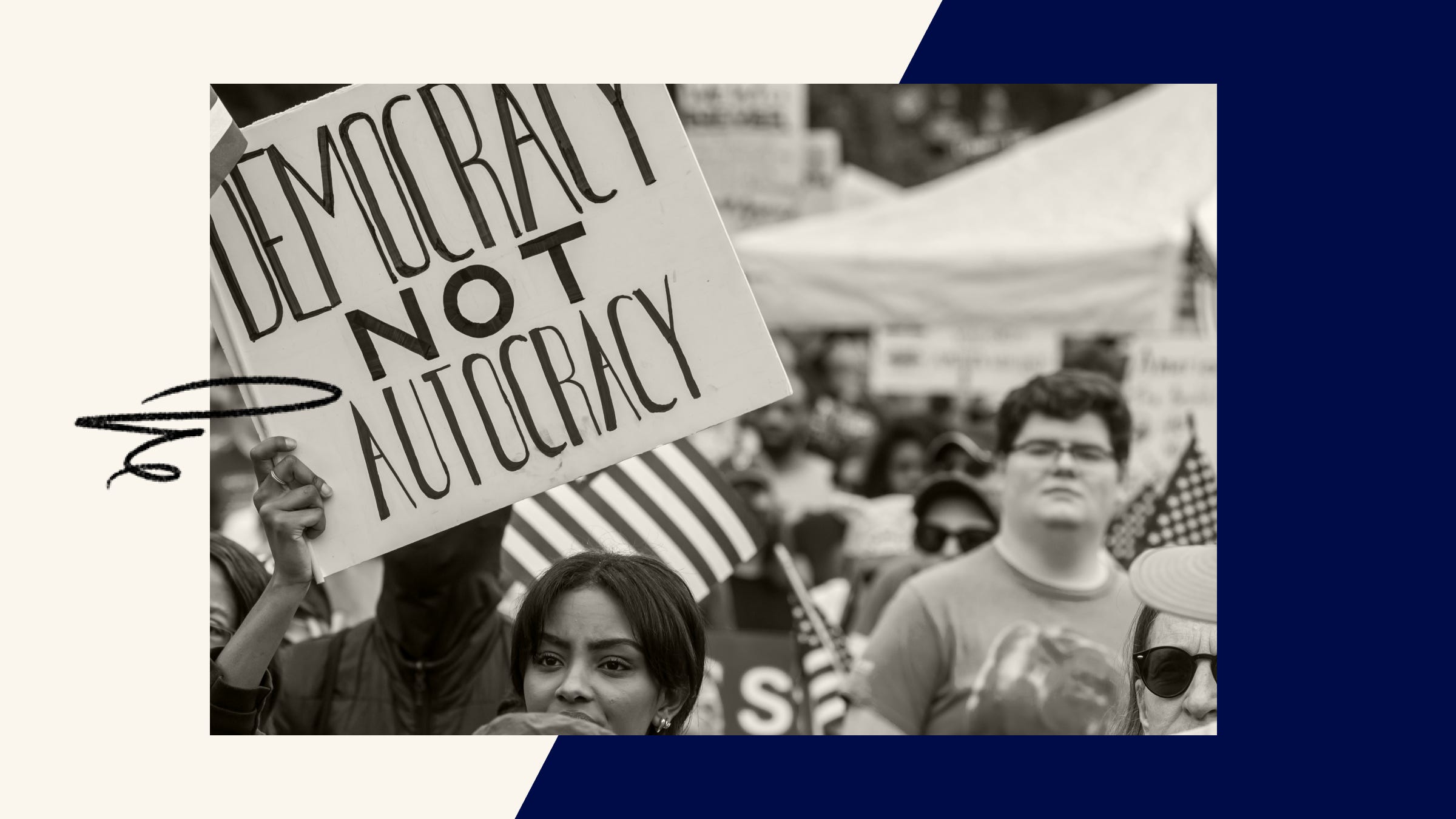
Since the 2024 election, we’ve been speaking directly with young leaders across the country about their views on democracy, the barriers to participating in our elections, and what holds back youth-led collective action. One thing we hear again and again from these chats is that efforts to engage youth in the midterms feel “transactional,” which tracks with our personal experience. At this point, we’ve lost count of how many times we’ve been told not a single candidate actually understands what it’s like to be a student, a job-seeker, and a young American today.
It’s a critical midterm year for the pro-democracy movement, and the traditional playbook for engaging young voters is failing.
But as Gen Zers who spend our days organizing and warning about the threats to our democracy, we know the story is far more nuanced than some of the narratives we’ve seen in the media. It isn’t that we don’t care. We do. We are simply exhausted by a system that refuses to deliver for us.
Building a truly resilient, cross-generational coalition to combat authoritarianism starts with treating our youngest citizens as full partners, rather than apathetic stakeholders. And today, National Youth Takeover Day, is a great time to start.
Myth-busting youth disillusionment
Data from The Generation Lab confirms that labeling Gen Z as apathetic is wrong. In fact, Gen Z remains deeply committed to core democratic principles like a belief in free and fair elections and opposition to elected leaders going “above the law.” Commitments to democratic guardrails are also widely shared and cut across some deep partisan divides.
What sets Gen Z apart from other generations, though, is a deep distrust of institutions and democratic systems. The Generation Lab poll finds only 21% of young people believe democracy is currently working well for them, and only 26% are confident that it can address the issues our nation faces. What’s eroding isn’t Gen Z’s belief in democracy, it’s the confidence that this version of it can deliver.
Read more — How do young voters really feel about democracy?
(Rational) skepticism vs. apathy
These stats highlight consistent frustration with the way our democracy seems to ignore young people’s priorities and dilute the political voice of young Americans. For Gen Z — the most racially diverse generation in American history — the Supreme Court’s decision in Louisiana v. Callais, which essentially gutted Section 2 of the Voting Rights Act, is a potent example of the system failing in real time. Every young person who has ever wondered whether their vote actually matters has just been handed evidence that it might not.
And just this week, rather than reduce high housing costs (a top concern for Gen Z), the president blocked housing relief to try to coerce passage of the SAVE America Act. The SAVE Act’s changes to mail registration and ID requirements would disproportionately affect student and young voters through proof-of-citizenship mandates and limits on mail-in ballots. So housing relief is in flux, and it’s in flux to make voting harder for our generation, in particular. Actions like these don’t just dilute youth voting power — they confirm exactly what young people have been saying all along. Our skepticism is rational.
It can be easy to mischaracterize skepticism as apathy. But the data tells a different story: in the first two months of this year, 61% of young people participated in at least one act of civic engagement. Gen Z isn’t opting out of civic life — we are expanding it and leading organizing efforts that have led to political wins.
After New Hampshire passed a strict law eliminating sworn affidavits for voter registration, the New Hampshire Youth Movement filed a federal lawsuit to protect first-time and out-of-state student voters. Last month, a federal court struck down the law as unconstitutional, letting tens of thousands of young citizens vote without facing ID hurdles.
And earlier this year, students in Maryland pressured state lawmakers to pass state-level voting protections. Their efforts led to the passage of the Maryland Voting Rights Act of 2026 (SB 255), legislation that gives state authorities new power to fight voting discrimination.
The path ahead for 2026
This is the context in which we approach the 2026 midterms: The anti-authoritarian impulse among Gen Z remains fiercely active, even when trust in institutions is low. That’s a reality the pro-democracy movement has to reckon with if it wants us to mobilize. Failing to acknowledge Gen Z’s real feelings of despair and disenfranchisement by just telling young people to “vote” isn’t an effective strategy.
Our advice for pro-democracy leaders looking to improve youth engagement this election season? Commit to these key practices:
Stop misdiagnosing youth disillusionment. Don’t treat youth frustration as a lack of care or a failure of civic duty.
Remain open to non-traditional forms of civic engagement. Young people are championing different kinds of civic engagement strategies (including digital organizing) that may be less visible.
Embrace intergenerational collaboration. Meaningful collaboration with Gen Z takes more than just featuring a young person on your next event panel. It will require including young people in decision-making spaces and viewing them as genuine partners.
Hear directly from Gen Z about their priorities and needs, and amplify by-Gen Z-for Gen Z resources. We know firsthand how helpful it is to hear from our peers about the challenges they face, and what solutions could look like. This consistent dialogue informed the creation of The Gen Z Election Defense Toolkit in partnership with Gen Z leaders from youth-serving pro-democracy organizations.
Young people are eager to join a pro-democracy movement that empowers them, and one they can identify with. As we grow older and gain more experience, we are committed to cultivating a new generation of young leaders that creates a broad multi-generational pro-democracy coalition. That coalition is going to be essential to realizing the democratic values we’re working so hard to defend and strengthen.
We are not asking the movement to flatter us. We’re asking it to take what we’ve been saying seriously — fix what’s broken and treat us as partners. This National Youth Takeover Day, let’s build a democracy that doesn’t just ask for youth participation but earns our trust.
Facing losses in court, the White House is pushing multiple levers of interference
This week, the Trump administration threatened to withhold a portion of more than $1 billion in annual homeland security grants from states that refuse to adopt sweeping election changes — including phasing out electronic voting systems and running voter rolls through a citizenship verification database that produces false matches and could wrongly remove eligible voters.
Courts continue to push back on parallel efforts to compel states to hand over voter data. A federal judge in Maryland dismissed the Department of Justice’s lawsuit seeking voter registration records — joining at least eight other courts — finding the administration’s legal theory contrary to the plain text of the Civil Rights Act of 1960.
The administration also faced losses in court over his executive orders seeking to alter the 2026 midterms. His executive order on mail-in voting was struck down in federal court, and his 2025 order requiring proof of citizenship was permanently blocked.
Even as he faced losses across multiple fronts in court, the president is also working to undermine faith in free and fair elections through legislation. Trump has halted progress on his nomination for the Director of National Intelligence, and the signing of a bipartisan housing bill, in a desperate attempt to force the passage of the SAVE America Act, a bill that would effectively disenfranchise millions of Americans and has become a top priority for the president.
See the Authoritarian Action Watch.


Great post! Would love to invite you two to a Live video discussion. Let me know the best way to reach you. My blog has 12,600 readers in 95 countries
Great post and information. Thank you