


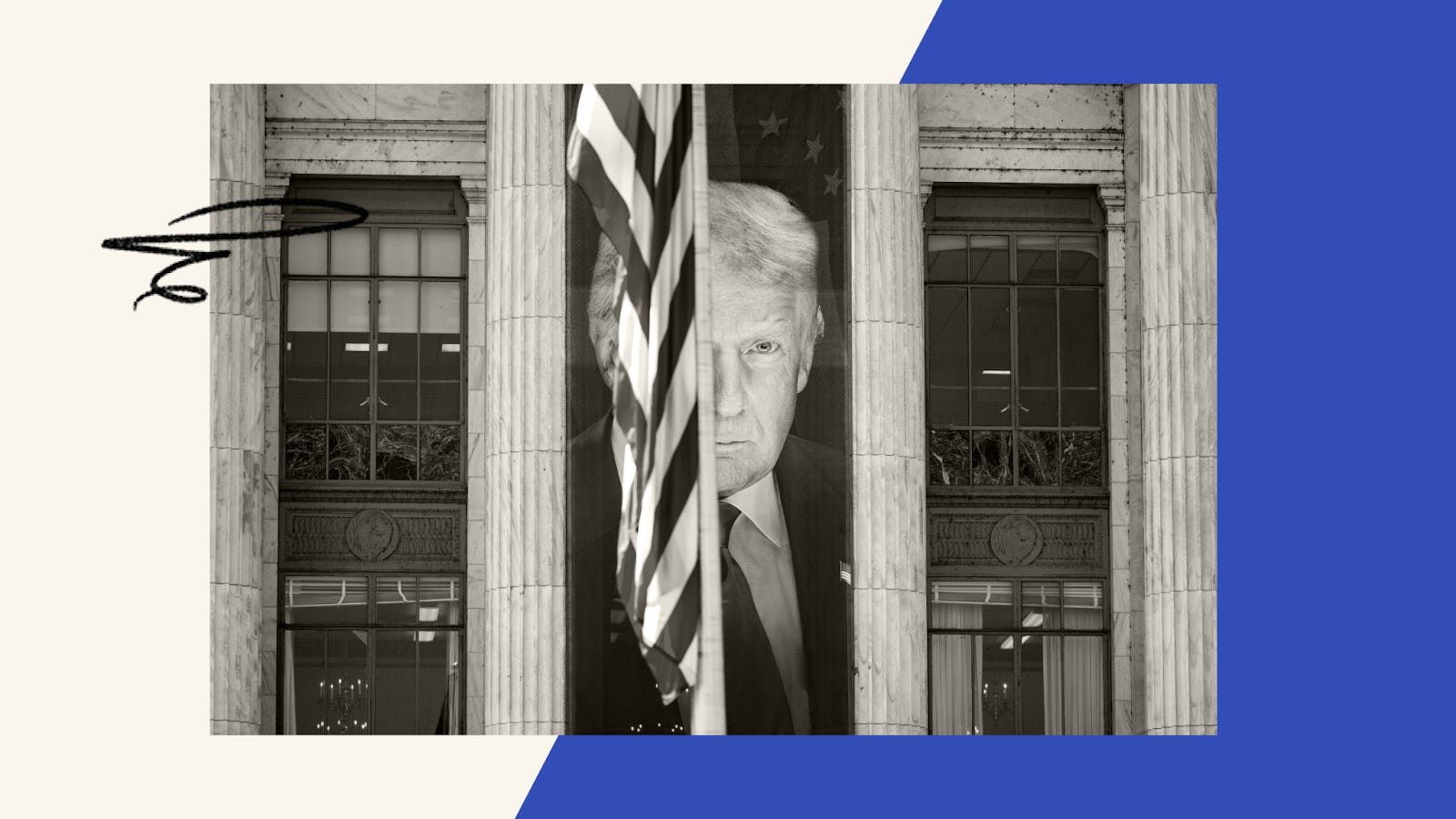
One year into the second Trump administration, we see reasons for hope amidst the rubble. As Isaac Gilles and Ian Bassin wrote:
[Trump] is losing the race against time and has failed to sufficiently consolidate power before becoming deeply unpopular, which was the recipe we knew would be necessary to prevent a full-on collapse into autocracy.
So while extreme danger still exists for our democracy, and many communities in our country still live in daily terror from the regime’s abuses, we can now see a path to defeating the autocratic assault and turning this crisis into opportunity.
The outcome of this race against time was not preordained. The advantage has shifted back and forth between the forces of autocracy and those of democracy. Here are some of the most important moments from this year — challenges, setbacks, and successes — in 11 pieces that are worth re-reading before we turn to 2026.
Despite opposition in his own party and from voters, on his first day in office, the president pardoned over 1,500 convicted Jan. 6 rioters, including Proud Boys and Oath Keepers.
Trump’s pardons solidified dangerous alliances with paramilitaries

Any plausible deniability Trump attempted to maintain between himself and those who stormed the Capitol on January 6 evaporated with the mass pardons. Trump’s act marked the first time in U.S. history that the leader of an insurrection pardoned insurrectionists, putting an American president in the column of other authoritarian leaders around the world who have used pardons to license lawbreaking by paramilitary actors and entrench themselves in office.
From day one of his presidency, aided by chainsaw-wielding Elon Musk’s Department of Government Efficiency, Trump took aim at the civil service. The authors of our Dear Civil Servant series saw through Trump’s strategy from the beginning.
Trump's endgame

You, dear civil servants, are also the canaries in the coal mine. If he can claim Article II authority to do all of these things to you and to the life-sustaining programs that you spent years running, he may also claim Article II authority to do terrible things to people across this country. Of course, he already has.
Over the summer, a new front opened in America’s forever redistricting wars when the president directed the Texas legislature to carry out an aggressive, unusual mid-decade redraw and gerrymander of the state’s congressional districts. While this was an escalation, the only way to stop endless gerrymandering battles is to do away with our winner-take-all system, once and for all.
How to end the forever redistricting wars

Proportional systems are much harder, if not impossible, to gerrymander — because voters’ representation is based on how they vote, not where they live. It’s easy to make the opposition a minority in any given district. It’s impossible to draw them out entirely. Just as importantly, proportional representation isn’t a pie-in-the-sky dream. None of this requires a constitutional amendment.
Another dominant story of the year was, of course, the Epstein files. In the political upheaval over the release of the files, Ben Raderstorf saw the bigger picture: The ongoing crisis and potential coverup at the DOJ was a near-inevitable outcome of politicizing law enforcement.
MAGA discovers the downsides of a politicized DOJ

What the American public wants is assurance that their government is not lying to them about one of the most notorious and awful criminals of the modern era to protect people in power from accountability. In the long term, the only way to really give them that is to restore prohibitions on political interference in law enforcement. To make it so those same powerful people do not get to directly meddle with investigations and prosecutions.
In July, President Trump sent Marines to Los Angeles. In August, he deployed the National Guard to “fight crime” in Washington, D.C. In September, he set his sights on Memphis. By the fall, he was openly attempting to occupy American cities, with Chicago drawing particular (and particularly violent) attention.
The ‘Chipocalypse’ is now

The aggressive actions DHS — and especially ICE — are taking in American cities should not be viewed as a sideshow to the military deployments; they are a grave warning of how the administration expects all federal forces, including soldiers, to operate.
But Americans across the country pushed back. Learning key lessons from Chicago and other cities, they showed how principled, patriotic, and non-violent mobilization can defend our democracy.
The antidote to lawlessness is the law

The American people are not powerless to stop a lawless government. Anti-legalism can be overcome not by responding in-kind, but instead with redoubled commitment to the rule of law and the Constitution. This is already happening. We saw it in Charlotte this week just like we saw it in Chicago before.
In September, activist Charlie Kirk was assassinated while speaking at a college campus. Predictably, the president and his allies attempted to weaponize that tragedy to escalate their efforts to clamp down on dissent. But we learned an important lesson about collective action when FCC Chairman Brendan Carr’s efforts to jawbone ABC into canceling Jimmy Kimmel Live! failed.
A weaponized federal government and how to push back

By far, the strongest bulwark against authoritarianism in the United States has always been a broad public distaste for the sort of censorship and repression that will be necessary to consolidate power. The Trump administration is already historically unpopular, and that discontent is likely to grow as the power grabs become more blatant. Kimmel’s reinstatement is a significant win for democracy. Disney’s decision to put Kimmel back on the air shows we have power when we push back together.
Fall of 2025 saw the longest government shutdown in U.S. history. But the real story behind the shutdown far preceded Congress’ failure to pass an appropriations bill. The administration’s unlawful attempts to withhold congressionally appropriated funding for vital programs started all the way back in January.
Who broke the appropriations process?

Imagine you and your toddler are playing a game of “keepy uppy” with a balloon. Your toddler grabs the balloon, intentionally pops it — and then asks why you stopped playing the game. (Parents: We’ve all been there.) That’s more or less what Russ Vought has done to the appropriations process.
In October, President Trump demolished the East Wing of the White House to make room for a gilded, Mar-a-Lago-style ballroom — without congressional approval. The image was a stark contrast to the massive No Kings Day protests on Oct. 18, which were the largest protests in American history.
Corruption is not a sideshow

What’s helpful about corruption, though — odd as that sentence is to type — is that it pulls the mask off authoritarianism. There has never been anything benevolent, patriotic, or nationalistic about autocracy, here or elsewhere. At its core, this is a small group of people consolidating control over everyone else. And then using that power as they wish for their own private gain. At some point, the obvious theft and lies push people to a boiling point that no amount of propaganda and spin and demonizing the opposition can keep a lid on.
Perhaps most importantly, the 2025 elections were free and fair (not to mention, significant political losses for the authoritarian movement). Still, the administration attempted to lay the groundwork for future election subversion efforts.
The underlying tension haunting the 2025 election

These are the first elections under the second Trump administration, which has quickly consolidated unprecedented power. Election deniers are in control of the federal government — including the Departments of Justice and Homeland Security. And the Pentagon. The electoral process hasn’t changed, so far. The environment has.
Throughout the year, President Trump has weaponized the DOJ to go after his perceived political opponents — from Letitia James to James Comey to Adam Schiff. (Our Retaliatory Actions Tracker is the best place to go for up-to-date information on these efforts.) In doing so, Trump is committing one of the oldest abuses in human government.
The oldest abuse in human government

In England, the Magna Carta first articulated the principle that independent law enforcement is a vital protection of individual liberty. Here in America, our Founders put that principle at the heart of our republic from the very beginning, embedding it in a set of constitutional protections. And yet today, Trump’s words and actions in his second term threaten to shatter what was one of the successes of our republican government that set America apart — justice of the law, not of the king. In so doing, his actions mark a reversal of nearly 1,000 years of effort to insulate the awesome power of prosecution from the leader’s whim.
Needless to say, it’s been a long year — with plenty of trials and tribulations that will each serve as lessons for the years ahead. We’ll be back in January with some of what we expect to see next year.
Things may get worse before they get better, and it will take all of us working together to defend our democracy.
I'm not sure how one can reasonably say our democracy survived 2025. The rule of law has been essentially destroyed. The President and his party have institutionalized corruption, dishonesty, racism, and cruelty for starters. History has been rewritten by the President and Republicans in a manner that would make the world's finest propagandists blush. The federal government has been dismantled and the 20th century is being repealed as we speak. Federal agents wear masks -- wear masks -- as they patrol our streets and look to deport as many immigrants as possible. The corporate media continue to cover Washington politics as if the Republican party and its leader are just the most recent version of previous Republicans. And the U.S. Supreme Court has adopted a model of American government that ignores what we all learned in middle school social studies about checks and balances, limited executive power, and so forth and bases its most consequential decisions on a completely fabricated "unitary executive" theory of American government.
Other than that, and a few hundred other things I left out, our democracy is just fine I suppose.