


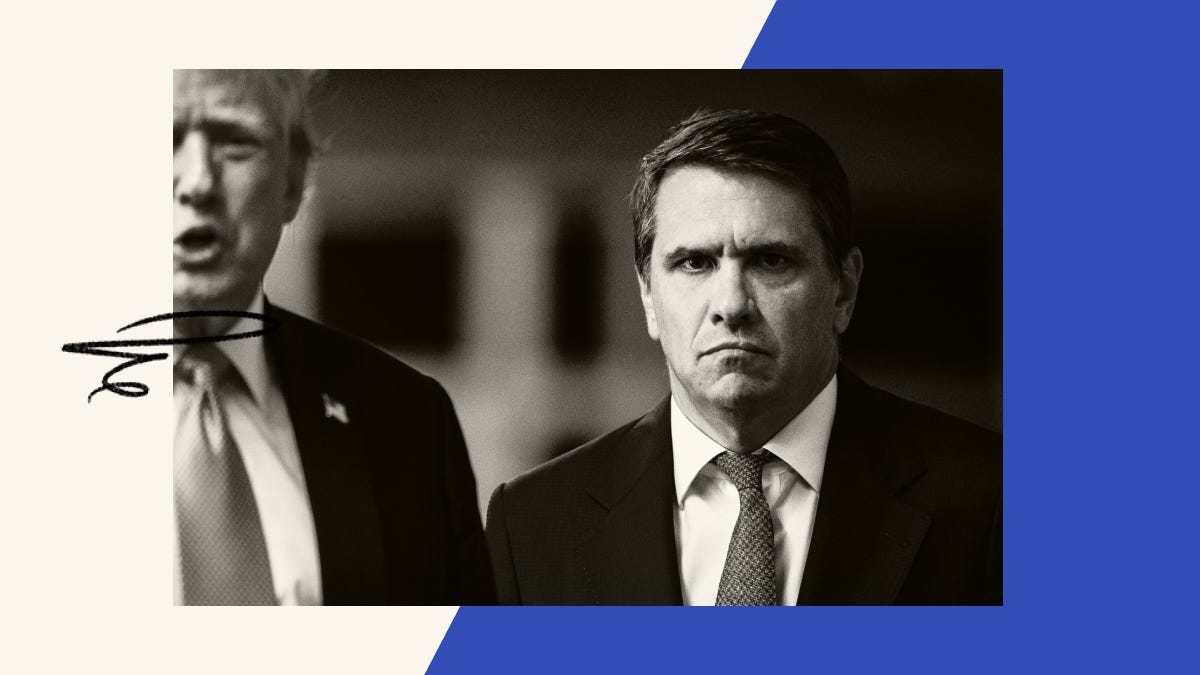
I spent this week wondering why I wasn’t more upset about Todd Blanche.
The confirmation of a sycophantic, obsequious, toadying, every-English-major-insult-applies myrmidon as attorney general should be a red alert for our democracy. The country’s top lawyer is now a “thank you very much, I love you sir” yes-man. He has the job purely out of willingness to protect Donald Trump and prosecute his enemies. Republicans in the Senate knew this and confirmed him anyway. Norms, laws, consequences, the Constitution — all of them be damned. At least Pam Bondi seemed a little bit uncomfortable acting as the president’s chief enforcer.
And yet… I just can’t get myself that worked up over him.
“Is this,” I asked myself, “the inevitable frog-in-boiling-water desensitization that authoritarianism brings?”
Then I read this piece in Just Security by Alison Hirsh and Justin Florence (which we’ll talk about more in a moment), and it clicked. Yes, Todd Blanche is Donald Trump’s dream attorney general. He’s a ruthless political operator who will gleefully wield the powers of federal law enforcement against both political opponents and the electoral process.
But everyone knows he’s Donald Trump’s dream attorney general. There’s not even a passing sense of deniability about his loyalties. Every serious reporter, litigator, judge, elections official, state or local prosecutor, commentator, and politics-watcher understands that Blanche sees himself as a presidential consigliere. Even some of the Republican Senators who confirmed him seem to know what they voted for.
That should become a problem for Todd Blanche.
In our system, the attorney general does have an enormous amount of power — but much of it relies on persuasion. To persuade a judge on a legal question. To persuade a jury or grand jury about the veracity of an allegation. To persuade a journalist about the truth behind an assertion. To persuade the public that revelations uncovered in an investigation are accurate. All of those are going to be much more difficult for a man whose entire reputation rests on political loyalty to Trump. Even when he succeeds at some of those things (which, to be clear, he probably will), it’s more likely that all the other checks and counterbalances in our system will react.
In short, the very thing that got Todd Blanche his job — a demonstrated willingness to go to whatever lengths to keep Donald Trump happy — could become the biggest obstacle to successfully executing the consolidation and weaponization of power that Donald Trump so desires.
Call it Blanche-22.
DOJ’s credibility is already gone
A partial list of the ways that Todd Blanche’s department has already failed to persuade:
All of the high-profile prosecutions of political enemies have fallen apart in almost comic fashion. James Comey, Sen. Mark Kelly, Letitia James, David Huerta, and others. Said one former federal judge on the Comey case: “If it weren’t made in the context of seeking to deprive a man of his liberty, it would be laughable.”
DOJ has lost in court 22 straight times as it attempts to seize voter data from states.
Other absurd, lower-level prosecutions against symbolic targets — D.C.’s “sandwich guy,” the reflecting pool Olympian — have predictably failed, including a tortured back-and-forth as prosecutors tried and failed to reconcile clear legal realities with Trump’s impossible demands.
The Department of Justice’s bungled, bumbling coverup of the Epstein files angered a supermajority of voters. After Blanche met with Epstein survivors, they described him as “abrasive, condescending and intentionally noncommittal.”
The administration’s crusade against corporate law firms also collapsed in court (with another embarrassing reversal), and arguably backfired as firms that did capitulate continue to pay the price.
Federal judges have started treating the department’s leadership as a credibility problem. A judge dismissed the Abrego Garcia case as a vindictive prosecution, citing Blanche’s own statements, and another judge referred Blanche to state bars over the collusive Trump-IRS deal.
Judges are also increasingly throwing out the “presumption of regularity,” the legal principle that the government is behaving as it should. According to Just Security’s presumption of regularity tracker, courts have raised concerns over noncompliance in at least 34 cases, distrusted government information and representations in at least 90 cases, and found “arbitrary and capricious” administrative action in at least 91 cases.
The department has failed to persuade its own workforce to stay. More than 16,000 DOJ employees have left, including roughly a quarter of the department’s attorneys. Career prosecutors like Western District of Virginia U.S. Attorney Todd Gilbert have resigned rather than pursue evidence-free investigations.
[For a much longer list of DOJ’s failures, see this helpful fact sheet from The Justice Connection: Todd Blanche’s devastating leadership at the Justice Department.]
None of this is cause for complacency. Blanche will continue to use the Department of Justice to extremely destructive ends. Most importantly, he will be the tip of the spear attacking the midterm elections. (Jessica Marsden wrote about how here.)
Three big risks there that shouldn’t be underestimated:
Even when illegal, politicized, and ultimately doomed, weaponized prosecutions and investigations can impose awful pain on the victims along the way. It’s terrifying and expensive for even well-resourced targets to face down the federal government. And it can seriously chill speech or distract organizations and political actors from their work. To counter this, courts must act swiftly to quash these abuses and impose sanctions on the DOJ as a deterrent.
The DOJ can try to change the facts on the ground by moving fast, before the legal system or public opinion can catch up. Think arrests or seizures. Especially in the thick of election season, those can be extremely dangerous. If the DOJ tries to illegally arrest a political opponent in August, that’s a harm that can be remedied over time. But if it tries to seize voting machines during vote counting? There’s a much higher risk that it can succeed in doing permanent damage to the election process. Magistrates, grand jurors, and state and local law enforcement need to look very skeptically at any fast-moving or election-related actions by the DOJ and move quickly to insist on regular process.
Blanche can try to coordinate directly with partisan, authoritarian-aligned judges to try to break the legal process. The DOJ on its own cannot overwhelm the rule of law. But there are a small but growing number of federal judges who share Blanche’s aims. As if to demonstrate, Blanche was sworn in as attorney general by Judge Emil Bove, the former Trump apparatchik most famous for encouraging defiance of court orders and reportedly saying the administration needed to tell the courts “f*ck you.”
Here’s Blanche’s swearing-in:
Nearly as importantly, Blanche will also continue to act as the president’s defense attorney. He — and by extension the Justice Department — will spend enormous amounts of time and resources defending a world-historic corruption scheme (i.e., everything I wrote about last week). Blanche’s IRS “deal” granting Trump immunity from tax scrutiny will just be the start. Expect more outlandish moves to run interference for fraud, graft, abuse, and self-enrichment.
Here too, though, the principle of Blanche-22 applies. Which gets us back to the article that inspired this idea.
Blanche’s corruption will be so outrageous that other actors will feel compelled to step up
Alison Hirsh (Protect Democracy’s chief impact officer) and Justin Florence (one of our co-founders) wrote a piece for Just Security this week about the reverberating consequences of DOJ switching sides from anti- to pro-corruption: Four things state and local prosecutors can do to combat federal corruption.
I highly recommend you read the piece in full (and, if you personally know any state or local prosecutors, please send it to them), but here’s the nut:
For generations, the federal government and DOJ have been a key bulwark against state-level corruption and civil rights violations. So defenders of the rule of law across the United States — state law enforcement included — had perhaps grown a little too complacent with law enforcement that was tilted toward the federal end of our federal system. But now we are in a different era, where the federal government poses more danger than defense to upholding the law. So it is critical to keep in mind that the federal government has never had a monopoly over the rule of law. And indeed, states have always had a responsibility to check and counterbalance the federal government when it overreaches.
The two of us spent decades working in local and federal government — Alison in New York City and State, Justin in federal government — and we saw the virtues of this productive tension firsthand. Law enforcement works best not when it’s a mandate from on high, from the U.S. Attorney General downwards, but rather when it’s a push and pull between local, state, and federal actors. Competition, tension, and collaboration between various levels has helped our legal system overcome some of its historic shortcomings, such as federal interventions downward on corruption and enforcement of civil rights laws, or state prosecutions upwards on financial crimes.
This is, after all, what the founders intended. As Hamilton wrote in Federalist 28: “Power being almost always the rival of power, the general government will at all times stand ready to check the usurpations of the state governments, and these will have the same disposition towards the general government. The people, by throwing themselves into either scale, will infallibly make it preponderate. If their rights are invaded by either, they can make use of the other as the instrument of redress.”
State and local governments have long upheld the rule of law separate and independent from the federal government. It’s time for them to prove that, when required, they can do so even against the federal government.
I believe everything that Justin and Alison call on state and local actors to do is going to happen. (It’s already starting — in fits and starts, at least.)
Why? Because that rivalry, the “check” that Hamilton wrote about — it doesn’t happen automatically. There’s no magic dial on the wall in judges’ chambers or the offices of state attorneys general that says “federal usurpation rising, reaction needed.” (Although I’d encourage them to follow our Authoritarian Action Watch.) The checks in our system are not self-balancing.
Systemic counteractions need to be provoked.
We don’t know exactly how Todd Blanche is going to weaponize the Department of Justice against the midterms. (We have predictions.) We don’t know exactly what brazen corruption schemes he’s going to enable, what absurd orders he’s going to dutifully follow, or what new ethical depths he will plumb.
But I am very certain he is not going to be subtle about it. He will provoke. He will stir the outrage and court the backlash.
And that, just like his boss, could be his downfall.
Watch Amanda on The Bulwark Podcast
Corruption, sweeping court losses, threats to the midterms, catering carts, and “astonishing weakness.” I loved Amanda’s appearance on Tim Miller’s podcast this week. It covers a lot. Give it a watch.
Two notable updates in the Authoritarian Action Watch this week — one, obviously, everything above. Todd Blanche’s confirmation tips Politicizing Independent Investigations into RAPIDLY ESCALATING.
But the other is more of a slow-burn. Over the last week or two, Trump has had some of his more alarming “yeah, I’m just going to do it anyway” moves. Tariffs, birthright citizenship, trying to fire Lisa Cook. Even the Kennedy Center, which both doesn’t really matter and absolutely matters.
It’s definitely a pattern. Aggrandizing Executive Power is ESCALATING.
Read the whole Authoritarian Action Watch.
How you can protect democracy #83
Get election news you can trust: Keeping up with elections requires more than following the news. Rules change, court decisions reshape ballots overnight, and state and local developments often get missed entirely. Having reliable, election-specific sources is one of the most practical ways to stay informed heading into November.
Votebeat is a news outlet dedicated entirely to reporting on voting access and election administration, with a national newsletter and state-specific editions for Arizona, Michigan, Pennsylvania, Texas, and Wisconsin.
Bolts covers power and political change from the local up, with a focus on voting rights and the elections that often fly under the radar. Their What’s on the Ballot resource is a guide to races across all 50 states.
What you can do:
Sign up for Votebeat’s national newsletter for weekly election and voting news delivered every Saturday, or subscribe to a state edition if you live in Arizona, Michigan, Pennsylvania, Texas, or Wisconsin.
Sign up for Bolts’ newsletter for weekly coverage of local elections and voting rights.
Share these resources with people in your life who want reliable election news.
Our new and improved How you can protect democracy playbook has 80+ concrete actions and counting. Sortable by time, type, and sector. See them all here.
Some last hits: Reminder to register for our American Democracy After Trump webinar with Vox on August 19. Check out this poll on support for proportional representation (6 in 10 Trump voters!). And while you’re at it, read this striking op-ed from Ruth Greenwood, one of the 500+ letter signatories mentioned in that story (and one of the litigators of the Supreme Court gerrymandering case): Gerrymandering won. It’s time to change the rules.
Change is possible.
Talk to you next week.
No substantive comment at the moment. Just want you to know I love you all and appreciate everything you are doing! I also love it when Amanda goes on with Tim, or really with anyone. She is a great ambassador for the cause and speaks clearly! Try Fox sometime!
You're perplexed because you're looking at the wrong thing. Here's where you should be looking: "He has the job purely out of willingness to protect Donald Trump and prosecute his enemies. Republicans in the Senate knew this and confirmed him anyway." The problem isn't Blanche. It isn't the clown who lives in the White House. Any more than the problem was the clown back in his first swipe at this country. Then, it was McConnell. He led the Senate majority, and he said it made no difference what the House thought regarding impeachment: he was going to corral the Senate Republican majority not to impeach the clown. Which he did.
We wouldn't have to deal with the clown or Blanche but for Senate Republicans. And some had very good reason not to confirm Blanche. Cassidy and Cornyn had lost their seats because of the clown. It would have cost them nothing to refuse to confirm Blanche. But they didn't refuse. And whine though McConnell has recently done, he protected the clown, at the expense of this country and its citizens, during clown 1.0. That's the problem. We wouldn't, as Nixon might have said, have the clown or Blanche to kick around any more if not for McConnell and current Senate Republicans.