


We’re going to talk about how we get the money back. It’s a big idea. One that’s resistant to pardons and presidential “immunity” and IRS “deals.” It could well be a cornerstone of post-Trumpism.
Before we get there, though, an explanation of why we can’t separate Trump’s authoritarianism from his corruption. We’re going to cover a lot — billions of dollars and IRS immunity and crypto and AI and pay-for-play schemes and more — but I promise, the payoff is worth it.
If you want to jump right to what the big idea is, click here. Otherwise, get your calculators out and do some math with me first.
Last year, Donald Trump reportedly made $2.24 billion in (and from) the Oval Office.
Numbers that start with “b” are hard to get your head around, so let’s break that down: That’s not far from the GDP of Cape Verde. If we start the clock at January 20, 2025, that’s just over $6 million every single day, weekends included. $266,000 per hour, every single hour. If those numbers are accurate, every 60 minutes, he takes home substantially more than the median net worth of American households. More than the average home sale price in Iowa or Ohio.
In the 20 or so seconds it took you to read that last paragraph, Donald Trump likely made about $1,500 from being president. The average American earns less than that in a week.
Plus, that $2.24 billion figure — which mostly just includes crypto and real estate deals — is hardly the whole story. Hundreds of millions more in corporate money is being donated to pet projects and causes such as the White House ballroom, the Trump Presidential Library, and politically aligned organizations.
(Highly recommend the WSJ’s exposé of Trump’s corporate shakedown fundraising operation: “The boss wants this money.”)
Meanwhile, one of the most shockingly corrupt acts in American history — the “deal” between Donald Trump the president and Donald Trump the taxpayer/business owner for permanent IRS immunity — was allowed to stand as Senate Republicans yet again caved. That means, for all we know, $2.24 billion could just be the tip of the iceberg. Without IRS scrutiny, his finances are a black box. At the very least, the deal will likely save Trump $100 million in taxes owed.1
We’ve had an ongoing office debate about how to understand the administration’s ever-more-brazen corruption.
Is it an ominous sign of a late-stage authoritarian project that no longer cares about political backlash? Or is it a frenzied smash and grab trying to get ahead of voter outrage? Does the grift contribute to the consolidation of power, or is it simply enabled by it? In technical terms, are we looking at “enriching” or “entrenching” corruption? (If you’re curious, I wrote about the difference between these two types of corruption last October.)
In short, is corruption the means to Trump’s autocracy? Or is his authoritarianism the means to corruption?
You probably know where I’m going here.
I think it’s both.
The best way to understand the corruption of this administration is all-of-the-above. It’s the how and the why. It’s the skeleton key that unlocks his particular autocratic model of politics.
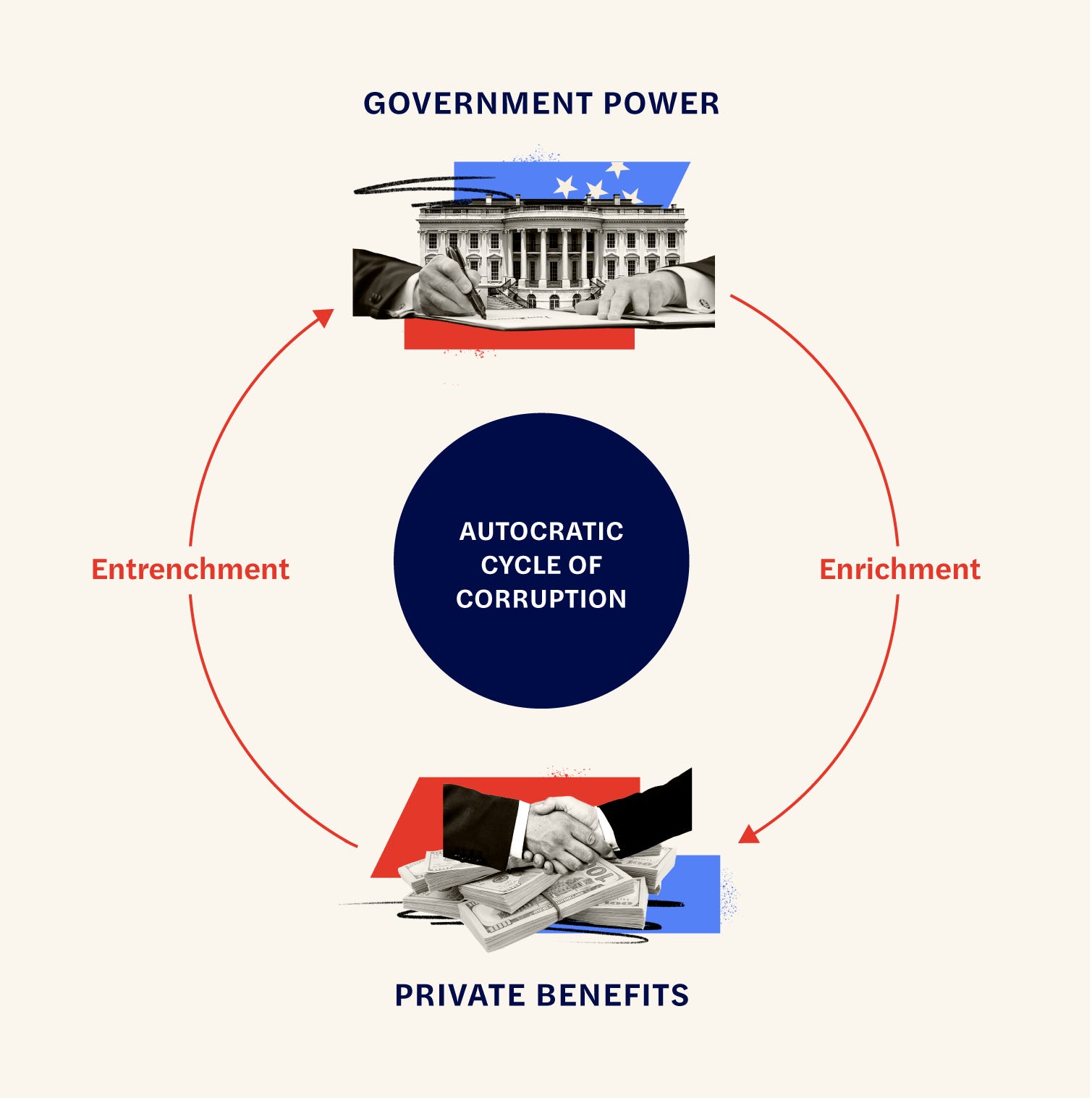
Trump’s corruption is a closed circuit of money and power. Government power is leveraged for private benefit, which in turn helps consolidate power over the government.
A massive corruption scandal in plain sight?
What does this cycle look like in practice?
The obvious example is cryptocurrencies:
Government power and resources — As president, broad authority over aspects of crypto, and he’s used that power in a series of aggressively pro-crypto moves.
Enrichment — The president and his family own a crypto firm (World Liberty Financial) and a cryptocurrency ($TRUMP) that benefited both directly from crypto deregulation and indirectly via favorable deals with the rest of the industry.
Private benefits — Last year, the president made $1.44 billion from crypto.
Entrenchment — The crypto industry alone represents about 40% of corporate election spending this year.
Crypto, however, may pale in comparison to a much bigger corruption cycle that may be happening with artificial intelligence. The Trump administration has seized for itself sweeping powers over AI, creating one of the largest corruption risks in years.
On June 12, the Commerce Department gave Anthropic 90 minutes to cut off worldwide access to its two newest AI models. The only way Anthropic could comply was to shut the models down entirely.
Eventually, the Commerce Department gave approximately 100 government-selected organizations access to one model before restoring broader access to both. Then, four federal agencies launched a new AI regulatory body known as GOLD EAGLE. On August 1, the White House announced it had a framework for reviewing and approving AI models before release. It did not disclose any details of the framework, including to whom it applies or when it takes effect.
None of this — absolutely none — was done with permission from Congress or any other public regulatory process. No new laws were passed; there wasn’t even public debate. It was a lawless power grab over the most important (and potentially dangerous) industry in the world.
Government power and resources? Check.
The American people know almost nothing about how the Trump administration plans to wield this enormous power over AI companies. And yet we can imagine countless vectors for abuse.
Most obviously, it could simply extort one of the wealthiest industries in the history of the planet for donations and financial support. OpenAI’s president gave $25 million to Trump’s super PAC.
Enrichment? Private benefits? Check. Check.
But the cycle doesn’t end there. Way more than crypto, AI is uniquely vulnerable to entrenchment risks.
The administration could demand certain capabilities, like autonomous weapons and mass surveillance (as it already did earlier this year).
Or it could push for politicization of the models themselves (millions of Americans are already using AI to get news).
We don’t know exactly how far this particular cycle of corruption has spun. That’s by design; they don’t want us to know. But we need to find out.
Today, my Protect Democracy colleagues filed Freedom of Information Act (FOIA) requests with four agencies — the Departments of Commerce and Treasury, the Office of the National Cyber Director, and the Office of Science and Technology Policy — about what could be one of the defining corruption vectors of the second Trump administration.
Read about why this matters so much for the future of our democracy. Deana El-Mallawany & Justin Florence explain: Autocratic capture comes for AI.

One big idea to break the cycle of corruption
The corruption cycle is an extremely daunting problem. There’s a reason why, once countries fall into this trap, they tend to get stuck.
But we’re not actually stuck yet.
Elections are the ultimate check on corruption, and ours are still mostly intact. If future elections remain free and fair, then there’s still a possibility of a future where the federal government again seeks to combat corruption. (Read what you can do to help protect those elections.)
And in that future, we don’t have to accept past corruption as fait accompli. And no, I’m not just talking about criminal prosecutions. While those too are likely merited, they’re going to be vulnerable to both the Supreme Court’s presidential immunity decision and abuses of the pardon power.
So here’s the big idea: We use existing laws — laws that are already on the books — to simply get the corrupt money back.
Specifically, two types of legal remedies, disgorgement (government seizure of fraudulent gains) and civil asset forfeiture (seizure of property connected to criminal activity), are uniquely suited to breaking up corruption, retroactively.2
Justin Florence and Justin Vail explained in MS Now:
Disgorgement has deep roots in moral tradition and American law. The Securities and Exchange Commission’s disgorgement authority, at issue in the Supreme Court this term, lets the government recover the money that fraudsters make through securities fraud (which could include crypto or prediction market scams). The issue before the court is whether the government needs to prove that the wrongdoer hurt specific people. The administration said no, arguing: “Disgorgement is a remedy designed to strip ill-gotten profits from wrongdoers,” so “SEC disgorgement under current law is not conditioned on a showing of pecuniary harm to victims.” In short: Those who profited through fraud have to give up the money, and it goes to the American people. …
[Plus,] civil asset forfeiture is uniquely resistant to pardons, presidential immunity claims and other defenses that could consume criminal proceedings. The asset forfeiture framework also allows the government to follow money wherever it goes. So government can recover proceeds from third parties, such as family members or shell companies, that received the fruits of corruption without a legitimate claim to them, even if those parties did not participate in the illegal actions. And the government doesn’t need to prove its case by the criminal law standard of “beyond a reasonable doubt”; it simply must show that the preponderance of the evidence supports recovery.
[Read their whole piece.]
Amanda Carpenter has a similarly great article in The Bulwark that gets into more of the politics and practicalities, touching on parallels to Hungary’s ongoing attempts to turn the page from Orbán: Undoing Trump’s golden age of corruption.
All just one, big, extremely American idea:
You can’t keep what you stole.
Join us August 19 — American democracy after Trump

Speaking of getting out of this mess: Earlier this year, we worked with Vox to support their remarkable America After Trump series on how democracies fall and how they come back. I think it’s the best thing yet written on the hardest question in American democracy.
We’re continuing that conversation live, together, with all of us.
Join Vox’s Zack Beauchamp and Protect Democracy’s Amanda Carpenter, Farbod Faraji, and Alicia Menendez-Brennan to talk about the threats facing the midterms, the structural reforms that could renew our democracy, and how proportional representation could end the gerrymandering wars for good. Bring your ideas and questions.
ICE has expanded its surveillance operation from immigrants to U.S. citizens who criticize the agency online, with identified users facing the threat of criminal charges and home visits from DHS agents. DOJ has also ramped up criminal charges of conspiracy and assault against those protesting immigration enforcement. With a high percentage of those charges falling apart under legal scrutiny, it is clear that criminal charges are meant to spread fear among critics, not punish serious wrongdoing.
The administration’s weaponization of government power against shared truth and history continues. A recent executive order directs the National Museum of American History to post warnings of potential “inaccuracies” and steer visitors toward “alternative resources.” The order follows a report by the Domestic Policy Council that decried the Smithsonian as a tool of “extreme political activism” and “anti-white activism.”
See more recent developments in The Authoritarian Action Watch.
$100 million is equivalent to the total tax bill for about 14,000 average Americans, by the way.
As anyone who watches John Oliver knows, these laws aren’t without their criticisms and abuses — but so long as they’re on the books I’m of the opinion that recovering ill-gotten gains of grand public corruption is a very appropriate use.
Great, GREAT coverage, and thanks for your exemplary work. That 6M/day haul for Trump is enough to make me cough up everything I ever believed about American “equality.”—Peter G, Newton, MA
It's becoming harder to remember back to when this dump was a democracy bound by laws.