


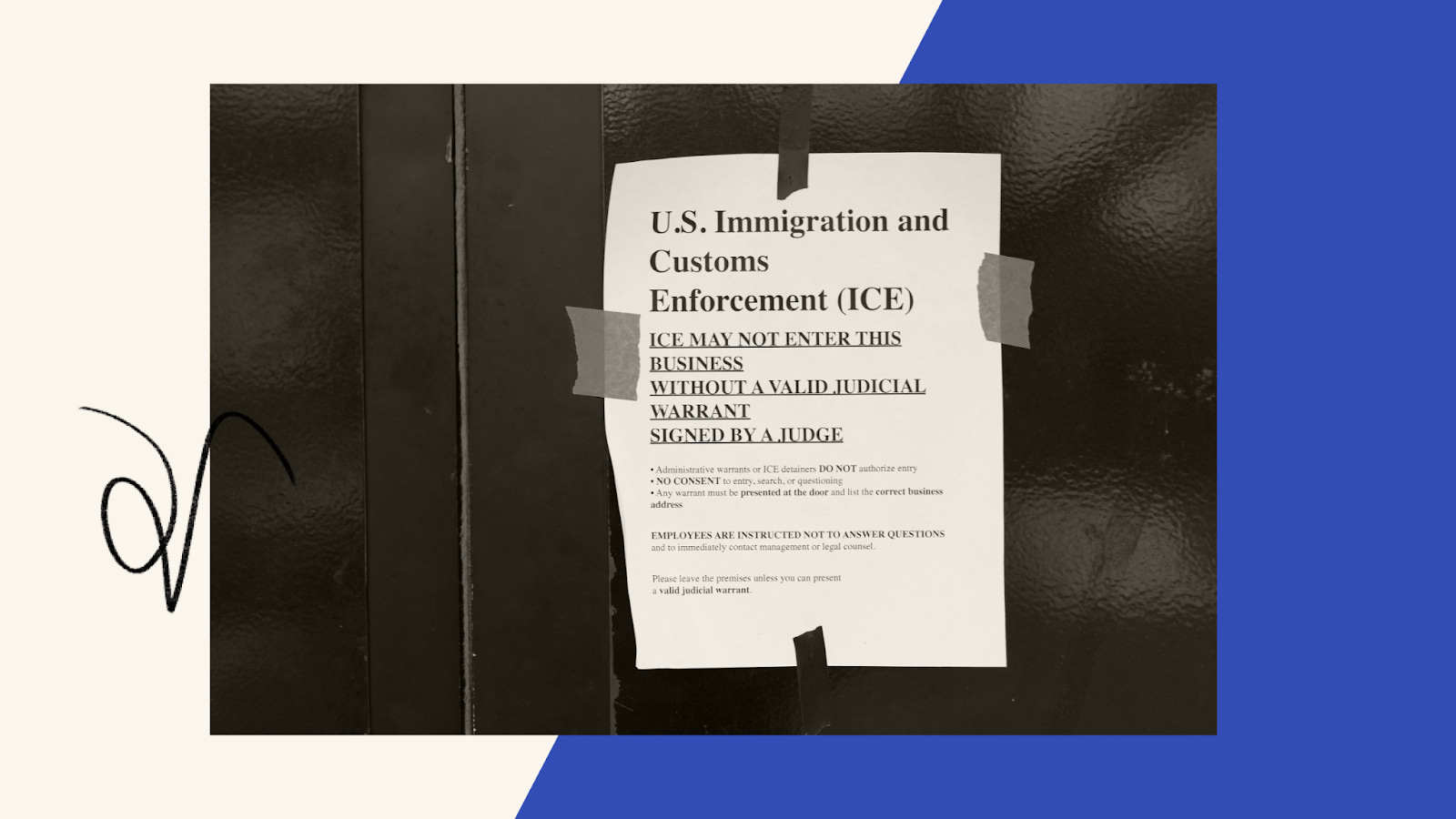
Exactly what — if anything — will change in Minnesota following the Trump administration’s supposed (partial) retreat earlier this week isn’t yet clear. What is clear is that Minnesotans have shown that collective action isn’t just a slogan. From the powerful neighborism of ordinary people to leadership from across the labor movement, faith communities, and clergy, Minnesotans are building a model for effective resistance. And while big brands have largely stayed on the sidelines, small business owners have been in the arena.
One of the key lessons from Minnesota is that small businesses are a critical part of the effort to defend democracy because they are directly impacted, ideally situated to develop and drive key components of a successful pro-democracy movement, and are trusted messengers.
Small businesses are in the eye of the storm
The past year has been harrowing for many small businesses struggling under the weight of huge tariff bills (imposed not by Congress but by executive fiat), broken contracts with federal agencies, cancelled grants, and policy whiplash from an administration governed by social media post.
Federal deployments of law enforcement to American cities are bad for business — depressing employment in key industries including agriculture, caregiving and childcare, hospitality, and construction. Small businesses — particularly businesses in diverse communities — continue to suffer from consumer fears with more than 44% of Hispanic households reporting avoiding public places. Overall, businesses in Minnesota have reported 30% drops in sales in recent weeks, and hospitality businesses in Minneapolis are reporting up to 80% declines in revenue.
We can expect the economic toll of lawless immigration enforcement to become increasingly clear and dramatic as economists have time to gather and process the data. Following the federal immigration enforcement crackdown in California last year, businesses in Orange County alone lost nearly $59 million in just 8 weeks. This was due to an 80% drop in foot traffic, substantially decreased productivity, increased absenteeism, and plummeting employee morale.
Then there are direct attacks against those businesses that have spoken up. Mischief Toy Store in St. Paul donated thousands of whistles to alert community members to the presence of DHS agents. Mischief co-owner Abigail Adelsheim-Marshall spoke to ABC News about their community protection efforts and hours later received an audit notice from the Department of Homeland Security regarding their I-9 employment forms. Retaliatory audits are a classic authoritarian tactic, common in authoritarian states like Russia. But the Marshalls, like many small business owners, are not easily intimidated. As co-owner Dan Marshall said, “This is an attempt to silence us, and it’s going to do the opposite.”
Small businesses drive key elements of a successful pro-democracy movement
Despite the difficult environment, small business owners have been actively resisting federal overreach across the country from Los Angeles to Chicago and New Orleans. But last Friday we saw something new: More than 800 businesses across the Twin Cities — game stores, yarn shops, record stores, tattoo parlors, bakeries, bookshops, restaurants, and coffee shops — closed their doors as part of a day of protest and activism across the state. (It’s worth scanning the complete list for a full sense of the scale of this action).
Other businesses stayed open but donated proceeds to community nonprofits, provided discounts, or free food for community members. Still others deployed creative strategies including serving as community hubs for mutual aid, food distribution, and fundraising efforts. Dozens made their spaces available for the community to make signs or attend training. Amanda Baumann, owner of Tandem Vintage, organized a diaper drive explaining that, “people need community right now, and that’s part of what our small businesses provide to folks: safe spaces to be together.”
Small business leadership on boycotts is key — and Minnesota’s leadership is already galvanizing national innovation. Protests, vigils, boycotts, and walkouts are planned in all 50 states today, including business closures from Portland, Maine, to Denver, Los Angeles, and Omaha.
And boycotts are just one tool in a powerful and creative arsenal. Small business owners are resourceful, nimble, and adaptable problem solvers — that’s what it takes to run a business. That’s also what it takes to build a movement. Small businesses are deeply embedded in our communities. They are what make our neighborhoods unique; they transform a block into a community. As nearly 100 Minnesota women small business owners and community leaders wrote this week, “Minnesota’s small businesses are more than storefronts; they are cultural anchors, community builders, and economic engines.”
All of these actions required immense bravery and dedication. Almost every business owner interviewed by local media explained that the decision to close their business was a difficult one. Many expressed concern about the impact on their employees, particularly hourly workers who depend on each paycheck. As a business reporter who spent the week talking to business owners explained, businesses were “facing the prospect of either closing and having no income on what is one of their busiest days of the week or sort of being externally denounced in the community as being a traitor to a larger cause.”
Fears of retaliation are widespread. One Minneapolis restaurant owner, who spoke to Twin Cities Business Magazine anonymously, explained that “by coming out there and saying we’re closing Friday, [it] does open us up to some risk, to be targeted. That’s scary.”
Yet for these small businesses, many of them brick and mortar stores, the relationships with their community members outweighed the risks. As Yoom Nguyen, owner of The Lotus Restaurant shared, “This is not about money for us. . . . We’ve been here since 1984. This community embraced our family when we were going through tough times, and [we] feel it’s our turn to return that favor, bring some hope and some joy and some warmth to people.”
The actions of hundreds of businesses in Minnesota last week and countless more across the country today represent key developments in the U.S. pro-democracy movement. As Maria Stephan, renowned scholar of non-violent social movements has written, sustained mass participation by diverse groups and sectors across society, tactical innovations across the movement, defections from key pillars supporting the authoritarian regime, including businesses, and resilience and discipline in the face of rising repression are the four key features of successful pro-democracy campaigns. Small business boycotts and activism display all four of these key elements.
Small businesses are some of our most powerful messengers
Small businesses are some of the most trusted institutions in the U.S. Per recent Pew Research Center data, an astounding 86% of Americans believe small businesses have a positive effect on the direction of the country. Confidence in small businesses is one of the few things Americans can agree on — with 68% of Democrats and 79% of Republicans reporting that they have “a great deal” or “quite a lot” of confidence in small businesses. There’s no other institution that even approaches that level of cross-ideological support.
This combination of factors — the relationships we all have with our local businesses, our cross-society trust in the small business community, and small business owners’ unique skillsets — make small business leadership in our movement critical. The courage of small business owners living their values is infectious.
Many of the biggest and most powerful institutions may not be in the fight yet, but we are still strong. The pro-democracy movement — like small businesses in towns and cities across the country — is resourceful, resilient, creative, and flexible. That is why we are going to win.
But we need to act now. These deployments of federal law enforcement develop chaotically and quickly — just ask businesses in New Orleans and Portland, Maine, that were overrun in a matter of days. Minnesota was uniquely prepared for this surge, but at this point every community needs to get ready. Now is the time to make plans, build community, and organize.
So, what should you do with this information? Here are some suggestions:
If you are a small business owner, join Integrity Matters to connect with other business owners organizing in defense of the rule of law.
If you have a small business owner in your life, give them a hug and encourage them to join Integrity Matters!
Support small businesses in your community, especially ones who are taking a stand.
If you’re organizing in your community, make sure you are engaging local businesses.
We all know why the Trump administration is still lying about the 2020 election
On Wednesday night, the FBI seized 2020 election records from Fulton County, GA – including physical ballots, tabulator tapes, images from the vote count, and voter rolls.
Donald Trump lost the 2020 election. Nothing they find in Georgia will change that fact. And while the president and his allies are still fixated on 2020, this unprecedented move is all part of an effort to lay the groundwork to subvert the 2026 elections by raising doubts about our election process. They are trying to convince the public that a problem exists where it does not. Trump and his election conspiracy theory allies are using the same playbook from previous years — deceive the public and disrupt the process to lay the groundwork to deny the results — but this time their efforts are supercharged by the power of the federal government.
An unexpected figure accompanying the FBI in Fulton County was Director of National Intelligence Tulsi Gabbard, who had also planned today to appear at a national conference of election officials before pulling out at the last minute. Although the intelligence community does perform some election-related analyses, particularly around foreign interference, the coordinator of those activities is the elections threat executive, not the DNI. Nor does she have any role in executing a search warrant. It’s just not her job. There is little doubt that had Gabbard actually shown at the conference, her appearance would have been more of the same peddling of debunked election conspiracies, not a good faith effort to improve the integrity of elections. It’s noteworthy that the DNI was even considering such an embarrassing attempt to curry favor with her boss (who remains obsessed with his 2020 loss) and to attempt to intimidate election officials into cooperating with the Trump administration’s efforts to subvert future elections. Just another troubling sign that the administration will abuse its power to attack perceived political opponents and interfere with the election.
— Ansley Skipper
What else we’re tracking
More on the collective action front: The Union of Concerned Scientists has “Five ways you can stand up to authoritarianism today.” For more on how the scientific community can get involved in the fight to defend democracy, read Protect Democracy’s Allie Cashel: Courage is (mildly) contagious.
Similarly, college and university leaders have a place in the fight, writes Wesleyan University President Michael Roth.
Former federal prosecutors for The Minnesota Star Tribune on the Justice Department’s baseless, politically motivated investigations of Governor Tim Walz and Mayor Jacob Frey.
The Justice Department’s arrests of Don Lemon and a local Minnesota journalist for their reporting on a protest are clearly an attempt to intimidate independent media into compliance. Good analysis from Greg Sargent in The New Republic and Jonathan V. Last in today’s Triad.


Tulsi Gabbard is in Georgia because there is an international connection to the 2020 election rigging through Serbia. Back in the 2020 investigations Dominion voting systems had a software development center in Serbia with programmers who were Serbian nationals. Dominion was accused of rigging the 2020 election by changing software and controlling voting machines from Serbia. That was shown not to be true. The Dominion issues were re-opened with a deposition in a civil suit by Dominion’s former Director of Strategy Development Erick Coomer against the author of the book “The Deep Rig” that was about supposed election rigging in 2020. Coomer is accused of working with the Serbian Dominion employees. Meanwhile, after Trump’s Davos speech where he said there would soon be prosecutions in the 2020 election rigging, there was an uproar in the Serbian parliament when a political analyst started throwing around accusations tying President Vucic and the Serbian secret service to the 2020 election rigging.
You can get the links at https://substack.com/@georgiafisanick/note/c-207514505?r=dvhmb&utm_source=notes-share-action&utm_medium=web