


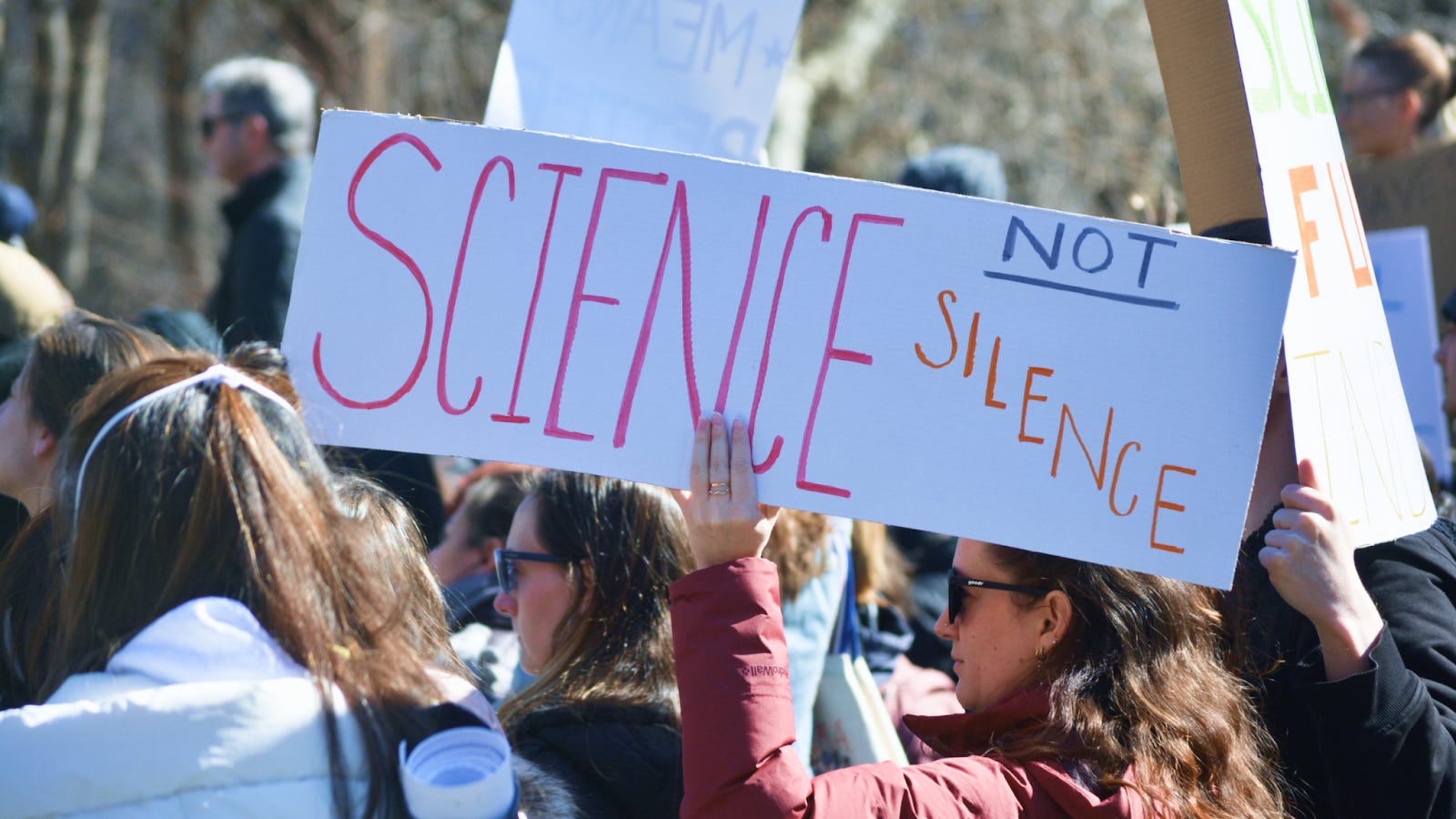
American scientific integrity is under attack.
Funding cuts have halted critical research, staff reductions are limiting agencies’ ability to fulfill their missions, and political interference and widespread disinformation are eroding public trust in decades of peer-reviewed science and proven public health measures. When an entire sector — scientific research as a whole — faces such direct and harmful political interference, what can its members actually do?
Over the past few weeks, I’ve spoken with more than 25 cancer scientists, virologists, epidemiologists, climate scientists, professors, environmental health experts, and public health officials to explore this question. Through those conversations it has become clear to me that the scientific community is facing a profound dilemma. For many scientists, objectivity isn’t just a value, it’s central to who they are. And while the scientific sector has long been connected to the political and policy worlds, many in this community never imagined themselves as political actors on such a hostile public stage. While some have begun courageously speaking out, others are keeping their heads down, hoping to weather the storm and avoid provoking further attacks.
The choice many scientists face at this moment feels impossible: stay quiet and risk seeing their work quietly dismantled, or speak out and risk losing everything to political retribution. It’s paralyzing. People are afraid that speaking out will politicize their reputation and their work.
That fear is understandable.
But as Abby Tighe, founder of the National Coalition for Public Health, recently reminded me, it’s built on a misconception. “Science and public health are inherently political,” she said.
Research priorities, funding decisions, and the direction of scientific inquiry are all shaped by policymakers, meaning the sector is always affected by political agendas. She went on:
We need to remember that while scientific research often intersects with politics, it does not have to be, and should not be, partisan. That distinction is crucial right now. The Trump administration has repeatedly undermined scientific independence, and over the past decade, partisan battle lines have been drawn around issues that were never controversial. We cannot allow basic goals, like safe communities, safe food, clean air and water, and strong scientific research, to be seen as partisan.
In an effort to appear neutral or objective, much of the scientific community is delaying action. In moments like this, delay becomes a concession.
Anticipatory obedience and the Authoritarian Playbook
As they try to “weather the storm,” many scientific institutions have been engaging in anticipatory obedience: self-censoring or complying with perceived threats before direct pressure appears. In this case, scientific leaders, trained in caution and consensus, believe that staying quiet will protect their work and institutions from political conflict.
We’ve seen this pattern play out repeatedly in countries where democracy has faltered.
Hungary under Viktor Orbán is a striking example. There, scientific institutes were stripped of autonomy and placed under political control, research priorities were redirected toward government-approved agendas, dissenting scholars lost funding, and entire departments were shuttered.
Orbán’s 2019 takeover of the Hungarian Academy of Sciences’ research network, followed by the “foundationization” of public universities, transferred institutional governance from independent bodies to political appointees. The Central European University, for example, was forced to relocate most of its programs to Vienna as further attacks on academic freedom took hold. Hungary, which was once home to some of the world’s most prestigious universities and scientific institutions, is now dominated by scientific bodies that largely validate government directives.
It’s no surprise that we’re seeing similar authoritarian tactics emerge in the United States. The goal is to control information so thoroughly that the administration becomes the sole arbiter of “truth’’ in ways that preserve power and advance a particular narrative and agenda. To achieve this, evidence is cast as suspect, questioning becomes risky, and silence feels safest. This climate of self-censorship is not accidental, it’s the intended outcome.
Around the world, there’s a clear pattern for how democratic decline tends to impact science and research. Here’s what we can expect to continue, according to the Authoritarian Playbook:
Further politicization of independent institutions. Agencies like the CDC, NIH, and EPA are portrayed as partisan, undermining their authority and recasting evidence as ideological. Universities are coerced, and civil society is forced to assume institutional work, inadvertently granting the government legitimacy.
Rampant disinformation. Attacks on vaccines, reproductive health, and climate science aim to undermine the public’s trust in established science and break the connection between the public and scientific professionals, replacing expertise with speculation.
Mounting suppression of dissent. When scientists see colleagues punished or attacked, they internalize the message and stay silent.
To many outside of the sector, these attacks seem scattered (one targeting climate science, another LGBTQ+ research, another undermining vaccine access). But that fragmentation is part of the strategy.
Gretchen Goldman, president and CEO of the Union of Concerned Scientists, put it clearly: “Make no mistake. This is a coordinated attack on scientific institutions across the country.”
The way out: collective action
This brings me back to that core dilemma. Science is not an apolitical enterprise sealed off from society; it is an independent one, and fiercely so. Great scientists, from Galileo to modern public-health leaders like Peter Hotez, have long understood that defending truth and scientific independence sometimes requires stepping into the public arena to confront organized misinformation.
The success of the authoritarian strategy to silence the scientific community depends on the community’s own compliance.
“We became scientists because we love science. That passion is empowering. Explaining why science matters can build solidarity and agency. The key thing is that you don’t have to do it alone.”
-Christina Pagel, professor of operational research at University College London
“Authoritarian regimes fear facts and evidence that threaten their power and agenda,” Gretchen Goldman told me. “That’s why they attack science they don’t like, and that’s why the scientific community must hold the line in response. We need independent scientific voices to stand united, speak truth to power, and ensure that essential science continues and truth prevails.”
It’s daunting, yes. But speaking out becomes far easier when your voice joins a choir. Christina Pagel, professor of operational research at University College London, recently put this beautifully: “We became scientists because we love science. That passion is empowering. Explaining why science matters can build solidarity and agency. The key thing is that you don’t have to do it alone.”
We’re already seeing courageous acts of collective action across the scientific community. Here are just a few examples from the past year:
NIH employees came together to sign the Bethesda Declaration (nearly 33,000 signatures, including 69 Nobel laureates). When they faced retaliation, nonprofits like Stand up for Science and volunteer attorney networks provided support.
Private funders provided bridge funding for recipients of terminated NSF education grants. Organizations like the Vaccine Integrity Project offered clear, evidence-based guidance when federal communication faltered.
The Association of Science and Technology Centers published a guide for organizing community discussions. Protect Democracy partnered with the Union of Concerned Scientists and the Health Research Alliance to host educational conversations about authoritarian threats to prepare members to step up and take action.
I recently heard an infectious disease specialist say that courage is contagious. He then quickly corrected himself, saying courage was only “mildly contagious.” If that’s true, for America to maintain its leadership in the scientific sector, we all need to add our voices to the choir. That means calling out attacks on scientific integrity when we see them (Christina Pagel’s Action Tracker is a great resource for staying up to date) and urging our institutions and professional associations to take concrete steps to protect and elevate academic research and critical scientific thought.
This is an extraordinarily challenging moment.
Speaking out carries real risks: Reputations, research programs, and team funding can all be affected. It’s natural to feel exhausted, anxious, or concerned that raising your voice could jeopardize work communities rely on. But when scientific independence and integrity are under attack, defending science is not a political act; it is a professional obligation and a civic duty.

Thanks, Allie, for keeping us informed. When we stick together, we have more clout against the forces of ignorance that have been riding high under the bloated orange bully.