


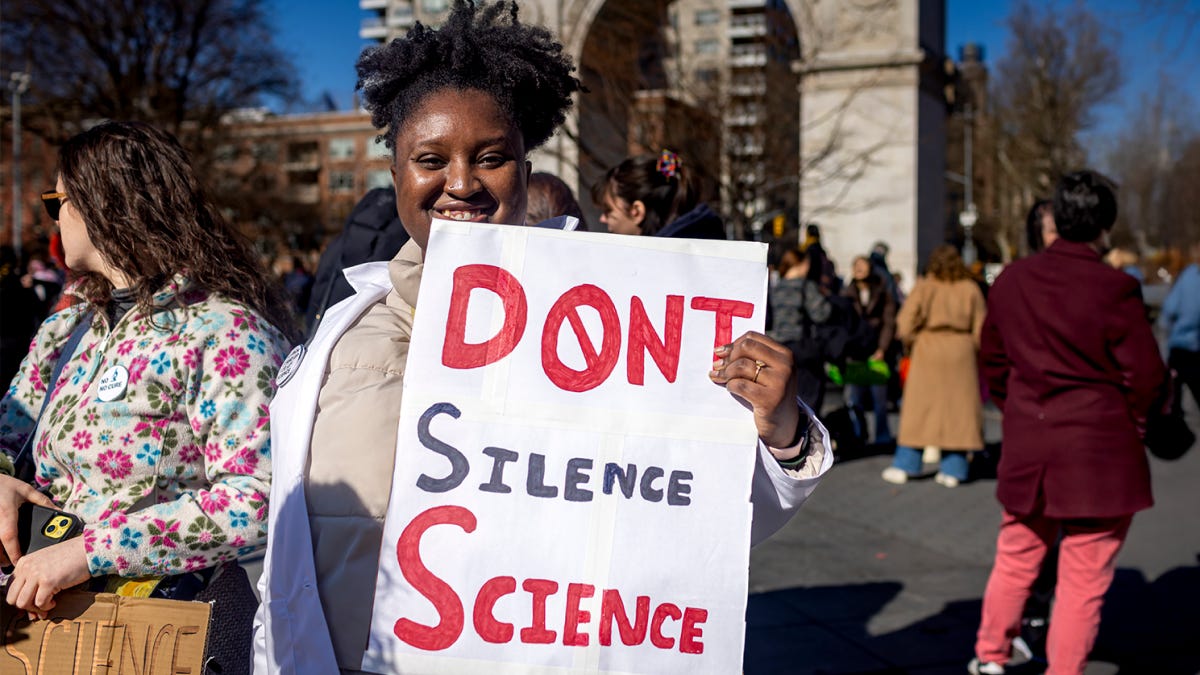
The second Trump administration has set about dismantling the institutions of American science.
Over the past 16 months, the administration has eliminated thousands of federal scientific positions, imposed sweeping funding cuts at the National Institutes of Health (NIH) and National Science Foundation (NSF), dismantled the Centers for Disease Control and Prevention’s (CDC) vaccine advisory committee, and worked systematically to manufacture political justification for abandoning the evidence that underlies public health and environmental policy.
These attacks are not random. They are interconnected parts of a nationwide strategy to erode shared truth, manufacture doubt, and teach the public to distrust what it once took for granted.
Science has been a testing ground. If you can make people doubt peer-reviewed research, vaccines, and climate data, you can make them doubt anything. An electorate that doubts everything is an electorate that can be told anything.
So as the 2026 elections approach and the administration escalates its efforts to deceive voters and deepen that distrust, it would be fair to assume the scientific community might stay quiet based on its initial response in 2025. When the first attacks came, the impact was profound. Many scientists were paralyzed by fear of losing funding, fear of political retaliation, fear that speaking out would cost them everything they had spent their careers building. Some self-censored, avoided controversy, and waited for the storm to pass.
Read more — Courage is (mildly) contagious
But something has started to shift. Scientists are fighting back. A resistance that began as individual acts of courage is now taking collective shape, and what has emerged over the past several months is beginning to look like the early architecture of a movement.
Inside out and outside in
Inside federal agencies, scientists and career workers have faced these pressures most directly. The Federal Workers Alliance for Democracy (FWAD) has built a growing coalition of workers and allies mobilizing the federal workforce to refuse compliance with dangerous and illegal orders, building networks across every federal agency in every state. Aisha Coffey, FWAD’s communications director, explains:
The thing about messing with career civil servants is that those are the same people this administration will rely on to carry out dangerous, illegal orders. If federal workers refuse to comply, we take an extraordinary amount of power away from a government that’s trying to do us harm.
It’s a powerful strategy. And to add to it, the resistance isn’t only coming from inside. Scientists are also building power from the outside.
In June 2025, Health and Human Services Secretary Robert F. Kennedy Jr. dismissed all 17 members of the CDC’s Advisory Committee on Immunization Practices (the body that has guided U.S. vaccine policy since 1964) and replaced them with a group that included vaccine skeptics and anti-vaccine advocates, some lacking relevant expertise.
The dismissed scientists did not simply step aside. They formed the Immunization Scientific Advisory Collaborative (ISAC) and published independent, evidence-based evaluations of the reconstituted committee’s proceedings. When the committee voted to end the decades-old recommendation that every newborn receive a hepatitis B vaccine at birth (despite no new safety data and no new evidence that the shots don’t work), ISAC documented what that process looked like. Together, they created a public record of what evidence-based vaccine policy requires and clearly told the public what had been abandoned.
Young scientists are adding their voices to the chorus
While many of these examples involve established scientists and career workers, early-career researchers have stepped up too. Without tenure, established reputations, or institutional protection, they have the most to lose by speaking out, but this isn’t stopping them. Graduate students turned hallway conversations into the Scientist Network for Advancing Policy (SNAP), now a nationwide coalition of more than 150 active members across 30 organizations.
SNAP’s McClintock Letters initiative coordinated more than 600 scientists to write op-eds for their hometown newspapers (not elite national outlets, but local papers) in the communities they grew up in. They have already published more than 200 pieces across 45 states. As JP Flores, speaking on behalf of SNAP, explains:
We wanted to get back in touch with the people we grew up with, the communities that shaped us, and the people who, in many cases, we became scientists for in the first place. We hoped our peers would join us and were amazed by how many did. If scientists want to continue to earn the support and the funding we’ve received from the American public, we have to not only communicate with them but also recognize their vital role as partners and stakeholders in our work.
The scientific community has been criticized, often fairly, for operating at a remove from the public. These early-career scientists are working to close that gap at precisely the moment it matters most.
Healthcare workers were crucial to resistance in Minnesota
Nowhere has that urgency been clearer than in health care. When the Trump administration designated hospitals as fair game for immigration enforcement, the Minnesota Nurses Association doubled down on their efforts to educate members about patient rights, what to say to federal agents, and how to protect immigrant patients, including Minnesota’s large Somali and Hmong communities. They developed badge buddies for nurses (printed cards with instructions and a QR code for resources) and built partnerships with immigrant rights groups, faith organizations, and legal aid groups.
Then, on January 24, 2026, federal agents shot and killed Alex Pretti, a 37-year-old ICU nurse at the Minneapolis VA. He was off duty, observing protests against Operation Metro Surge. That day, he stepped between a federal agent and a woman who had been pushed to the ground. Alex had spent years helping care for patients in the ICU and was doing the same for a neighbor. Federal officials said he had brandished a weapon. The video tells a different story.
Pretti’s death galvanized nurses nationwide. National Nurses United declared that “ICE messed with the wrong profession” and organized a nationwide week of action: candlelight vigils at hospitals and VA facilities from Minnesota to California to New York, with explicit demands that Congress defund ICE or face electoral consequences.
Year after year, Gallup finds Americans rank nurses the most trusted profession in the country. When a profession like that organizes, it brings the power of everyone it has spent decades caring for.
Where to plug in
These examples are far from comprehensive. Organizations like HealthBegins have been training frontline clinicians to treat pro-democracy work as an extension of their professional identity, not a betrayal of it. Stand Up for Science returned to the streets in March 2026 with rallies in 46 locations nationwide. New cross-sector coalitions are forming in states across the country. Momentum is building as scientists get in formation ahead of November 2026.
One example of this growing momentum: On June 3, the Union of Concerned Scientists is launching Science Rising, an initiative aimed at mobilizing the science community for sustained engagement, building the political infrastructure to defend science and democratic accountability through the 2026 elections and beyond. As Gretchen Goldman, president and CEO of the Union of Concerned Scientists, says:
If ever there was a time for scientists to step into our power, it is now. Science Rising recognizes the gravity of the threats to science and democracy at this moment and harnesses the power of scientists and science supporters to fight back.
The launch webinar on June 3 (3-4 p.m. ET) will feature three concrete actions: signing up for SMS alerts for rapid mobilization, raising awareness in your own networks, and joining the Science Rising Action Corps for tools and opportunities focused on congressional accountability throughout the summer and fall.
If you are a scientist (or just someone who believes science should serve the public good) RSVP for the launch here. If you work in science or technical fields specifically, there is a scientist-specific form here.
Over a year ago, the fear was felt at the individual level. A scientist’s grant withdrawn, or their name added to a list; a career built carefully over years at risk of being lost overnight. The administration bet that the fear of thousands of scientists, isolated, weighing the costs of speaking up, would add up to compliance. But the math has changed as the scientific community is proving them wrong by remembering it is one.

New rule: if someone’s anti-science, they don’t get to have a mobile phone. Or car. Or a TV.
Thank you. I signed up for the launch of Uniting to Protect Science and Democracy. One more nurse, looking out for us.