


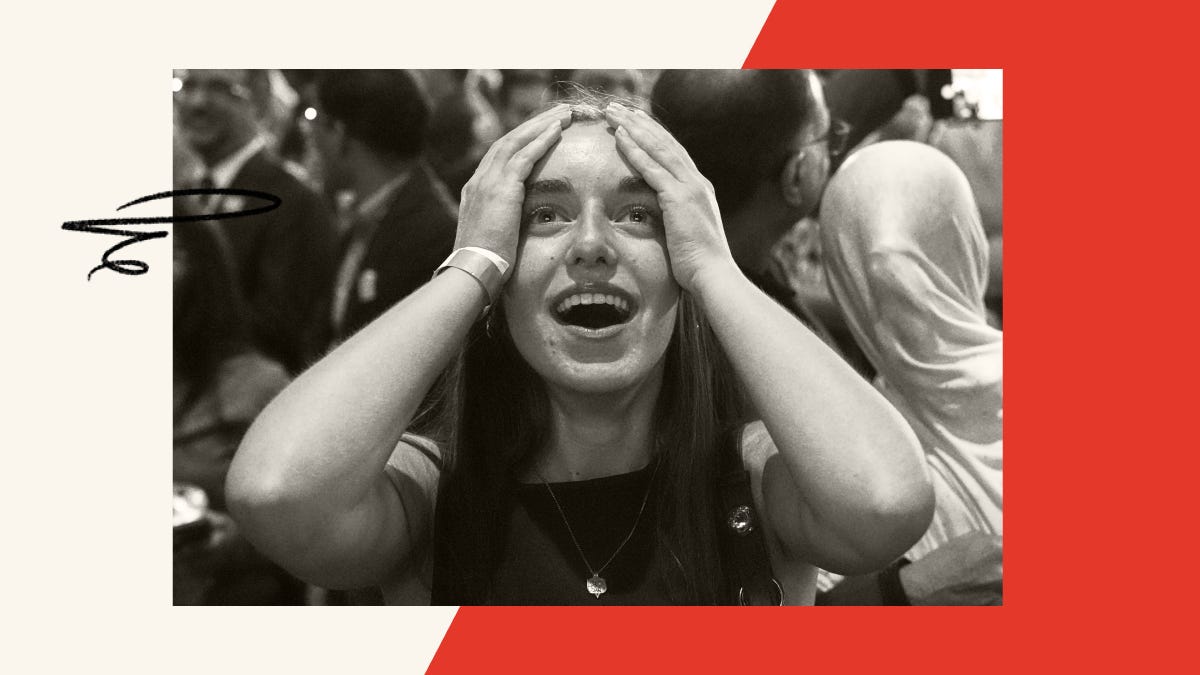
For people my age, there was no pre-Trump political world.
I was eleven when Donald Trump launched his first run for president. It’s hard to overemphasize just how much the political lives of those who grew up in the 2010s have been shaped by Trump and resistance to him. Those have been the two notes ringing throughout our whole political lives. Backlash to backlash. Anger at anger. Trump to not-Trump to Trump again. Two notes make a boring, cynical song.
But this week, it has felt like we may have finally struck a new chord.
Trump has loomed over our young adulthoods
I was starting middle school when Trump was elected president. I didn’t know much about politics at the time — I was still grasping the basics. I dutifully scribbled out flashcards of civics terms for my Constitution test — Separation of Powers, Bicameral, Bill, Amendment. You had to get at least a C to pass seventh grade.
When Trump was elected, my flashcards provided no insight, no roadmap.
At school the next day, my teachers struggled to keep their voices steady. Throughout middle school and early high school, politics felt like a series of crises, spiraling down toward something ominous.
In 2020, the warm, hopeful feelings that followed Trump’s defeat were quickly replaced with deep, existential fear after January 6. Stuck at home in remote school, I sneakily watched the certification vote during class — Congress split screen with Calculus. Out of the corner of my eye, I saw the proceedings abruptly shut down, watched as members of Congress were rushed out of the chamber. The pomp and ceremony of the day suddenly devolved into raw panic. I stayed up all night scribbling drawings of the Capitol in flames in the margins of my diary. I saw news footage of Nazi imagery and Confederate flags hoisted in the Capitol rotunda, images that felt ripped out of the pages toward the front of my history textbook.
My junior year of college, Trump was elected again. He soon launched a full-scale assault on universities, including mine. I watched my international classmates demonized and their visas revoked. I watched funding stripped from my friends’ research projects. I watched city streets swarmed by armed, masked agents. It felt pointless, absurd to show up to class and write academic essays when the pain was so real, so near. The very rhythm of our college lives, too, became defined by Trump.
But, last week, voters resoundingly voiced their rejection of the Trump administration’s abuses of power and blatant corruption. We watched a new slate of leaders rise, including in unexpected places. And these wins, fittingly, were powered by young people.
On election night, celebratory memes flooded my Instagram feed and had me doubled over with laughter. Across the country, young voters pushed through voting barriers with joyful determination. A generation starved of political hope built it nonetheless.
There is no such thing as normal anymore
Over the last ten years, our collective imagination has become so constrained that normalcy itself became the aspiration. It was an understandable shift. With Trump-style politics ripping apart so many of our norms, change became associated with destruction. Hope that our country could change for the better was replaced with urgency to prevent it from changing for the worse.
Now hints of a post-Trump politics are beginning to shine through the clouds.
Trump has been repudiated. Not defeated — there will be much pain and work in the years ahead. Cornered, desperate authoritarians tend to thrash and bite. But the American people have made clear that they’re done with a political period that has spanned my entire teenage and young adult years. This era — the Trump era — is ending.
It feels both poignant and fitting that my generation played a key role in beginning its end.
We’re not demanding a return to the politics of before. Many of us didn’t even experience what came before. Roughly 50 million Americans, far more than the population of California or Texas, have only ever been eligible to vote in elections where Donald Trump was on the ballot, literally or figuratively.
But maybe that’s how we get out of this. Limited not by nostalgia or preconceptions of what politics was, maybe we can see what it could be. Young Americans are resolutely independent, suspicious of both parties, and able to smell stale pandering from a mile away. More than four in five young voters in the 2026 midterms said they want substantial political change. We want results. We want imagination. We want to be able to dream of something better and work toward it.
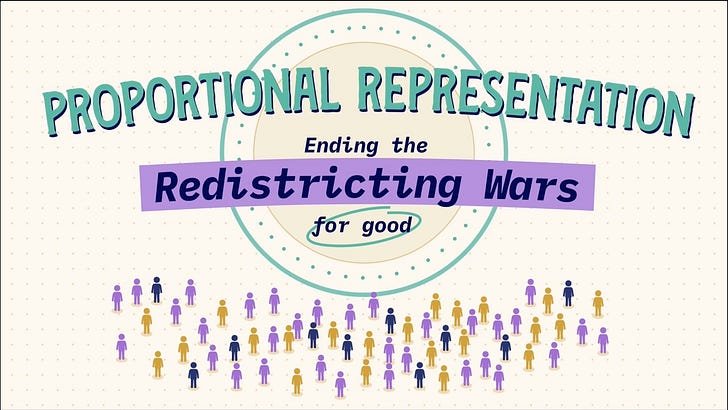
And now, we get to strive for more than normal. We get to work toward bold, transformative ideas that may have felt impossible before but now appear firmly on the table, like ending the endless cycle of gerrymandering through proportional representation. We get to use this moment of opportunity to envision a more inclusive and resilient democracy. We get to play our role in bringing our country closer to the aspirations it was founded on, to the potential that generations of Americans have believed in and fought to build.
We get to build a future where the next generation of seventh graders writing out their Constitution flashcards aren’t just memorizing the rules of a dysfunctional, out-of-reach system. We get to make those concepts feel like tools they can access and use to build their communities. And maybe, if we do this right, we’ll even give them a few new flashcards to add to the deck.
Millions of us might not have known the before. But now we get to create the after.
If Congress wants to get serious about corruption, it has to get the money back
Protect Democracy co-founder Justin Florence and Noah Bookbinder, the former president of CREW, have a new piece in Just Security on how an anti-corruption agenda isn’t just about oversight and new laws:
If leaders in the new Congress and beyond want to strengthen American democracy, accountability for high-level corruption is essential. Long overdue congressional oversight is a crucial first step, but it won’t be nearly enough; even with Democrats taking back Congress and likely performing real oversight, more comprehensive forms of accountability will be necessary to truly restore faith in democracy. And given the difficulties of criminal prosecution, a lesser-known alternative — clawing back corruptly obtained money — may be the most viable approach for effective accountability. Pursued effectively, that form of accountability can also advance the priorities that voters care most about, like addressing the high prices caused by corrupt deals and conflicts of interest.
Read the whole piece here.
Authoritarian Action Watch
For the first time in a long time, the Authoritarian Action Watch looks like this:

The main drivers behind this swing toward improvement, beyond the midterm results themselves:
Corrupting Elections: While he has started in some Truth Social posts to cast doubt on the results, the president — and more importantly, almost all of his allies in Congress — has accepted the election results.
Spreading Disinformation: Similarly, election losers across the country have largely conceded and accepted defeat. The scale and tenor of disinformation about the results online is dramatically different from 2020.
That said, there are still some negative developments, including in Quashing Dissent — especially Attorney General Blanche’s threat to bring criminal charges against members of Congress for conducting oversight — and Targeting Vulnerable Communities — namely, the elevation of Stephen Miller to White House chief of staff.
See all the updates: Authoritarian Action Watch.
How you can protect democracy #115
Observe and support the certification process — election certification doesn’t happen behind closed doors. Canvass and certification meetings are public, and community members have a real role to play in witnessing and supporting the process. Getting involved in this final stretch of the election process is one of the most direct ways to help ensure every vote is counted and support free and fair elections.
What you can do:
Attend your county’s canvass or certification meeting — contact your local election office for the schedule.
Check your state’s certification deadlines so you know what to watch for in the coming weeks.
If you are a lawyer, law student, or legal professional, sign up with the Democracy Legal Defense Network for canvass monitoring opportunities in Michigan, Pennsylvania, Georgia, North Carolina, Florida, and Nevada.
Check your local ACLU affiliate for canvass observation opportunities in your state — in Michigan, the ACLU is coordinating observers across all 83 counties.
Share accurate information about the certification process with your networks using the When Something Happens messaging tools.
Extra Credit: Read Protect Democracy’s Election Certification Explained for a deeper dive into what certification means and why it is a mandatory legal duty.
There’s a lot more you can do. See them all: How you can protect democracy.
It is time for my generation to step aside and support the younger generations crafting the legislation that they and their children will be governed by. Their challenges and circumstances have changed from the time I was their age. I still have my own needs and demands from government, but I need to support the election of younger representatives that will ensure I am not left behind while crafting legislation for the needs of families in the future.
What does Donald J. Trump mean when he says, "I want to get Cuba done before Trump leaves office?