


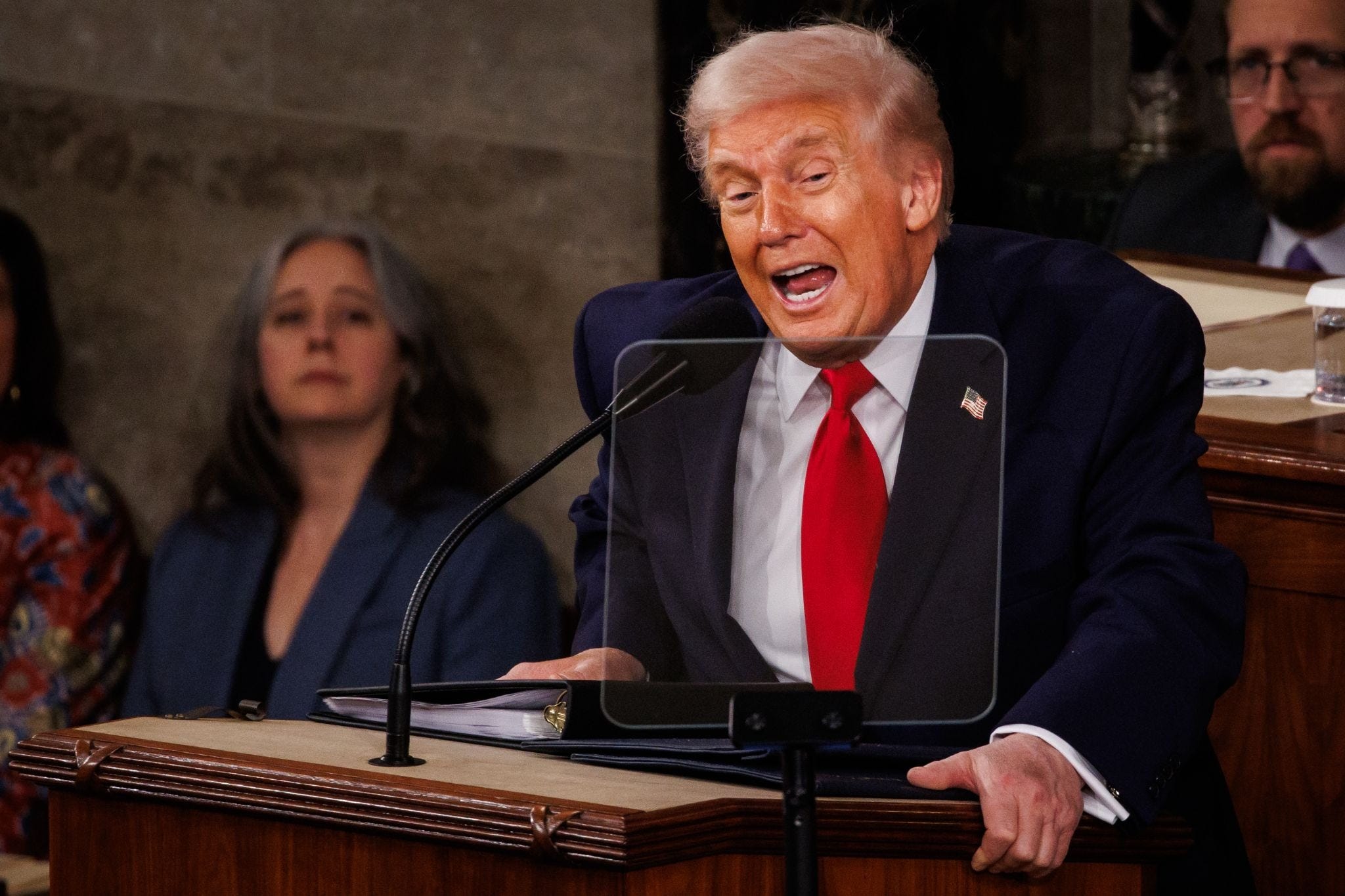
Last night, in the same place where five years ago a violent mob and 147 members of Congress attempted to overturn a free and fair election, the president laid the groundwork for the Next Big Lie.
President Trump’s State of the Union address was full of falsehoods on nearly every issue (you can find some version of a fact-check by most major outlets today), but buried nearly an hour into the record-length speech was a litany of untruths about American elections. Sowing doubts about the election process is the first step in the president’s strategy to interfere with this year’s midterm elections to ensure his party maintains power, regardless of how the American people vote.
Here are the five major lies the president told about our elections, debunked.
One: ‘Cheating’ is rampant in our elections
This lie about American elections might be the single most consistent position that the president holds. At least since 2012, Donald Trump has called elections that he and/or his preferred candidates lost “rigged,” “stolen,” and a “sham.” Sometimes a conspiracy between the FBI and social media companies is the primary culprit. Other times, mail-in ballots draw his greatest ire. 2020 was a bit of an “all of the above” or “throw spaghetti at the wall” style strategy. In 2026, his primary fixation — the Next Big Lie — is widespread non-citizen voting.
Just to be clear, he’s been wrong every time.
According to an election fraud database maintained by the conservative Heritage Foundation (the authors of Project 2025), from 1982 to 2024, there were only 1,546 “proven instances of voter fraud.” In 2020 alone, dozens of courts reviewed allegations of fraud and dismissed them for lack of evidence.
Multiple bipartisan audits and hand recounts in multiple battleground states confirmed the accuracy of the results.
Undermining public trust in elections with blatant lies like this lays the groundwork for the president to attempt to use the power of the federal government to change the rules and tilt the electoral playing field in his favor to guarantee his preferred outcome in November.
Read more: Elections are the essential remaining pillar of our democracy.
Two: ‘Illegal aliens’ vote in our elections
Sixty-eight. That’s the number of noncitizens who voted between 1982 and 2024, according to the American Immigration Council’s review of the Heritage Foundation data. 68 out of over one billion total votes cast during that time. That’s below 0.0001%.
According to a Brennan Center report, in the 42 jurisdictions they studied, the total number of undocumented immigrants who were referred for investigation for illegal voting in 2016 was just 30 — 0.0001% of votes cast that year.
There’s just no evidence to support the president’s claims. But that’s beside the point for Trump. He’s searching for a pretext to interfere in election administration, stifle political activity, and silence voters so that he can control who holds office, regardless of who wins the election.
Read more: Free speech, ICE, and free elections in 2026.
Three: Mail-in voting is ‘crooked’
Ever a favorite target of the president, mail-in voting remains a convenient, secure way for Americans to vote. Take it from a recent Brookings Institution report:
We find that mail voting—universal vote-by-mail in particular—has substantial benefits for election administration and tens of millions of U.S. voters. As part of this analysis, we corroborate prior research that mail voting is secure and find low overall mail voting fraud, particularly in universal vote-by-mail voting systems.
To put a finer point on it, cases of mail-in voting fraud account for only 0.000043% of all mail ballots cast. That’s four in 10 million.
Most Americans want every eligible voter to be able to vote and have their vote counted. Most of us support absentee and early voting, and many of the president’s own voters rely on these options to cast their ballots.
Despite President Trump’s vague reassurances last night, restricting absentee voting primarily impacts military voters, seniors, voters with disabilities, and rural communities who rely on mail voting to make their voices heard. And all of us benefit from early voting options. Eliminating ballot drop boxes and limiting in-person early voting would create longer lines and more chaos on Election Day, which could turn away even more voters.
Four: The SAVE America Act is ‘common sense, country-saving’ legislation
This sweeping “election integrity” bill is an effort by an increasingly unpopular president and party to pick and choose who gets to vote in a desperate attempt to stay in power.
Instead of preventing rampant non-citizen voting (which, as I discussed above, isn’t real), the impact of this legislation would be to make it harder for law-abiding citizens to vote, requiring all of us to find or pay for expensive documents, made even more complicated for anyone who has changed his or her name — including the vast majority of married women — to register to vote. And the registration process itself may become prohibitive for many voters; the bill could effectively end or severely limit automatic, mail-in, and online registration methods.
Americans deserve simple, accessible systems that allow every eligible voter to participate in our democratic process and have their vote counted.
Right now, roughly 21 million eligible citizens do not have immediate access to the specific documents this bill requires. For many Americans, obtaining these documents requires time, travel, and money. And it’s important to note that this legislation will disproportionately impact Black, Latino, Asian, Indigenous, and immigrant communities.
When viewed alongside this administration’s ever-escalating attacks on free and fair elections, it becomes clear that the SAVE America Act is part of a coordinated effort to silence voters who the president expects to vote against his party.
Moreover, because the bill is unlikely to pass over a Democratic filibuster, its failure may also be used as a pretext to attack future election results. An equally dangerous scenario for the SAVE America Act isn’t just that it could pass and disenfranchise millions of voters. It’s also that it could fail — and have that be used to try to invalidate everyone’s votes.
Read more: Trump’s elections Chimera.
Five: Voting is a privilege
Of all of the falsehoods uttered by the president last night, this one may have upset me the most (lots of competition for this, I know), even if it largely flew under the radar for most commentators.
Voting isn’t a privilege; it’s a constitutionally protected right of American citizens. Full stop.
When President Trump called voting a privilege, he said the quiet part out loud. If the government views voting as a privilege that it can pick and choose upon whom to bestow, no American’s right to vote is safe — even those who don’t expect to be impacted by the president’s current disenfranchisement efforts.
This year, on the 250th anniversary of our country’s founding based on the principle that citizens have a God-given right to choose their own leaders, we have the opportunity to reflect on the struggle and sacrifice that have expanded the right to vote. The Women’s Suffrage and Civil Rights movements. The bloodshed on battlefields and on American streets. The leadership of activists, soldiers, teachers, union organizers, brave citizens from all walks of life. And in this reflection, we can find inspiration to keep going as we take up this mantle.
This year, we are engaged in a struggle to defend that most fundamental right of Americans to govern ourselves. Last night made clear that the challenge we face is steep, but I have no doubt that we will win.
I’m a Republican myself, so I don’t see this as a partisan attack — just an observation. I find it interesting that there’s so much focus on Democrats allegedly undermining election integrity, when some of the most visible attempts to overturn results have come from within the Republican Party.
That’s also why the SAVE Act discussion surprises me a bit. Stronger election safeguards sound good in theory, but depending on how they’re applied, they could potentially work against anyone — including Republicans — if the rules had existed during past elections.
To me, protecting elections should be less about scoring political points and more about making sure the process is consistent, transparent, and trusted by everyone, regardless of party.
Great post that concisely and accurately frames many of the counterarguments we will all need in the coming year to fight the onslaught of lies and misinformation that will be used to provide pretexts for challenging legitimate election results.
Also, at the risk of sounding like a broken record, I would be remiss if I did not make the following tangential point, as I never want it to be forgotten. After a failed and humiliating summit with President Putin in Alaska, President Trump said that he agreed with President Putin (“a smart man”) that the reason for all the bloodshed in Ukraine was the fact that the American people use mail-in voting. That may not be the depths President Trump will go to in order to avoid saying that he lost the 2020 election, I have failed every time I try to put limits on the depths he will go to, but I cannot imagine a more hateful thing to say about the American people than to blame us for Russia’s depravities in Ukraine simply because his ego, insecurities, or delusions will not allow him to face the truth that the American people rejected him.