


Last Sunday, Viktor Orbán conceded defeat. 16 years of authoritarian rule in Hungary ended with a phone call to the man who beat him.
Péter Magyar’s Tisza Party won 138 out of 199 seats — a two-thirds supermajority — on nearly 80 percent turnout, the highest in Hungary’s post-communist history. Orbán called the result “painful” but “clear.”
What makes Sunday’s result so important is not just that the opposition won. It’s how they won — and what they did to prepare for the possibility that they wouldn’t be allowed to.
Hungary’s elections are mostly free, but not fair. Orbán’s party had redrawn every district to maximize its advantage. In 2022, Fidesz won a two-thirds supermajority with just 54 percent of the vote. The opposition needed to clear roughly a five-point structural handicap just to win a bare majority. Orbán controlled nearly all broadcast media. His allies owned hundreds of private outlets. Russian intelligence operatives were actively working to tip the scales. This all built on a long-term effort to change the rules, eliminate meaningful electoral competition, and consolidate power in ways MAGA saw as a model for what they could do here.
The Hungarian opposition didn’t respond to any of this by being quiet about it. They did the opposite. Magyar accused Orbán of “treason” for inviting Russian agents to interfere. He called the government the “Orbán mafia.” He told voters that the election was “a choice between East or West, propaganda or honest public discourse, corruption or clean public life.”
And then they prepared — openly, systematically, and relentlessly — to defend the vote.
Tisza deployed a remarkable 50,000 election monitors to vote-counting committees in polling stations across the country. In a country of 9.5 million people, that’s about one out of every 200 Hungarians. For the U.S. to do the same, per capita, it would take about 1.7 million observers.
Tisza also built its own fraud-reporting system so voters could flag irregularities in real time. Transparency International Hungary convened organizations from across the region to share best practices for detecting manipulation. And six opposition parties withdrew from the race entirely, clearing the field so the contest would be a straight two-way fight that gave Tisza a chance to overcome the system’s built-in handicaps. The Socialists said explicitly that an electoral system amounting to “legalized cheating” could only be overcome by uniting behind a single candidate.
Hungarians named the threats, they built the infrastructure to counter them, and people showed up to do their part.
It’s time for the United States to do the same.
2026 isn’t like 2020
Back in 2020, anyone paying attention could predict that the sitting president might not go quietly into the night. One might have been able to hypothesize the myriad ways the administration might try to interfere in the election, but no one knew how far they would take things.
This time around, it’s different.
As those who have been following this newsletter or read our Executive Override report know, there is no doubt that the Trump administration is preparing to use every tool in its toolbox to try to maintain its lock on power. There’s no one left inside the White House to check that impulse. And the experience of recent elections has made clear to the public the extent to which Trump will go to cling to power and the range of ways he may do so. There’s no downplaying the threat anymore.
To be clear: None of that means Trump’s attacks on the midterms will succeed. The administration’s strategy requires inducing many collaborators to break the law, keep eligible Americans from voting, and throw out lawfully cast votes. Their transparently malicious approach may have — in tipping their hand to the American people — already doomed them from the start. But it does focus our strategy not just on careful preparation but also on loud, open defiance.
They’re not being subtle about their intentions, so we shouldn’t be subtle about them either.
Why the midterms matter so much
To appreciate the nature of the threat, it helps to understand why Donald Trump even cares about the midterms. After all, in 2018, he didn’t do much to help Republican congressional candidates politically, let alone consider breaking the law and the Constitution to try to keep them in office against the will of their voters.
Unfortunately, Trump learned from that experience.
For the first two years of his first term, the Republican-controlled Congress enabled Trump: They confirmed his nominees, funded his priorities, and ignored his corruption. But when Democrats regained the House in 2018, they reclaimed the power of oversight — and they used it. Many of the most significant abuses of his first term, such as attempting to coerce Ukraine into making up political dirt about Joe Biden, were exposed and stymied by an opposition Congress.
Turns out that, if you want to build an autocracy in America, you need a legislature that’s willing to sacrifice its own power for you to do so. That’s much more likely when your copartisans are in control. Congress should be one of the greatest bulwarks against tyranny. In 2020, that system worked as designed.
And that’s why Trump is so focused on the midterms now: If he manages to rig, overturn, or otherwise mess with the midterm elections such that he decides the next Congress, not the voters, he won’t just have protected his ability to set policy; he will have essentially removed the Constitution’s most important check on his power going forward.
That also explains why the key question this November is not just which party controls Congress, but whether the voters actually get to choose. Yes, if the president’s party retains power in Congress because that’s what the voters choose, it will bolster his efforts to cement himself in power. But Congress as an institution will still exist, and still theoretically be capable of pushing back. The status quo, in effect, will stay the same.
But if the president effectively overrides the congressional elections, picking control of Congress over the objections of the voters, then Congress will cease to be an independent branch of government.
How to explain the dangers
In the 2018, 2020, and 2022 elections, talking about threats to fair elections was a difficult balancing act. On one hand, we knew the threats were coming; on the other, the scope was uncertain and the risks of speaking too loudly were real. You don’t want to hand an authoritarian a roadmap. You don’t want to undermine responsible actors inside the system who are doing their best to hold the line. You don’t want to deter people from participating. And you don’t want to cry wolf so loudly that the public tunes you out.
None of those considerations apply anymore.
The administration isn’t working from a hidden playbook. It’s broadcasting its intentions from every available platform. The president has publicly demanded to “nationalize the voting” in states he doesn’t control. The Department of Justice (DOJ) has sued more than 20 states for refusing to hand over voter data. The FBI has raided election offices. The Cybersecurity and Infrastructure Security Agency (CISA) — which once helped local officials defend against foreign election interference — has been gutted, with roughly 1,000 staff gone in a year.
As our Executive Override report details, this isn’t a collection of unrelated provocations. It’s a strategy — and it has three parts: deceive, disrupt, and deny.
Deceive the public by manufacturing the appearance of fraud where none exists. Use federal task forces and investigations to produce “findings” that cast doubt on election integrity. Flood the zone with so much noise that ordinary voters don’t know what to believe.
Disrupt the mechanics of voting itself. Use executive orders to try to sow chaos and mess with voter registration systems. Deploy federal agents — or threaten to deploy them — near polling places, creating the conditions for voter intimidation even if no one is formally turned away. Drive experienced election officials out of their jobs through harassment and the threat of politically motivated prosecution.
Deny the results if, despite all of the above, the voters still deliver an outcome the administration doesn’t like. Use the conspiracy theories and the manufactured “evidence” as a pretext to contest, delay, or overturn results through litigation, certification refusals, or outright defiance.
If everyone does their part, we can defeat the strategy
Still, even with all that, America’s election system has an enormous structural advantage. Elections in this country are run not by the federal government but by officials across all 50 states, more than 3,000 counties, and roughly 175,000 individual precincts. That radical decentralization, under normal circumstances, can be a headache. But under these circumstances, it’s an incredible source of strength.
No executive order can take over all of those precincts. No single DOJ investigation can intimidate every county clerk in every state. The president can tweet — or Truth — whatever he wants; he still can’t count the ballots. The Constitution makes that clear, and so far the courts have largely agreed.
Many of those advantages are things the Hungarian people did not have last week. But still, just like in Hungary, our elections need people willing to defend them.
That means state election officials who refuse to hand over voter data to corrupt fishing expeditions. It means local clerks — Republicans and Democrats alike — who follow the law even when the pressure to bend comes from the most powerful office in the world. It means state legislators who protect their states’ electoral processes rather than caving to White House demands. It means judges who continue to apply the law, as they’ve mostly done throughout this administration (with some notable exceptions). It means civil society organizations and litigators prepared to swiftly respond to abuses as soon as they happen. It means protestors prepared to take to the streets at key moments to defend their right to representation.
In short, it means all of us.
We can only be prepared if we’re honest about what’s coming. And then, together, we can Defeat the Deceive, Disrupt, Deny strategy.
Next week, we’re going to get into what we expect — starting with all the ways this election will be different from 2020. But before then, we want to hear from you. Drop in the comments or shoot us an email with what you’re most worried about or what you’re doing to protect elections where eligible voters can cast their ballots and have them counted.
Authoritarian Action Watch updates
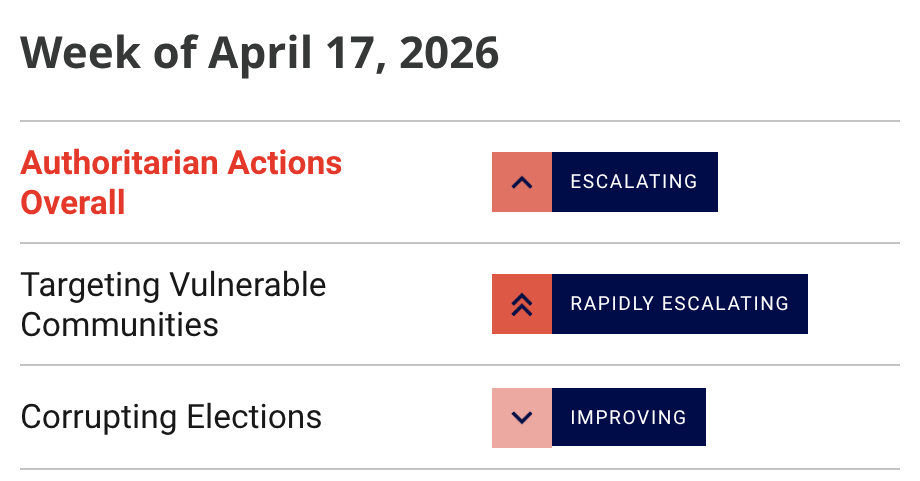
Trump is facing court resistance in his effort to corrupt elections
Since President Trump signed an executive order in March that purports to create federal voting lists that can be used to control who receives a mail-in ballot, the order has been challenged in court multiple times. Those challenges, when taken with the news that the administration’s attempts to consolidate state voter files are facing roadblocks in court, are a reminder that the courts still play a robust role in defending our right to vote.
Trump’s attempts to tilt our elections are far-reaching, however, and not all of them need to succeed to undermine voters’ confidence in the system. Between the mail-in executive order, the demands for state voter file data, and Trump’s declining approval rating, the administration seems to be gearing up to attack the safety of our elections on multiple fronts.
See the Authoritarian Action Watch.

Volunteer to drive voters who need transportation assistance to the polls.
What I'm most worried about?
The three Ds. Deceive Disrupt Deny.
The Save Act is a lever for all 3.
What I'm doing to protect elections?
1. Election judge at my local precinct.
2. Educate myself and others. To that end: share this article / series.
3. GOTV efforts
4. Help voters check their registration, help get registered.