


The White House is pressuring Congress to pass the SAVE America Act, the omnibus voter suppression bill that aims to swing the midterms by mass-disenfranchising voters.
To say Trump is obsessed with this bill is perhaps an understatement. Just this week, the White House has fomented airport chaos by blocking TSA funding as leverage to try to jam the SAVE America Act through, told senators to skip Easter to pass it “for Jesus,” and argued “we won’t have a Country any longer” if it fails. (All while voting by mail himself in Tuesday’s special elections in Florida.)
The SAVE America Act is going to fail. It doesn’t have anywhere close to 60 votes to clear the filibuster. So why is the president pushing so hard?
Trump is obsessed because, at its core, the SAVE America Act is not just an election subversion strategy in itself. It is also part of a pretext for a much broader strategy to undermine the midterms.
Today, Protect Democracy released Executive Override, a new publication documenting how the Trump administration is deploying the full machinery of the federal government against the 2026 midterm elections. The report describes a coordinated strategy already underway to spread disinformation and conspiracy theories; tilt the electoral playing field and manipulate election outcomes; and, if necessary, try to overturn unfavorable results.
This strategy does not require Congress to pass any laws. In fact, the central goal is for the White House to override Congress and states. To do so, the administration plans to use the lies promoted by the SAVE America Act: that elections are rife with fraud and that harsh anti-voter measures by the federal government are a necessary response. As my colleague Alexandra Chandler puts it:
“You didn’t pass the legislation that would have solved this fake problem, and therefore the election results are not valid.”
In other words, Trump is pushing the SAVE America Act not just on a distant hope of disenfranchising some voters. He is, much more immediately, hoping to use its failure to override the electoral process entirely.
The three prongs of the White House’s Executive Override strategy
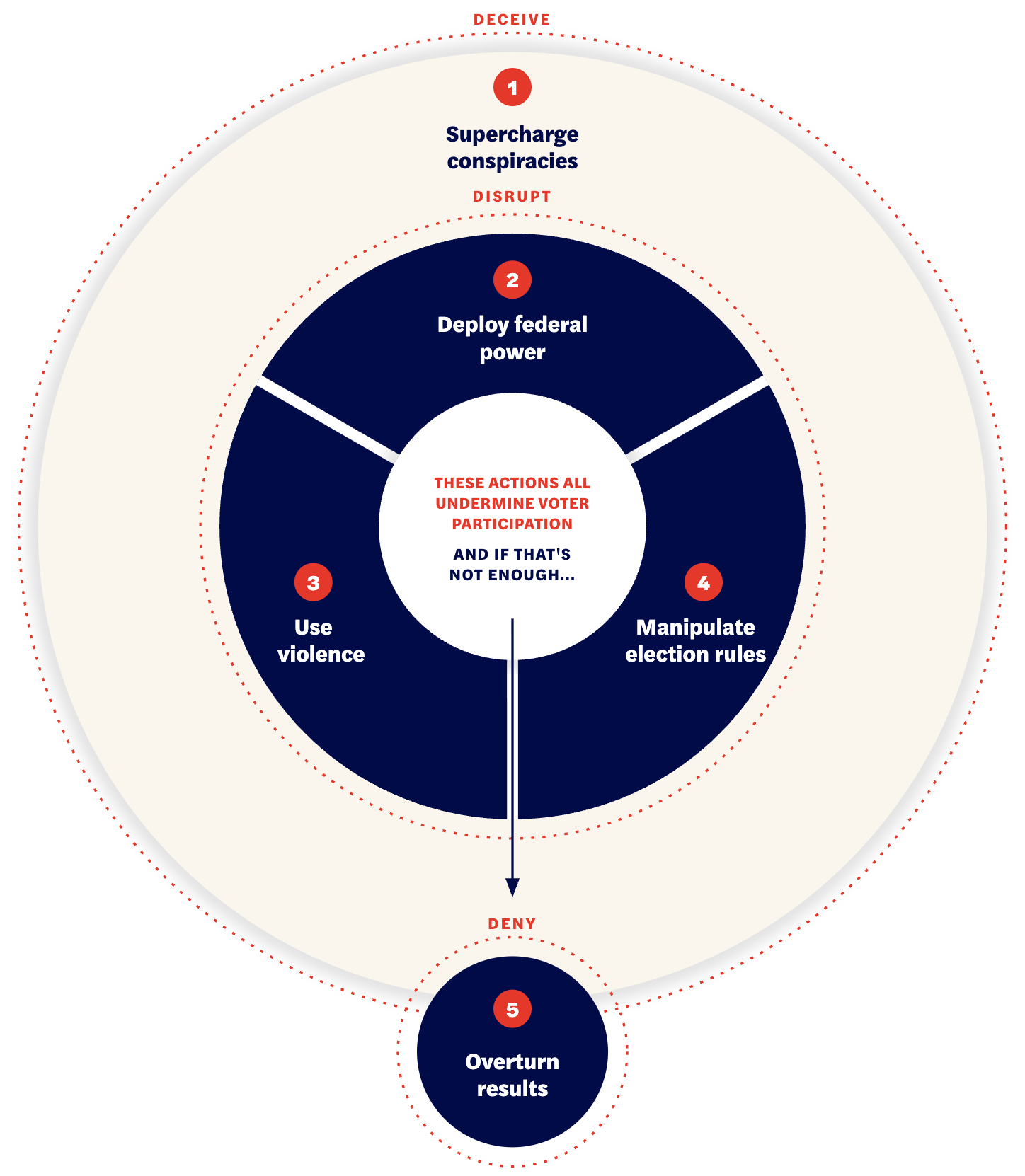
Over the coming months, we should expect the federal government to attack the midterms in a variety of ways. It’s a three-part plan to try to ensure that the president effectively picks the next Congress, not the voters.
First, deceive: The administration has institutionalized election denialism as official federal policy, using law enforcement and intelligence powers to manufacture the appearance of fraud — including a Jan. 2026 FBI raid on a Fulton County, Georgia election office and the seizure of voting machines in Puerto Rico — while dismantling the agencies that protect elections from real threats.
Second, disrupt: Federal investigative and prosecutorial power is being used to target political opponents, civil society organizations, and nonpartisan election officials. The administration has also created conditions for voter intimidation through the possibility of deployment of ICE agents near polling locations and the use of force against protesters.
Third, if necessary, deny: The administration is positioning itself to contest, delay, or overturn results it doesn’t like through post-election law enforcement action, pressure on certification officials, bad-faith litigation, and potential defiance of court orders.
We don’t know exactly how this strategy will manifest in the months ahead (I suspect Trump and his allies don’t either — they’re going to improvise a lot) but just for example, here are three news stories just from this week that clearly fit into the plan:
In California, one of the president’s allies — a sheriff who just so happens to be running for governor — seized more than 650,000 ballots from last year’s redistricting election based on an “audit” from a group of citizens. (Not clear yet if the federal government is involved, but it’s a textbook example of casting doubt on elections.)
In Washington, D.C., Trump’s allies on the Supreme Court expressed extreme skepticism towards mail-in voting, hinting at unfounded conspiracy theories about security and integrity.
In Oklahoma, the state government handed over its voter rolls — including sensitive personal information — to the DOJ as part of the administration’s demands for data on all voters.
That’s just recent days. Expect stories like this every week between now and when the next Congress is sworn in next January. All of them will fit into this overarching strategy — and they aim at the same goal: overturning elections if the president’s allies lose.
What can we all do about it?
The good news is that this strategy, while genuinely dangerous, faces enormous obstacles. And we are far from powerless.
The Executive Override report identifies five major roadblocks standing in the administration’s way. These are the pillars of American democracy that make it much harder to corrupt and steal legislative elections in the United States than it was in Russia, Hungary, or Venezuela.
None of them are invincible — but together, they’re formidable.
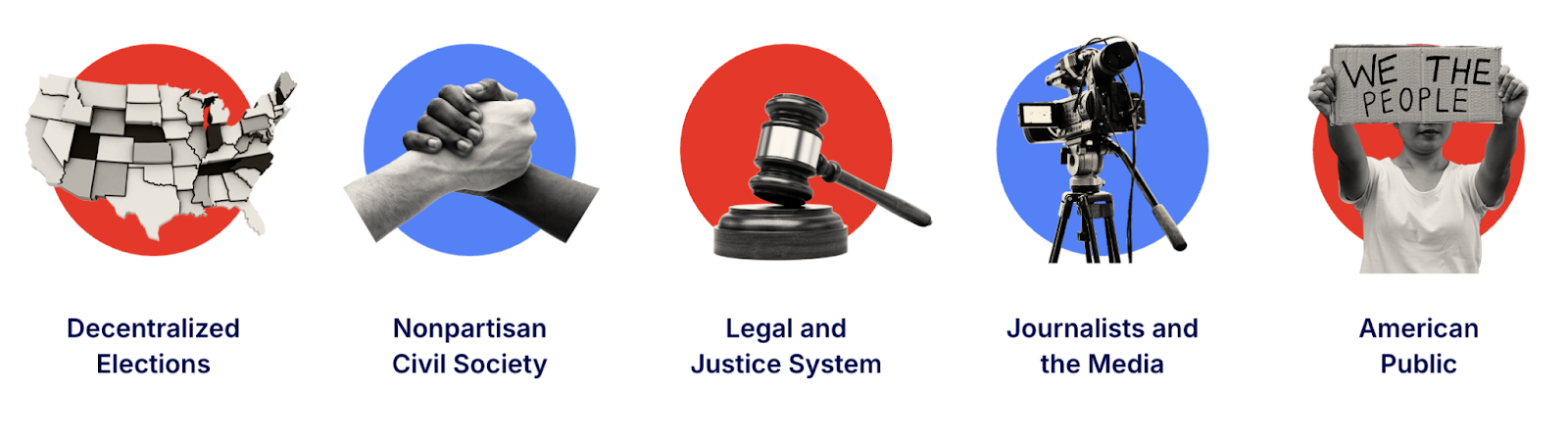
Our elections are decentralized. There is no federal election system. Elections are run entirely at the state and local level, with very little role for the federal government. That means Trump and his allies aren’t seizing control of the machinery from the inside. Even from the White House, they’re attacking it from the outside-in. That’s a much harder thing to do. Still, state and local election officials need to have a clear understanding of the likely threats before the pressure arrives, making concrete plans for how to respond when it does, and building solidarity with counterparts across their states and communities so that no one faces that pressure alone. [Read more here →]
Civil society is ready. Far more so than even in 2020, a wide range of nonpartisan organizations, civic groups, and private sector leaders are prepared to defend free and fair elections. The pro-democracy coalition is bigger and more organized than it has ever been — but it only works if it stays active. All of us need to speak out, organize, and act, using whatever credibility and reach we have to protect civic participation and make clear that attacks on our elections will not go unanswered. And yes: Be prepared to attend large protests if a critical moment demands it. [Read more here →]
The justice system remains a real check — for now. Courts have been one of the most effective counterweights to the administration’s power grabs, and that resilience extends to election law. But “fairly resilient” is not the same as invulnerable, and the legal community as a whole needs to be ready — from grand jurors who scrutinize the evidence to magistrates who decline to rubber-stamp deficient warrants to judges who apply the law rigorously when election subversion moves fast. The judiciary doesn’t defend itself. The legal profession has to defend it. [Read more here →]
The media can connect the dots. Independent journalism — including social and new media — remains capable of covering this story honestly. That matters enormously. The administration’s strategy depends on individual abuses of power being seen as isolated incidents rather than parts of a coordinated whole. Journalists, influencers, and creators need to be prepared to connect those dots: establishing clear protocols for covering government disinformation, linking specific actions to the broader strategy, and shedding light, not spreading fear. [Read more here →]
And finally: We the People. At its core, the Executive Override strategy seeks to rob all of us of our ability to elect our own legislators. That is not something the vast majority of Americans are going to accept quietly.
But we’re going to have to show up. Counter disinformation. Vote. Help others vote. Strengthen community connections. Volunteer as poll workers. Be prepared to mobilize peacefully if a critical moment demands it. (If you want practice, the next No Kings protest is this Saturday.)
Democracy only survives if we’re active participants in it — that’s always been true, and it’s never been more urgent than right now.
Want to learn more? Join us on March 31st at 1 pm ET / 10 AM PT to dive deeper into this critical analysis and how we prevail together
Protect Democracy’s acting chief impact officer Ben Berwick and All Voting is Local co-founder and chief executive officer Hannah Fried will dig in to the report, the systems and strategies in place in key races across the country, and why we must face these threats together.
ICE is not legally allowed to backfill TSA
The administration claims to have found an end-run around the partial government shutdown: sending ICE agents to airports to do crowd control.
This is, of course, as stupid as it sounds (ICE agents have no training on airport security). But just as importantly, it’s against the law. Congress didn’t fund ICE to do airport security — and unlawful spending abuses like these set a dangerous precedent for the future.
Protect Democracy has a new explainer of why: DHS funding is no blank check — and doesn’t permit ICE to backfill TSA
The use of ICE for crowd control at airports — a role that has nothing to do with its authorized immigration enforcement mission — is an alarming and drastic repurposing of federal agents to create a standing security force seemingly deployed at the whim of the President.
The Constitution recognizes the danger of having a “standing army” answerable only to the executive and unaccountable to the Congress. That’s why it limits funding for the Army to no more than two years. While this limit has been largely ignored for the last century, recent questions have been raised about whether Congress should once again take up this important check against executive branch abuses of authority.
President Trump has already shown his eagerness to deploy uniformed military forces for domestic policing operations. Now that those efforts have largely been rejected by courts, it is troubling to see him turn to ICE — newly equipped with military-grade equipment — as an all-purpose civilian law enforcement force.
Except I don’t think it will fail given I think they see they’re doomed without it, given they have said out loud they’ll lose if they don’t get it done for certain. Mike Lee said the quiet part out loud, I expect them to nuke the filibuster to do it before November at this rate on the SAVE Act.
Trump’s also at his likely lowest today (41.2), but it’s March, so who knows what’s coming and so far at Dems highest of cycle poll the lead is still under 6 points which is worse than even 2020’s average let alone 2018’s even now at this high for the party off of hatred of him alone (but it’s increased alright, now range is 4-5.8).
Re the SC's skepticism on mail-in "grace periods", there are fair arguments on both sides of that issue. In my view, such periods should be very short, if at all. I don't know how many days, but not many. Elections do have to be decided, and sooner is better.