


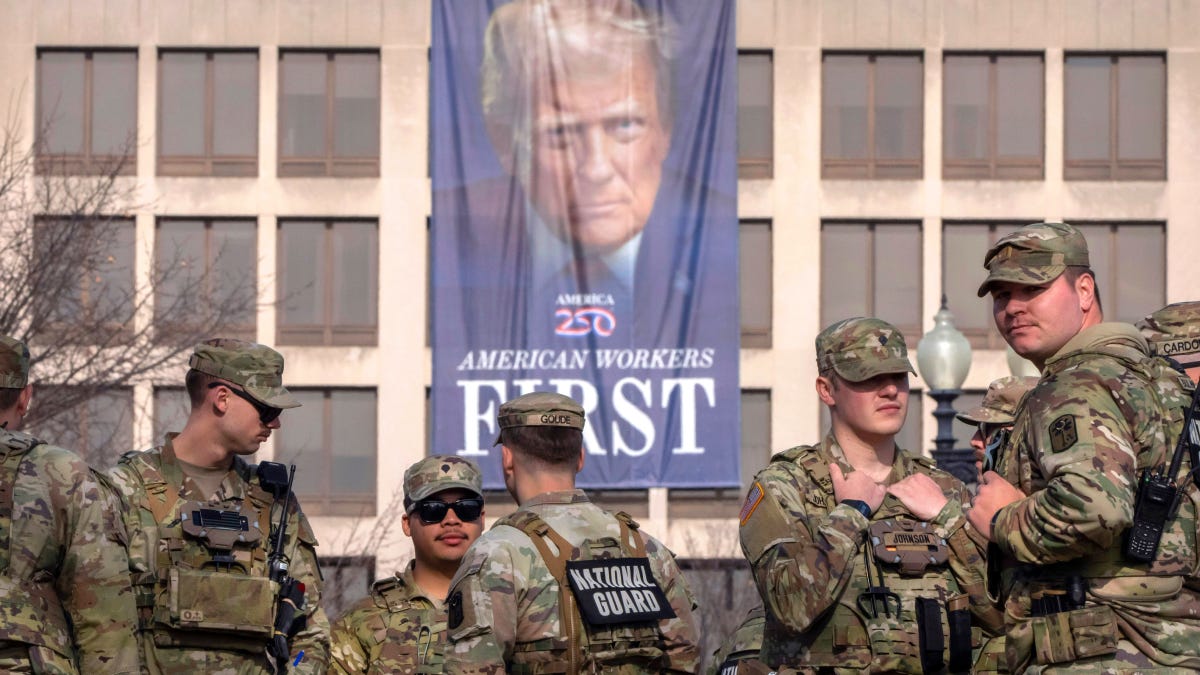
Next week marks one year since President Trump deployed National Guard troops to the streets of Washington, D.C. What began under the thin pretext of a “crime emergency” has devolved into a long-term — and unprecedented — military deployment in the nation’s capital.
In recent months, the deployment has ballooned to roughly 5,000 troops from D.C. and nearly two dozen states operating under Joint Task Force-District of Columbia. It’s been one dubious justification after another: the “crime emergency”; beautification of the Mall and other landmarks; security for high-profile events like the UFC fight at the White House. Abandoning the facade of exigent necessity, the Pentagon just confirmed that the D.C. mission will, at the very least, continue through January 2029 — when the next President is sworn into office.
Roving patrols of armed military personnel have been a familiar sight in Moscow, Cairo, Havana, and other capital cities around the world going back decades. But in the United States, law and tradition have long excluded the armed forces from domestic policing, ensuring the military could focus on its actual mission: national security.
Yet armed Guardsmen are now a routine sight throughout the District, rarely prompting headlines or national outcry — apart from exasperated D.C. residents who condemn the “occupation” of their neighborhoods. As fresh outrages have taken over the headlines, the prolonged deployment normalizes the day-to-day presence of uniformed troops policing civilian life. Compounding this problem was the decision by several Democratic governors to — after previously arguing in court that the mission was dangerous and illegal — accept the administration’s questionable public safety claims and deploy hundreds of their Guardsmen to D.C. during this summer’s Freedom250 programming.
The ripple effects of an indefinite, overtly political deployment extend far outside of the District, undermining civil-military relations, weakening the military’s nonpartisan ethos, and inviting future authoritarian abuses. Notwithstanding the integrity and discipline of our men and women in uniform, these risks are amplified by Defense Secretary Pete Hegseth’s comprehensive efforts to politicize the armed forces — from staging tank parades for the president’s birthday, to staging political rallies on military bases, to forcing senior officers into early retirement for exercising independent judgment, to corrupting the promotions process with a discriminatory political ideology.
These emerging dangers explain why separating military operations from domestic law enforcement has been a core tenet of the U.S. constitutional order, pre-dating the Revolution with hard-earned lessons from life under British military rule. Two hundred fifty years of self-governance have reaffirmed the wisdom of this principle. So have countless other episodes around the world.
We recently published a report — The Dangers of Military Intervention in Civilian Law Enforcement — on military interventions in domestic policing across history. We found that, time and time again, they produce three dynamics that are dangerous to civil society, the rule of law, and the military itself: escalation, disillusionment, and politicization.
One year in, and all three trends are clearly visible in D.C.

The deployment hasn’t reduced violent crime, but it has raised the risk of escalation
One recent analysis by the Center for American Progress finds that the National Guard’s D.C. deployment has had no measurable impact on the reduction in violent crime that started in earnest back in 2024. The Niskanen Center reached a similar conclusion, characterizing the deployment as “an expensive tool deployed in the wrong places for the wrong types of crime” with “no measurable effect” on violent crime in the District.
The fact that, for much of the past year, Guard patrols have predominately targeted the Mall and other high-traffic tourist areas rather than neighborhoods facing the highest crime rates underscores the White House’s prioritization of optics over genuine efforts to improve public safety.
Meanwhile, the escalatory risks to troops and civilians alike have grown. In November 2025, a targeted attack on two West Virginia National Guard members tragically killed Specialist Sarah Beckstrom and critically injured Staff Sergeant Andrew Wolfe. At the start of the deployment, military commanders had already contemplated the heightened risk of placing Guard members in harm’s way with their highly-visible D.C. patrols. After the attack, one D.C. Guardsman reflected: “Those poor kids just came to the city, and they didn’t want to be here … The whole thing is … senseless … I gave up trying to understand it.”
Tensions between D.C. residents opposed to the deployment and the Guard have continued to escalate in recent months. Though the Guard lacks law enforcement authority, the U.S. Marshals Service has deputized troops as special police, allowing them to carry firearms and detain individuals until police officers make any formal arrest.
In May, Guard personnel reportedly held down and detained Amy King, an Army combat veteran, outside of her D.C. home. When D.C. police arrived at the scene, an officer reported that King was involved in a prior confrontation — an allegation that King categorically denies. Though the full picture isn’t entirely clear yet, King filed a legal claim to challenge the Guardsmen’s apparently excessive force. This episode again emphasizes the fundamental mismatch between the Guard’s training and the de-escalation skills required during civilian confrontations — a gap that makes even routine encounters between troops and civilians more likely to escalate.
The costly deployment has a mandate far beyond the Guard’s core mission, breeding disillusionment
Polling consistently shows that the D.C. deployment is unpopular among residents (and Americans nationwide), fueling disillusionment inside and outside the ranks as troops take on duties well beyond the scope of their traditional mission.
The deployment’s substantial focus on groundskeeping, sanitation, and other “beautification” efforts around the District bears little resemblance to the troops’ specialized training and operational expertise. Reflecting that mission creep, a congressional report notes that the D.C. Guard has more specified metrics for measuring its beautification efforts than for measuring the deployment’s impact on public safety. Even Acting Attorney General Todd Blanche framed the mission through these efforts, telling a crowd of Guard personnel they should measure their success “[N]ot just [in] the reduction in crime, but the beautification of the city … [and] the cleanliness of the city.”
And the price tag only keeps growing. The deployment is already on track to cost more than the Metropolitan Police Department’s (MPD) entire annual operating budget, and could total between $2.5 billion and $3.4 billion by January 2029. The Pentagon’s own more conservative estimate, which assumes a troop drawdown from current levels, still puts the total well over $1 billion. The administration seems unfazed by the mounting costs, and officials recently signed a $292 million contract to house Guard personnel in what the National Guard Bureau called “the largest interagency lodging acquisition” in the Guard’s history — for a deployment that most local residents neither asked for nor want to continue.
The costs of the prolonged deployment extend to the Guard’s readiness. D.C. Guard leadership reportedly expressed “significant concerns” that the deployment has already degraded — and will continue to degrade — operational readiness, particularly “in the event of a foreign conflict,” hardly a far-fetched risk as hostilities with Iran continue. The deployment has also strained the MPD’s own force readiness, pulling dozens of police officers off their beats to deploy alongside the D.C. Guard in lieu of their full-time law enforcement duties.
The administration has politicized the deployment
In the early weeks of the deployment last year, internal National Guard documents warned of growing perceptions that the mission would drive a “wedge between citizens and the military,” pointing out the predictable byproduct of a deployment tied to the administration’s power grabs. Whatever the Guard’s efforts to remain above the fray, domestic deployments driven by politics rather than genuine security needs often perpetuate a cycle of politicization. As the D.C. deployment has become more embedded over the past year, reports of Guard personnel veering into politically fraught territory have also increased.
Ahead of the D.C. primary elections in June, footage showed Guard personnel patrolling around a ballot drop box, immediately raising concerns about potential voter intimidation. The fact that troops apparently received no clear instructions before voting started to avoid areas around polling sites or drop boxes shows how prolonged deployments have the potential to create downstream political risks.
Another video that was posted to the Guard’s website — before it was removed following public backlash — showed departing Arkansas Guard members signing a “Free D.C.” flag as if it were a trophy or souvenir from battle. Whatever the intent, the optics alone show how the continued deployment of out-of-state troops fuels further politicization that ultimately undermines the Guard’s apolitical tradition.
Earlier this summer, Guard personnel were roped into President Trump’s Reflecting Pool saga, patrolling the grounds around the Lincoln Memorial alongside U.S. Park Police in search of alleged vandals and threatening to detain anyone suspected of touching the water. And in July, hundreds of Guard members served as the staged audience for a political stunt by Secretary Hegseth and Stephen Miller, placing troops squarely in the middle of the administration’s politicized rhetoric aimed at D.C. residents and those opposed to the deployment.
Taken together, these developments demonstrate how the deployment’s continuation normalizes the Guard’s presence on America’s streets — accelerating the potential for more overt politicization down the line — in D.C. and elsewhere. Normalization invites mission creep, and an ever-expanding mandate will inevitably serve political ends. This is already happening: the Tennessee Guard has been deployed for months in Memphis as part of a federal task force focused principally on advancing the administration’s domestic immigration agenda.
When the military is used for political purposes, public trust, operational readiness, and civil-military boundaries all erode. And a military tapped to carry out a partisan agenda on behalf of whoever holds power threatens the very constitutional order it is meant to protect.
There are still opportunities to change course
With the administration’s continued extension and expansion of the National Guard’s deployment in Washington, D.C., it’s increasingly clear that normalizing the presence of armed troops patrolling the nation’s capital is a feature, not a bug, of the mission. But we need not acquiesce and march down this troubling path. There are steps we can all take to ensure that the past year in D.C. does not become the new normal.
Tell your governor to keep the Guard at home. Roughly 90% of the Guard personnel currently in D.C. come from states around the country — Alabama, Alaska, Arkansas, Florida, Georgia, Hawaii, Idaho, Iowa, Louisiana, Michigan, Mississippi, Nevada, South Carolina, West Virginia, and Wyoming — and governors can freely decline participation or recall deployed troops at their discretion. Indeed, roughly half of sitting governors — of both parties — have refused. Others have brought troops home early after learning more about the situation on the ground. Deployments to D.C. take employees out of their full-time jobs, parents away from their families, and undermine the mission readiness of Guard units for core functions at home and abroad. The risk of serious political backlash can help governors muster the necessary courage to resist or draw down existing deployments.
Tell your Members of Congress to demand accountability. One of the few must-pass bills every year authorizes our national defense policy, providing lawmakers the opportunity to rein in the administration with provisions limiting domestic military deployments and demanding transparency from administration officials. Provisions tackling other areas of executive branch overreach have already drawn bipartisan support this cycle, and the legislative door for reform remains open not just this year but in the years ahead.
Distinguish between honorable troops and dishonorable policy. The overwhelming majority of Guardsmen deployed to D.C. have followed the law and treated civilians with respect. Many themselves have misgivings about the mission and are doing their best to navigate difficult and unpleasant circumstances. The public absolutely should demand accountability for individual incidents involving excessive force or other unlawful conduct. But advocacy and rhetoric should be careful to avoid alienating law-abiding troops and their families, when it is civilian leaders who bear ultimate responsibility for this unnecessary and improper deployment.
Veterans and retired national security leaders can speak out. These voices carry unique credibility on the threat that improper domestic deployments pose to healthy civil-military relations, and many have used their platforms to inform and persuade. Many joined a legal brief explaining the dangers of the D.C. mission to the health and strength of the military. Others have spoken up in support of the governors who declined to send troops this summer.


I was wondering if the reason that administration wants to keep the guard in DC is because they’re worried about future protests and unrest against them. They want armed military on the ground in case they have to put down a “rebellion.“ Like if they try to steal the midterms, or 2028.
In typical trump fashion, what we have here is a vote-buying and favorability-buying scam. Trump hates ‘welfare’ so what does he do when his garbage brain cooks-up every conceivable way, including tariffs, and wars, and monuments to himself, and a $1.8b slush fund to distribute to do with what he wishes — and thereby raises the cost of living for middle class Americans? In amidst his endless self-enriching and self-serving grift and corruption, he pays tens of thousands of Nat’l Guard troops to walk around DC chatting with one another and checking their step-counting apps. This is purely a subsidy for these mostly young citizens to buy favorability and votes. He bypasses Congress in providing these subsidies to large numbers of favored Americans, just like he’s doing with the salaries and signing bonuses for ICE recruits and many others who he wants available as his personal militia when he needs them.
The corruption is simply unprecedented.