


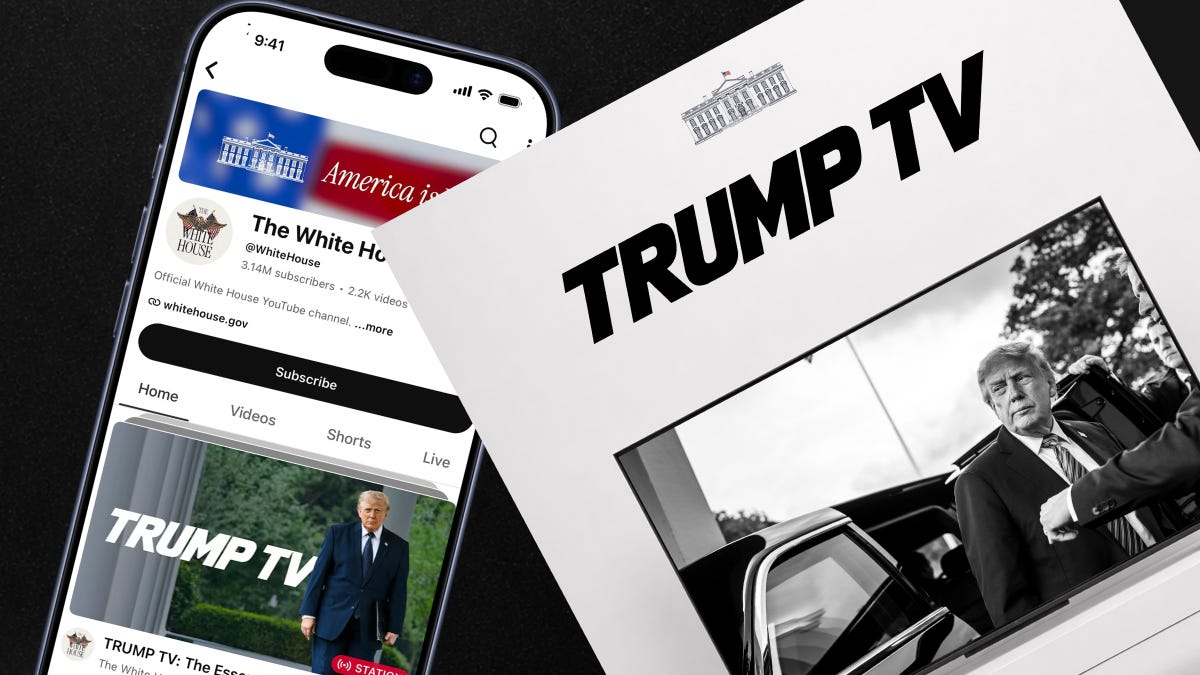
Yesterday the White House created a state-run streaming service named after our president, Trump TV. So far, the entertainment value appears to be limited (it’s mostly just reruns of old Trump speeches). Even so, it comes just days after the president banned several prominent news outlets from the White House.
Trump TV is part of a much larger effort by the White House to distort public perception, bias content, and generally spread propaganda. Every White House wants to persuade the populace that the president is right — but Trump’s goal is not to persuade. Like all authoritarians, he wants to control the information environment and force opposing views out of sight. That’s why, at every turn, this administration has tried to suppress independent journalism and simultaneously elevate regime outlets and allies. (Protect Democracy is litigating to secure records about how the Department of Homeland Security has used this strategy to shape public understanding of its brutal immigration enforcement efforts.)
But this propaganda is not just offensive and anti-American. It’s also illegal and potentially punishable by jail time.
Spending taxpayer money on propaganda is illegal
For 75 years, Congress has banned the use of federal funds for publicity or propaganda. This restriction is included each year in the spending laws and applies to all of the spending across all of the appropriations laws.
The current restriction is Section 718 of the Financial Services and General Government Appropriations Act for Fiscal Year 2026. It states:
No part of any appropriation contained in this or any other Act shall be used directly or indirectly, including by private contractor, for publicity or propaganda purposes within the United States not heretofore authorized by Congress.
More about the Anti-Publicity & Propaganda Rider here —>
That means that any agency or employee that uses funds for publicity or propaganda that has not been explicitly approved by Congress spends money that agency doesn’t legally have. This constitutes a violation of the Antideficiency Act, which prohibits agencies from spending unappropriated federal funds. (See B-302710, May 19, 2004.)
You would be hard-pressed to find a federally funded agency, resource, or staffer’s time that is not bound by these restrictions.
And that makes sense, right? How could you possibly get the bipartisan votes you need to pass spending laws if the people in charge of agencies could turn around and use that money to talk about how great they are as a person or as a political party? Of course there are laws against that.
When an official uses taxpayer-funded resources — their time, their government computer, their government phone, their government staff — to put out partisan communications, or communications that glorify an agency or official, that is a violation of these restrictions. “Covert communications” also violate the law, as when government money helps produce a video or segment but that government role is never disclosed to the public. (Whether that’s happening at DHS is one of the things we hope our litigation will shed light on.)
Importantly, there is no minimum dollar threshold for a violation. Any use of agency resources counts — even a single dollar or a social media like or retweet.
Slapping Trump’s name on the Kennedy Center, hanging banners of his face on government buildings, the Department of Defense secretly hiring influencers to push positive press, and now the creation of Trump TV all clear it by a mile based on existing precedent.
Jail time? It’s not off the table
The legal consequences for violating this law fall under the Antideficiency Act and include a range of penalties from removal of officials to fines and jail time.
Federal employees who knowingly and willingly spend (or commit the government to spend) beyond available appropriations face up to $5,000 in fines, up to two years in prison, or both. Responsible officials are also supposed to face appropriate administrative discipline, including suspension without pay or removal from office.
For decades, agency and White House lawyers have largely followed these laws, preventing secretaries from making political pitches on government time or naming buildings after themselves.
American taxpayers are paying for Trump TV. They’re also paying for dozens of other efforts that likely violate this rule. The reason this law exists, though, is so that you can have some confidence that the money you give the government is not used to sell some party or candidate back to you. And right now, that’s exactly what this administration is doing.
They have been beyond sloppy at policing their compliance with it, but the laws are still on the books. And the criminal penalties have a five-year statute of limitations. No one is holding their breath on the current Department of Justice prosecuting anyone, but people prepping Trump TV for prime time should be aware that the next DOJ may not feel the same.
Goodness knows there will be plenty of networks interested in covering the fallout.

