


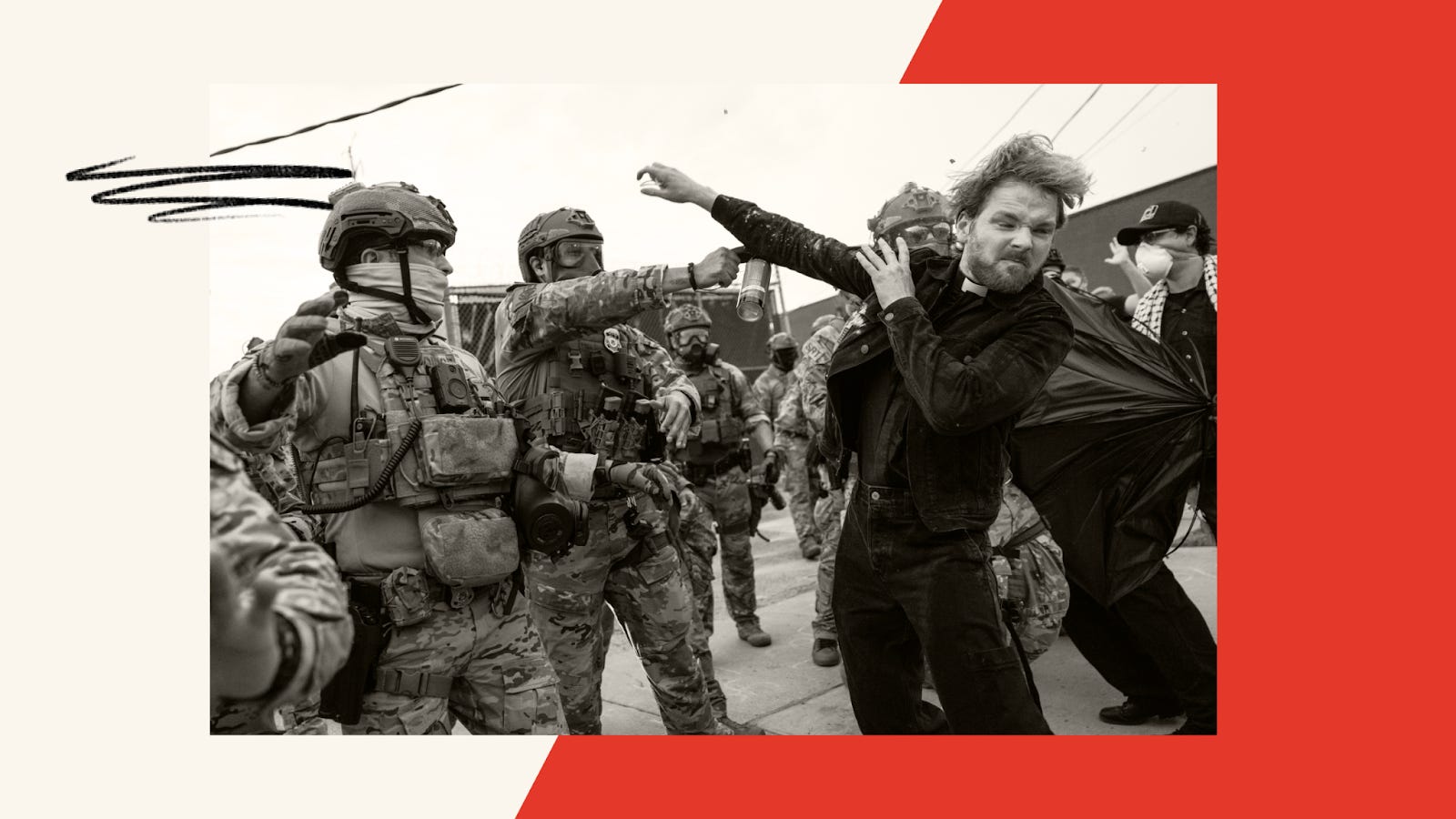
With our partners at Interfaith Alliance, Protect Democracy is launching a national campaign celebrating the many religious leaders and communities actively mobilizing against DHS’s authoritarian and dehumanizing tactics.
Yesterday, this ad started running in digital, broadcast television, and streaming media markets across the country (including West Palm Beach, FL). The spot will run between now and Christmas — please do let us know if you see it in the wild.
We would love your help sending it to anyone in your life who considers themselves a person of faith, whatever form that might take. This ad is about Christmas, but the message of grace and love, not hate or cruelty, is universal.
Add your name and help spread the message at: LoveNotICE.org
Speaking candidly about religion and democracy may feel like unfamiliar territory. (At least it is for me — speaking as a Catholic by upbringing but not practice.) A not insignificant part of what we are all working to protect is our freedom to disagree about what, if anything, is sacred.
Yet while separation of church and state has always been a critical part of the American experiment, our communities of faith and religious leaders, from Quaker abolitionists to Rev. Martin Luther King Jr, have always been critical moral voices in our civic conversation.
That same moral clarity and leadership is proving to be critical in our current struggle for democracy. (For just one example, watch this remarkable video from the Catholic Conference of Bishops.)
There are three reasons why this religious mobilization is so important — and is having such a profound impact. One is moral, one practical, and one historical.
Reason one: Democracy is a moral cause
First, democracy is not just some soulless, technical thing. The struggle to maintain, and ultimately improve, our systems of self-government is a profoundly moral quest.
All the values that democracy represents — grace, selflessness, humility, cooperation, compassion, human dignity, love — intersect with those of essentially every faith. Contemporary religious movements and faith communities can help give democratic values endurance and meaning. They ground shared values in community life and practice democratic principles day to day.
As Ian Bassin and Rev. Paul Raushenbush, Interfaith Alliance’s CEO, wrote today in The Bulwark: Toward a new Great Awakening.
The turn toward the holidays feels more difficult this year. All around us we’re confronted with tragedies deeply at odds with the spirit of the season: a college student on her way home to surprise her parents deported instead by our government to a country she left when she was 7; students forced to cower in fear under the desks on which they should be taking their final exams; a head of state responding with mockery and derision to the brutal murder of a loving couple.
It feels as if we are in a moment in which the moral ground beneath us is shifting. Compassion is in retreat and hatred is on the rise. Alienation is ascendant and community harder to find. Our public life is fractured, our discourse coarsened, and our confidence in one another eroded. Unmoored and anxious, the temptation for many is to retreat into tribes or despair. Or both.
Yet history whispers that such times are not only moments of danger. They are also invitations.
America has been here before.
Again and again, when the nation has faced spiritual exhaustion or moral confusion, waves of renewal have risen—not imposed from above, but kindled in hearts, congregations, and communities. We have called these movements “Great Awakenings,” moments in which we collectively re-find our purpose, conscience, and responsibility to one another in response to a feeling of having lost those things.
Read their whole article here. It’s wonderful and there’s no paywall.
When we speak of democracy only as a mechanical thing — as process and systems, not soul and values — I think we miss a large part of the point. Democracy is nothing short of a profound expression of love and faith in each other. The notion of human dignity of all individuals, as embedded in almost all faith traditions, forms a bedrock of individual rights and the rule of law.
Reason two: Religion is already caught in the struggle between autocracy and democracy
Second, the practical reason. Like it or not, religion is already central to the conflict between authoritarianism and democracy in the United States.
Just as faith has been a powerful motivator for democracy and freedom, so too has it been used as a justification for repression, abuse, and autocracy across history. From the Taliban in Afghanistan to Tsarist Russia to modern competitive authoritarians in Poland and Hungary, dictators have often claimed the mantle of protecting faith.
Since he first arose on the national scene, Donald Trump and those around him have sought to hijack and misappropriate religion in pursuit of oppression and power. While there is little evidence that Donald Trump himself is religious in any real way, his rhetoric often verges on messianic. (As Michael Kruse wrote earlier this year: Does Trump actually think he’s God?)
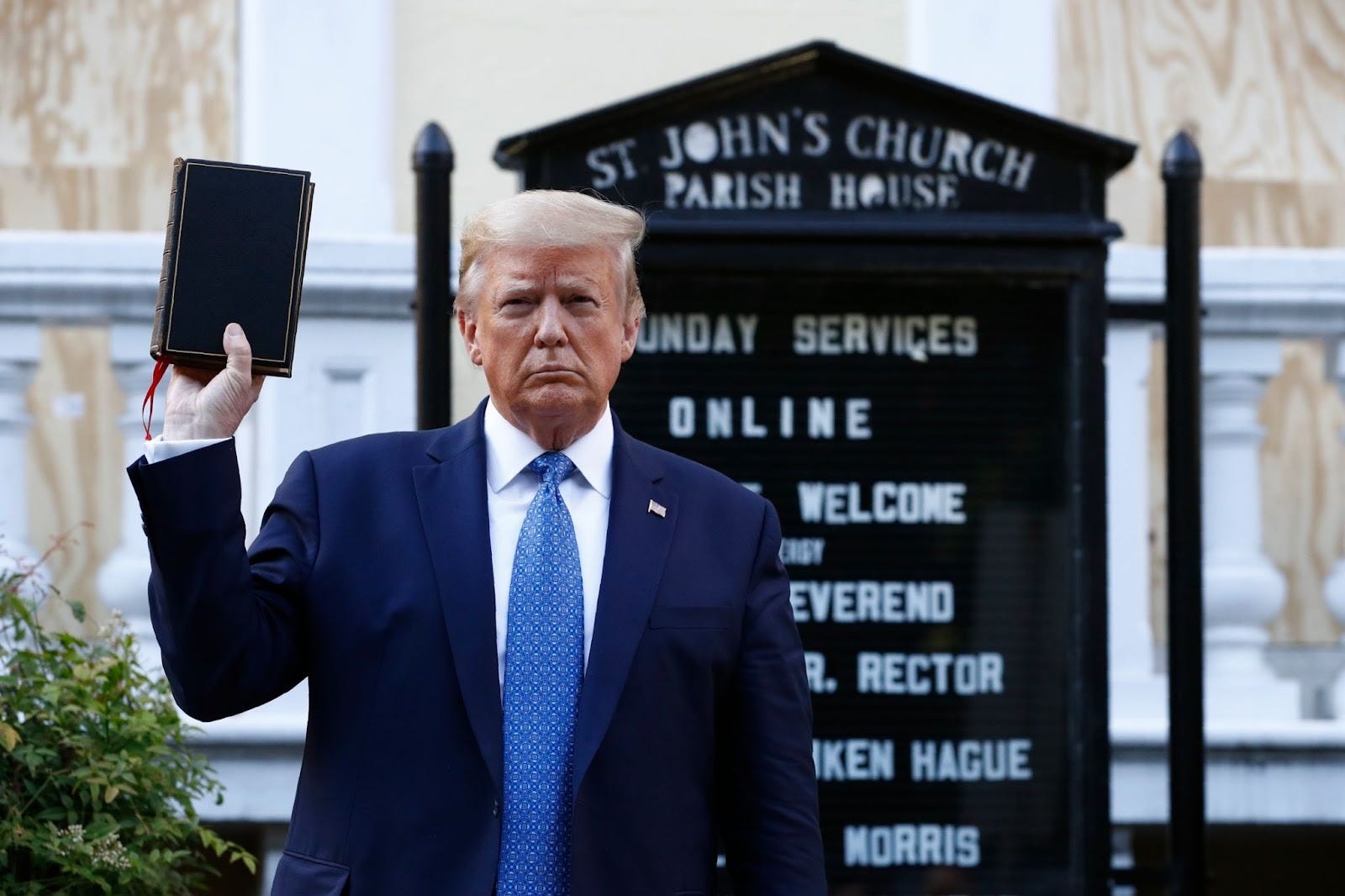
Almost every corner of this administration is infused with a particularly radicalized (and racialized) vision of Christian nationalism.
Against this backdrop, religious leaders and communities across traditions are speaking out, signaling that many within faith communities see this moment as one that demands moral attention and public response.
Reason three: The immense historical power of religious mobilization
The final reason religious mobilization is so important?
Simple practicality: When religious communities line up on the side of democracy, democracy tends to win. Around the world, religious leaders have often been early, front-line, and disproportionately effective pro-democracy leaders.
(Shortly after Trump was elected, my former colleague Chris Crawford was asked who is going to be the first to stand up to the president. “I think it’s going to be the nuns,” he said. He was more-or-less right.)
If you look across history, the catalytic role religious actors often play is, honestly, striking. Not only have almost all pro-democracy movements included people of faith as at least one part of the coalition, but in many cases, they play an early and tone-setting role:
Martin Luther King Jr.’s Baptist ministry formed a moral bedrock of the Civil Rights Movement, as did other religious leaders like Rabbi Abraham Joshua Heschel.
Mahatma Gandhi’s inclusive Hinduism was arguably a founding creed of Indian democracy.
Lech Wałęsa and other devout Catholics forged Solidarity — a broad coalition with labor and civil society — that overcame autocracy and built a lasting democracy in Poland.
Bishop Desmond Tutu was the voice and heart of the movement against Apartheid in South Africa (and chaired the Truth and Reconciliation Commission).
The Arab Spring, at its most aspirational, was infused with pluralistic visions of Islam, such as that of Tunisia’s Rached Ghannouchi.
Corazón Aquino, a devout Catholic backed by the Philippine Church, led the People Power Revolution to topple dictator Ferdinand Marcos in a nonviolent revolution.
Archbishop Oscar Romero’s leadership, and subsequent assassination, were critical factors in El Salvador’s struggle for democracy.
(I told you. Striking!)
So how can religious communities in the United States today play a similarly catalytic role?
I recommend starting with our The Faithful Fight series, developed with the Horizons Project.
The Faithful Fight draws upon the experience and expertise of religious leaders from across denominations and across the country, bringing practical skills and uplifting stories to help religious communities take action in ways that align with their values and their skills. It includes lessons on everything from building bridges across difference to organizing and training for collective action.
Explore all the toolkits here:
Most important, though, is for all of us, whether we consider ourselves religious or not, to vigorously engage in our democracy with love and faith in each other.
As Ian and Rev. Raushenbush conclude in The Bulwark:
The task before us is not to win arguments, but to begin to heal a moral ecology. To cultivate the virtues without which no free society can endure: honesty, courage, patience, generosity, empathy, and hope. Hope, especially — not as naïve optimism, but as disciplined commitment to the common good.
In troubled times, the question is not whether history will judge us. It will. The question is whether we will rise to the moment we have been given.
May we have the courage to awaken again.
Whatever your faith tradition holds, may you have a restorative holiday season that inspires action, courage, and awakening.
Excellent. And keep showing up. Susan Tincher, a 55year old Rotarian, keeps showing up. And it works.
https://open.substack.com/pub/jasonstanford/p/agents-cut-off-her-wedding-ring?r=2nzz7&utm_medium=ios&shareImageVariant=overlay
I saw the ad in Charlotte last night. So powerful. Thank you.