



Something about this Thanksgiving feels special. The midterms are over and the presidential campaigns haven’t begun. The Trump era is clearly fading. What comes next is still a ways off.
For me, this holiday is the first moment of genuine pause — for reflection, inflection, and quiet uncertainty (the good kind, not the bad) — in many years.
If you can, I’d encourage you to embrace this magic hour of stillness and possibility. It’s a time for fallow fields, not fresh furrows. In that spirit, instead of writing, I want to encourage you to read three brilliant pieces written by others — pieces that speak to the questions, not just the answers.
“How to fix the country,” by Pema Levy
If you read one long-form piece for the rest of this year, make it this one by Mother Jones’ Pema Levy. In it, she contrasts the incoming 120th Congress’ monumental structural reform challenges with the eerily parallel task faced by the 39th Congress, which took power in 1865:
[T]he 39th Congress faced [an] immediate and existential threat: Abolition had undone the Constitution’s notorious three-fifths compromise, which had inflated white Southerners’ political power before the war. By not allowing the freed men the right to vote, abolition would now ironically hand white Southerners some 30 extra votes in the House and Electoral College—enough that they might win control of the federal government when combined with allied Northern Democrats. If that happened, ex-Confederates aimed to reinstate a form of slavery, compensate slaveholders for their lost property, and pay off Confederate war debts while blocking payments on the Union’s. The threat left two tasks for Republicans: democratize the nation and keep the former Confederacy out of power. These projects were inextricably linked.
Now, 161 years later, the increasingly unhinged second presidency of Donald Trump is threatening to end American democracy, just as civil war and the threat of Confederates returning to power did. Trump’s movement violently stormed the US Capitol to overturn the 2020 election, and, back in office, he has challenged the country’s ability to conduct free elections.
…
Despite these authoritarian tactics, the Democrats’ resounding midterm victories have forced Trump’s coalition out of power in Congress. If MAGA should lose the White House, the anti-Trump majority must decide whether it can proceed with mere tweaks to our democratic system—the path Democrats followed after Trump’s first term, when they failed to enact new voting rights legislation, only to see him return more dangerous than before—or make major reforms to vanquish Trumpism by creating a more small-d democratic government.
Read the piece here, no paywall.
“The next era could come sooner than you think,” by Grant Tudor and Lee Drutman
A year ago, Grant Tudor and Lee Drutman wrote about why our seemingly intractable and calcified two-party dysfunction may be much less stable and entrenched than it appears. At the time, it felt helpful and optimistic. Now, a year later and after a seismic election? It feels downright prophetic.
Especially if you didn’t read the piece then, read it in full. A taste:
[T]wo-party systems are a choice. They are just one way of organizing a country’s politics, one that many political scientists warn against. It’s also, thankfully, an arrangement we can change — with a simple act of Congress (no constitutional amendment required).
The problem, of course, is the political will — and the collective belief that a different game is possible.
It’s on that measure where we feel more optimistic than ever before about the advancement of proportional representation, the single most important electoral reform that would open the door to more creative, pragmatic, proportional multipartyism. Within the last six months, several intersecting trends have begun to point towards a massive reform window opening. Not just in our lifetime, but potentially within a few election cycles.
Admittedly, many of these trends are not in themselves positive ones. (In fact, many are the convulsions of a democracy in serious crisis.) But taken together, they may also present an opportunity for democratic renewal.
Here is our case for why big electoral reform is more likely than it’s been in half a century.
Read their whole article here.
“How open are Americans to electoral system reform?” by Sohini Desai
Three years ago, Protect Democracy conducted an experiment. We planned a Thanksgiving menu by polling the country on its favorite dishes.
...but with a twist.
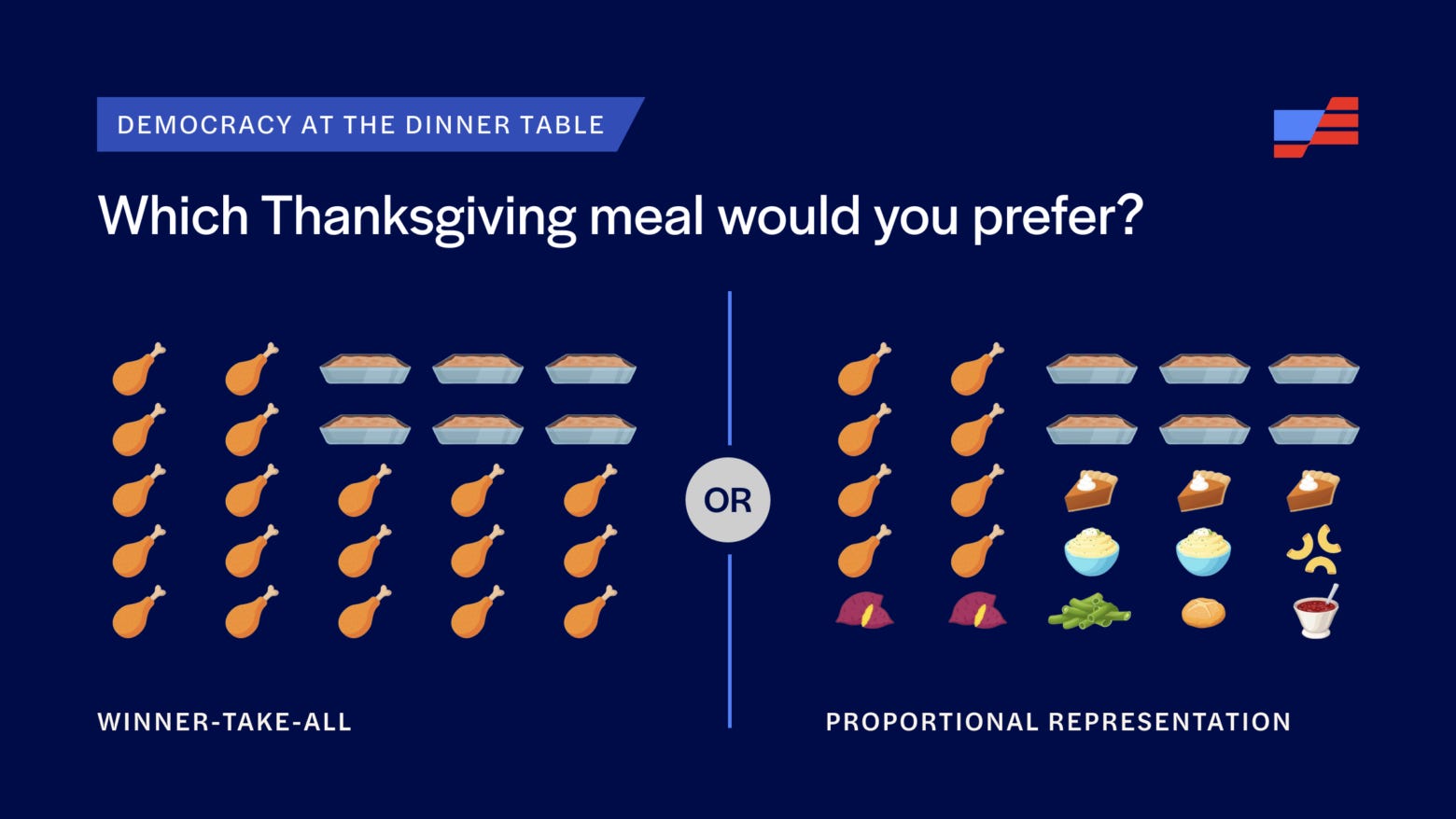
We elected the menu two different ways: First, using the same winner-take-all electoral system we use to elect Congress right now — each district elects one winner — and second, using a simple proportional representation method instead.
Under the winner-take-all system, it was a predictable two-party showdown of turkey and stuffing. Those were the only two dishes that could get elected anywhere. But under a proportional representation system? Completely different. The whole table was represented. Pumpkin pie, mashed and sweet potatoes, green beans, mac ’n’ cheese. The Midwest voters, earning my ongoing respect, even elected dinner rolls.
Analysis of the poll explains:
A national poll conducted by Citizen Data on behalf of Protect Democracy confirms popular wisdom turned political trope — Americans are less than satisfied with their congressional representation. According to the poll, two-thirds wish they had more political parties to choose from. Less than half feel closely represented by their congressperson, and two-thirds don’t feel represented by Congress as a whole. These results hold true across the ideological spectrum — a majority of Republicans, Democrats, and Independents feel under-represented.
The familiarity of this dissatisfaction shouldn’t make it any less striking: in a functioning democracy, at least half of voters should feel represented overall, and most voters should at least feel represented by their individual congressperson.
The poll also reveals that Americans are quick to understand that the way we elect our representatives results in under-representation, and are therefore open to changing our electoral system.
Taken together, these findings suggest that dissatisfaction with representation is due in large part to the winner-take-all design of our electoral system, where a single winner is selected to represent an entire district. Those polled intuited what scholars have long argued: that winner-take-all can result in systematic underrepresentation — especially in diverse societies with significant racial and political minorities — along with uncompetitive elections that make much of the populace rightly feel like their vote doesn’t count.
It’s no wonder that most democracies around the world use some form of proportional representation instead, and that scholarly consensus recommends replacing winner-take-all with a more proportional system for U.S. elections, too.
Read the whole thing.
Happy Thanksgiving, friends. Have some dinner rolls for me. And as you’re digging into the feast, give thanks for this moment of possibility — and that you have more than two dishes to choose from.