


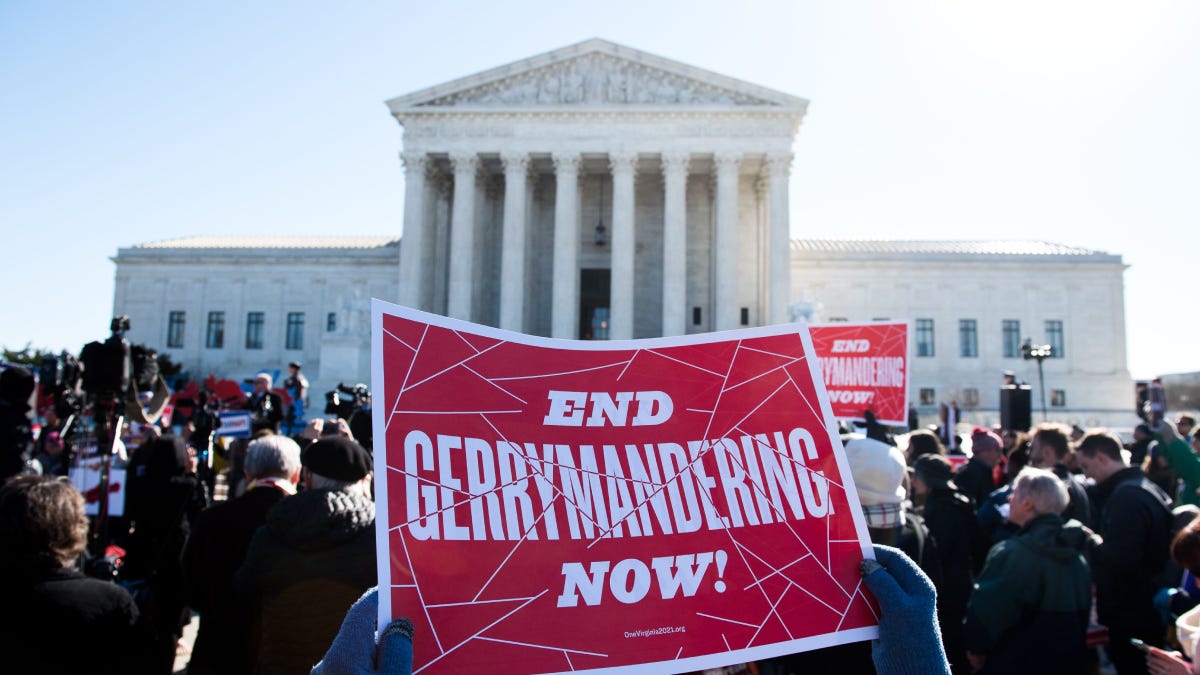
The Supreme Court’s decision to gut what remained of the Voting Rights Act is the latest blow to our democracy; states in the South immediately began mobilizing to redraw congressional and state legislative districts in a way that further dilutes the voting power of Black and Latino voters.
The situation for minority voters was dire to begin with. Latinos, for example, are dramatically underrepresented in Congress, occupying only 11 percent of its seats despite making up 20 percent of the population. Our voting power has been diluted by extreme gerrymandering for decades, which will likely grow more severe this year. In Texas, for example, where nearly 40 percent of the population is Latino, minority voters have long been underrepresented in the House delegation. The new gerrymandered voting map in Texas was specifically designed to eliminate Latino and Black-held seats; we will see more of this as a result of the Callais v. Louisiana decision.
Because this year’s midterm elections are vital to the fate of our democracy, with their potential to check the president’s authoritarian agenda, the Administration’s opponents are responding to these dynamics with gerrymandering efforts of their own in states controlled by Democrats. While this is an understandable impulse, given the high stakes, extreme gerrymandering is terrible for the health of our democracy in the long run. Even before the current rush to redraw districts, only 4 percent of congressional races this year were judged to be competitive overall.
Uncompetitive elections are a sign of a broken system that affects all Americans and contributes to our disillusionment with both major parties, as well as with our seeming lack of ability to do anything about our nation’s political gridlock. We are living through a year replete with evidence that our winner-take-all election system incentivizes the creation of uncompetitive elections that further political polarization. This has contributed mightily to the horrifying excesses of the Trump era, while Congress seems powerless to check even the President’s most egregious actions.
But even if we were somehow to prevent the further gerrymandering that dilutes minority voting power, it is not clear that even districts where Latinos and Black Americans are the majority of voters are the best way to ensure that our voices are heard fairly. In states with smaller but still significant Latino populations, like Colorado or Georgia, for example, the number of districts we control is likely to remain small, even without gerrymandering.
Beyond that, the idea that majority-minority districts will concentrate power among people whose views are similar because of their shared ethnicity has never held up in a community as diverse as ours. Just ask a Latino Republican in California or a Democrat in Florida.
We can do so much better than this. A growing body of research strongly suggests that Americans of all types, including Latinos, would benefit from a move to a fairer system for all voters, one that aligns voters’ actual preferences more closely with our electoral outcomes, and where every vote matters. A different electoral system — one used by most other mature democracies around the world — would ensure this: under Proportional Representation, multi-winner districts are used to allocate votes proportionally so that our elected representatives reflect the actual preferences of voters.
Read more — Proportional representation, explained
In a single-member district like the ones we have now, 51 percent of voters can elect one candidate, and the other 49 percent get nothing. But if four single-member districts collapse into one broader district that elects four winners, a minority population that makes up 25 percent of the district can elect one of the candidates. The 50 percent majority can still elect two candidates in proportion to their numbers, too. This means that voters are represented in proportion to their preferences regardless of whether the district lines are drawn to favor them.
In fact, gerrymandering tends to be far less of an issue in democracies with proportional representation. Because parties win seats according to their share of the vote, it typically doesn’t matter much how voters get shuffled around — wherever they are, their electoral power generally remains the same. And because votes are more likely to matter everywhere, parties and candidates are incentivized to broadly compete for those votes — including among voters of color. The system could even open up our two-party gridlock by allowing new parties to compete, reflecting a multipartyism in line with the diversity of American political perspectives.
Latinos have never waited for permission to shape this country’s future. We’ve built communities, forged coalitions, and fought for our voice in a system that was rarely if ever designed with us in mind. This moment, as dark as it feels, is not new. But we now have a growing movement of Americans from a diversity of backgrounds who want the same thing we do: elections that actually capture the will of the voters, representatives who have to earn every vote, officeholders who reflect the diversity of our communities, and a politics capable of solving very real problems rather than manufacturing endless conflict.
We should not continue to accept a system that dilutes our power, rewards extremism, and leaves the majority of Latinos and Americans feeling like our vote doesn’t matter. The choice before us now isn’t just between the two major parties: it’s between the broken system we inherited and a fairer one we can build together. For Latino voters and organizations, building a politics where our voices are heard and our votes counted is the next frontier of the fight for our representation and our rights. In this moment of peril for our democracy, it’s a fight we should take on.
This piece was originally published in Democracy Journal.

Mr. Bloch's comment is extremely important. The single district problem is definitely the reason that gerrymandering works, but how we choose in a multi-district system is the real question. If we continue to insist that parties or factions are to be represented proportionally, we do nothing but encourage the continued health of faction aggregators. The two party aggregators are the problem in the first place, and their power to steer elections as well as capture loyalty from our representatives must be addressed. Preference voting systems that intentionally attempt to address proportionality such as STV ranked choice type systems exacerbate the problem. Until we insist on genuine consensus voting systems like Condorcet for single seat elections or Borda for multi seat elections, we are not going to solve the problem of partisan capture of our governance. And yes, multi-rep districts are a critical part of structural repair, until we address all of the components simultaneously, the parties will simply adjust. How we vote, how we count, and how our legislators insure genuine non-partisan operating rules all need to emerge together. We have all become minority voters because factions are never "all policy issues" deep. Ms. Munoz is correct to point out that there is no such thing as "an Hispanic voter", even though many of our Hispanic brothers and sisters vote. They, we, all, are just people hoping for a voice as envisioned by Madison, Adams, Washington etc.
Absolutely.
Gerrymandering is hard to define, but there's one way to make sure you're not doing it: allocate voters to "districts" in a way that's utterly un-correlated with race, political party, or anything else, such as by birthday rather than home address.
Which would be an absolute disaster for minorities, whether racial, political, sexual, etc. If one party has a 52% majority state-wide, and "districts" are un-correlated with party, then that party will have a 52% majority in EVERY district, and win nearly 100% of the legislature.
But drawing districts by race or party is bad too, in that (as Ms. Muñoz points out) it creates a lot of "safe" seats for one party or another. When legislators are only worried about winning a party primary, not winning a general election, they're drawn to the extremes of their own party, and they have more incentive for performative defiance than for constructive compromise, so the resulting legislature is dysfunctional.
Any system of single-seat, winner-take-all districts will inevitably have one or both of the above problems: either many of the seats won't be competitive or minorities will be seriously underrepresented.
There are different ways to achieve proportional representation. Some are explicitly by race or party: if Party X gets N% of the vote, then it gets roughly N% of the seats. Unfortunately, this enshrines political parties into the voting system, when I'd rather see political parties _lose_ influence and "wither away". And if a political issue isn't associated with a particular political party, the system has no way to ensure proportional representation with regard to that issue. Other systems, like Single Transferrable Vote, achieve proportional representation by whatever criteria the voters consider important, as revealed by ranked ballots and regardless of party. Unfortunately, it's a fairly complex system, hard to explain, so it'll be hard to pass into law.