



To say the new Congress has its work cut out for it is an almost comical understatement.
From the moment they take power on January 3, they’ll face three essential tasks: affordability, pursuing popular legislation to address the rising cost of living, including gas prices, health care, housing, and tackling other issues that are worrying voters, like data centers and AI; accountability, pushing back on the Trump administration’s crimes, abuses, and corruption; and agenda-setting, laying the groundwork to win a pro-democracy trifecta in 2028 and what it would accomplish.
This “walk and chew gum and juggle” problem is the talk of Washington. Can they really do all three?
We don’t want to downplay the challenge. The job is monumental, no way around it. But at least when it comes to these three critical, absolutely do-or-die priorities, Congress actually has something pretty big going for it: Underneath the surface, affordability, accountability, and agenda-setting aren’t competing priorities. They all rely on the same underlying strategy: Congress must rebuild its own power, capacity, and leverage relative to the other two branches.
Much of what’s wrong with our democracy comes back to a weak and broken Congress
Consider the problem underlying each of the three pillars.
Affordability: Congress has lost the ability to pass legislation. In recent decades, legislative productivity has declined precipitously.
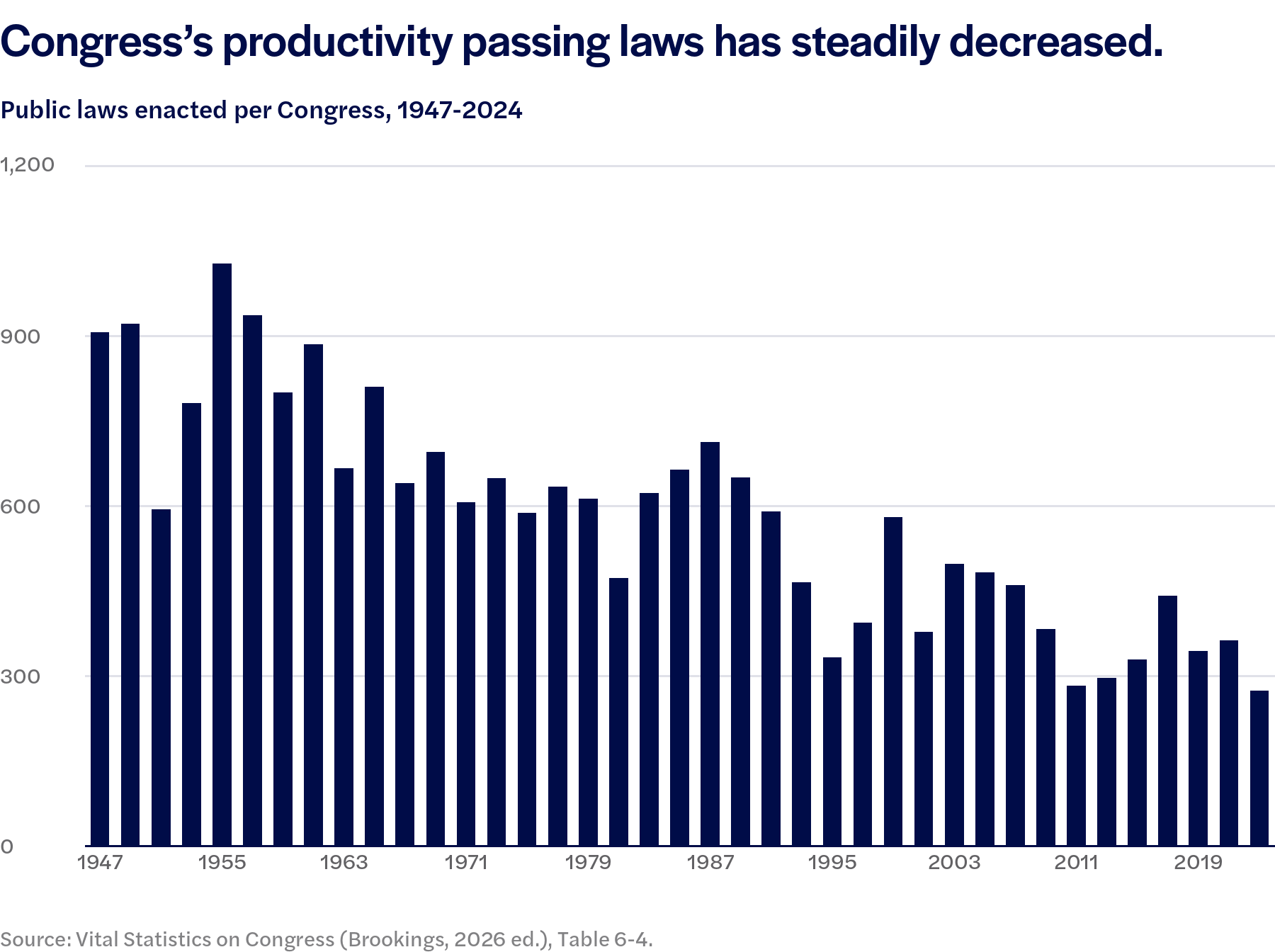
Congress’ inability to pass laws doesn’t just push key policy decisions into the executive and judicial branches; it is also at the root of the affordability crisis. Our democracy has been unable to tackle complex legislative questions of housing, energy, agriculture, and more. Like deferred maintenance, this dysfunction has spilled outward into our economy. (And, of course, the current Congress’ failure to flex its war powers to stop a disastrous war is probably the single biggest contributor to rising costs.)
Accountability: Over the last 22 months, the Trump administration (and their allies in the Supreme Court) has run roughshod over the Constitution and the Bill of Rights with hardly a flicker of pushback from the people’s elected representatives. If we’re going to continue to have a democracy, not an elected autocracy, the next Congress must regain the strength and capacity to be the first and most powerful branch. It’s not optional. Otherwise, all these other questions become largely academic.
Agenda-setting: Donald Trump came into office with an agenda that, legally or not, largely bypassed Congress. The next pro-democracy president will not have that luxury. If she or he is really pro-democracy, achieving durable, landmark priorities will require Congress. The biggest obstacle would not be a dearth of ideas, but rather a legislative branch that has lost the capacity to lead and to turn those ideas into law.
So, on all three of these priorities, Congress should conceive of each first and foremost as a problem of congressional power.
The affordability agenda requires building legislative muscle
The next Congress faces a big question: “Should Democrats seek to find areas of compromise with Trump in an effort to keep their election promises around affordability?”
Merely asking that question assumes that Congress must accept a weakened, secondary role in our system. We’ve all gotten so used to an outsized executive and a broken legislature that the presidential veto — designed as a tool of last resort against bad legislation — is now at the center of our political discourse.
Congress mostly shouldn’t care one way or another about what Trump will or won’t veto. The House should pass good, important, popular, and easy-to-understand legislation. Of course, under current Senate rules, the Democratic majority will need to win some Republican support for any bills that aren’t budgetary. So lawmakers should work across the aisle and challenge their colleagues to pass legislation that Americans want. If the president wants to sign those bills, great. Wins for the American people. If he doesn’t, well, make that his problem.
Show the American people that the president is the obstacle to what the people voted for, not Congress.
Congress needs to use accountability to reassert its own authority
Within the accountability agenda, a variety of tools are extremely conducive to building congressional power, even beyond the next two years.
Oversight, obviously, comes first: expose the crimes, corruption, and abuse of power. And oversight is part of addressing affordability. The American people understand that the rampant corruption is stealing from them and making their costs go up. Oversight can lay the groundwork for recovering the money stolen through corruption and impose accountability on Donald Trump’s oligarchic backers.
Congress should reclaim its power of the purse. Congress, not the president, allocates money. Trump and his OMB director, Russell Vought, have only been able to usurp this power and illegally cut funding because Congress has not pushed back. The new Congress can change that, punishing officials who infringe on Congress’ spending authority. It can also, in must-pass bills to fund the government, apply riders that prohibit the use of funds for the worst abuses of power — from weaponized law enforcement to blatant corruption.
(As a fun example: Congress could earmark the corrupt gifts the president has solicited for his vanity projects to fund priorities voters care about. Literally, they can pass a law redirecting ballroom funds to Medicaid.)
They can also rebuild Congress’ muscle to litigate against the administration. Trump has at times gotten away with lawless conduct — like construction of the ballroom — because the Roberts Court has said private litigants lack standing to stop it. But Congress has standing. (Congress should be strategic and staff up the lawyers at the Office of the General Counsel and the Office of the Senate Legal Counsel to be ready to stand up to a defiant White House and increasingly hostile Roberts Court.)
The new Senate should also lean into the confirmation power: No more life-tenured judicial confirmations for election-denying MAGA loyalist judges. No more Hegseths, no more Blanches, no more Kennedys. Trump must produce constitutionally suitable nominees or the offices will remain vacant. And yes, Trump will seek to exploit the vacancies process to circumvent Congress, but even then: The Senate should lean into the “advice” side of its “advice and consent” power, passing resolutions that declare those acting officers illegitimate and unqualified.
Finally, accountability is not just for the president. The new Congress should also confront the Roberts Court. If the Roberts Court had been on the ballot, it too would have been voted out. The Supreme Court has consistently stolen Congress’ power. It’s time to take it back. Congress can use its oversight power to shed light on just how extreme this Court has been and how removed its actions are from the needs of the American people. It can also develop legislation to limit the Court’s aggrandizement of its own power and address the corruption of justices — including, if necessary, using the power of the purse to force compliance with the law.
The next pro-democracy president will need a strong Congress, ready to lead
As congressional weakness has become the norm in our politics, we’ve shifted our focus from congressional agendas to presidential ones. There’s going to be an instinct to talk about how this new Congress’ agenda fits into the possible priorities of the next pro-democracy president. This Congress should aspire to flip that conversation: Build a legislative agenda that coming presidential contenders can fit themselves into.
If Congress succeeds in moving the center of political power back down Pennsylvania Avenue from the White House to the Capitol (as the founders intended, mind you), this won’t just benefit our democracy. The political fortunes of the next pro-democracy president would also benefit.
A top priority of the next president should be to rebuild trust that our democracy can meet the needs of the American people. This will require creatively wielding executive power in a lawful manner to quickly rebuild government and deliver results. But aggressive use of executive power alone won’t be enough.
The next president will need an able partner in Congress to achieve the meaningful, durable legislative change that voters demand, from lowering the cost of living, creating a more fair tax code, setting guardrails for AI, to enacting the structural reforms that will make our democracy more resilient and responsive, like eliminating gerrymandering through proportional representation and reducing the corrosive effects of money in politics.
As Congress works to assemble a bold policy agenda and win public support for it, it can also start building its own capacity to match the next president’s.
Congress should hire more experienced staff and increase their salaries, relaunch the Office of Technology Assessment, modernize and expand its own office space, allocate more resources for constituent services, and increase funding for its legal teams. It should reform its rules so it can legislate more efficiently and effectively. It should ban insider trading and pass other ethics reforms to begin earning back the public’s trust.
2029 will be upon us in no time. Congress can be ready to meet the moment.


The Congress does the people's business in the people's house on the people's dollar. Congress owns nothing (except handouts like parking spaces and those are just on loan). Everything the Congress does is the property of the people. Doesn't make any difference if Republican or Democrat or Whatever - the responsibility of the Congress is to the people, not to their Party. Hasn't worked that way for nearly 250 years but we, the people, have to keep insisting and reminding and voting out and voting in.
the "three essential tasks" you frame your column with (affordability, accountability, and agenda-setting) do seem about right to me.