


FCC Chair Brendan Carr has ordered the American media to rally around the flag of war.
Citing Donald Trump’s anger over Iran War media coverage, Carr threatened to revoke broadcast licenses unless broadcasters “correct course before their license renewals come up.” He did not specify which outlets the FCC is threatening, directing his aim at the media generally.
This threat is as outrageous — and un-American — as it sounds. So much so that Republican former FCC commissioners, chairs, and senior staff called on Congress to step in and stop Carr’s abuses. Here is the full statement from former FCC Chairs Mark Fowler (a Reagan appointee) and Alfred Sikes (an H.W. Bush appointee), and former FCC Commissioner Rachelle Chong (a Clinton appointee), along with former FCC Chief of Staff Jerald Fritz:
While this weekend’s threats by Chair Carr weren’t his first, they represent a notable escalation of attacks against news media, which are especially concerning in an election year.
In a democracy, the government does not get to decide what is news and how to cover it. Chairman Carr knows better. In 2019 he rejected the idea that the FCC could police speech in the name of the “public interest.” The Constitution as well as the Communications Act forbid it. We filed a formal petition last fall with the FCC explaining why the First Amendment forbids the use of the news distortion policy — or any FCC power for that matter — to correct alleged bias in the news. Chairman Carr has failed to take any action on that petition. Instead he has continued his unconstitutional pattern of threatening to strip broadcast licenses from stations whose news outlets report news in a way he or the President doesn’t like.
Because Chairman Carr has shown he is uninterested in following the Constitution, Congress should act. Congress should investigate the FCC’s interactions with media companies and legislate to remove or narrow the regulatory powers Carr is abusing — including the oft-cited news distortion policy. The recent oversight hearings held by the Senate Commerce Committee and the House Energy and Commerce Committee were good starts. But there is much more to be investigated, including the details of how the Chairman’s abusive regulatory coercion has affected media companies seeking to merge. Or, as the Chairman has shown himself to be constitutionally unfit to hold the office, Congress could consider more serious remedies. It is past time to stand up to this intimidation. The future of free speech and the free press in this country are at risk.
The emphasis is mine, but the indignation is clearly theirs.
It’s hard to overstate how far over the line of the First Amendment you have to be before former FCC chairs and commissioners, traditionally some of the most careful and staid voices in Washington, start calling you “constitutionally unfit to hold the office.”
They also aren’t the only Republicans criticizing Carr. Conservatives like Sen. Ron Johnson and even Marjorie Taylor Greene are also raising alarm, including with worries about the censorship precedent he could be setting for future administrations.
If anything, though, Carr’s behavior is even more dangerous than it looks.
Carr and Trump aren’t just aiming for censorship (although they are hoping for that too); they’re also trying to use the threat of censorship to destroy the robust tradition of independent, fact-based American journalism altogether.
Direct censorship through the FCC is extremely difficult
If you go to the FCC’s website, you’ll find a helpful explainer page (which, unlike other FCC pages, does not appear to have been tampered with under the current administration).
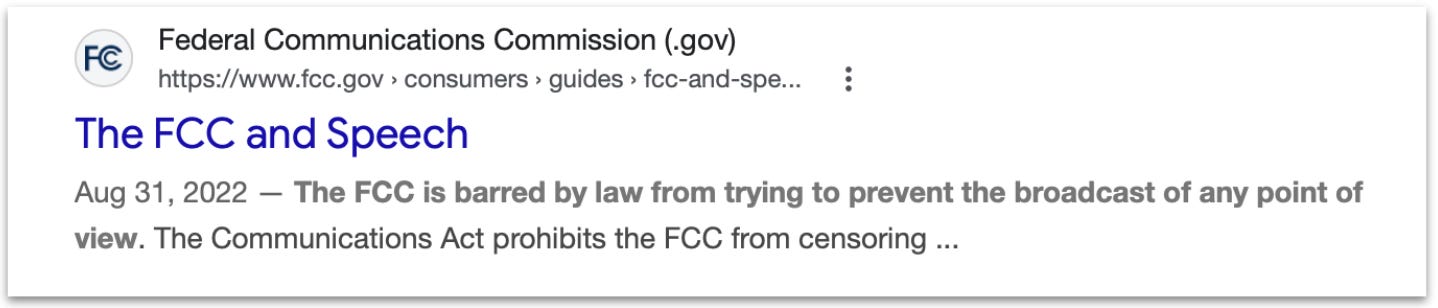
On that page, the FCC itself is clear: “The FCC is barred by law from trying to prevent the broadcast of any point of view.”
What Brendan Carr is doing is illegal. It is illegal for the FCC to even threaten to use its regulatory power to coerce or censor speech.
Specifically, the Communications Act — as the FCC’s web explainer helpfully cites — states that:
[Nothing in the law] shall be understood or construed to give the Commission the power of censorship over the [broadcast] communications or signals transmitted by any [broadcast] station, and no regulation or condition shall be promulgated or fixed by the Commission which shall interfere with the right of free speech by means of [over-the-air] broadcast communication.
If Carr were to follow through on his threats and attempt to strip licenses for disfavored coverage, there are many technical, legal, and practical barriers.1 But most of them boil down to this: Such transparent censorship would almost certainly be reversed by the courts. Immediately.
Here’s the Supreme Court’s position as of 2024, as summarized by Justice Sonia Sotomayor in Moody v. NetChoice, LLC:
[O]n the spectrum of dangers to free expression, there are few greater than allowing the government to change the speech of private actors to achieve its own conception of speech nirvana.
Read more: The FCC’s News Distortion Policy should be rescinded.
So why is Carr threatening censorship when doing so is so plainly illegal?
The broader goals are intimidation, self-censorship, and a drift towards media capture
Like anyone who makes similar threats, Carr clearly hopes he will never have to try to follow through.
Instead, the goal is to get media outlets to engage in what’s called “anticipatory obedience” — to obey in advance.
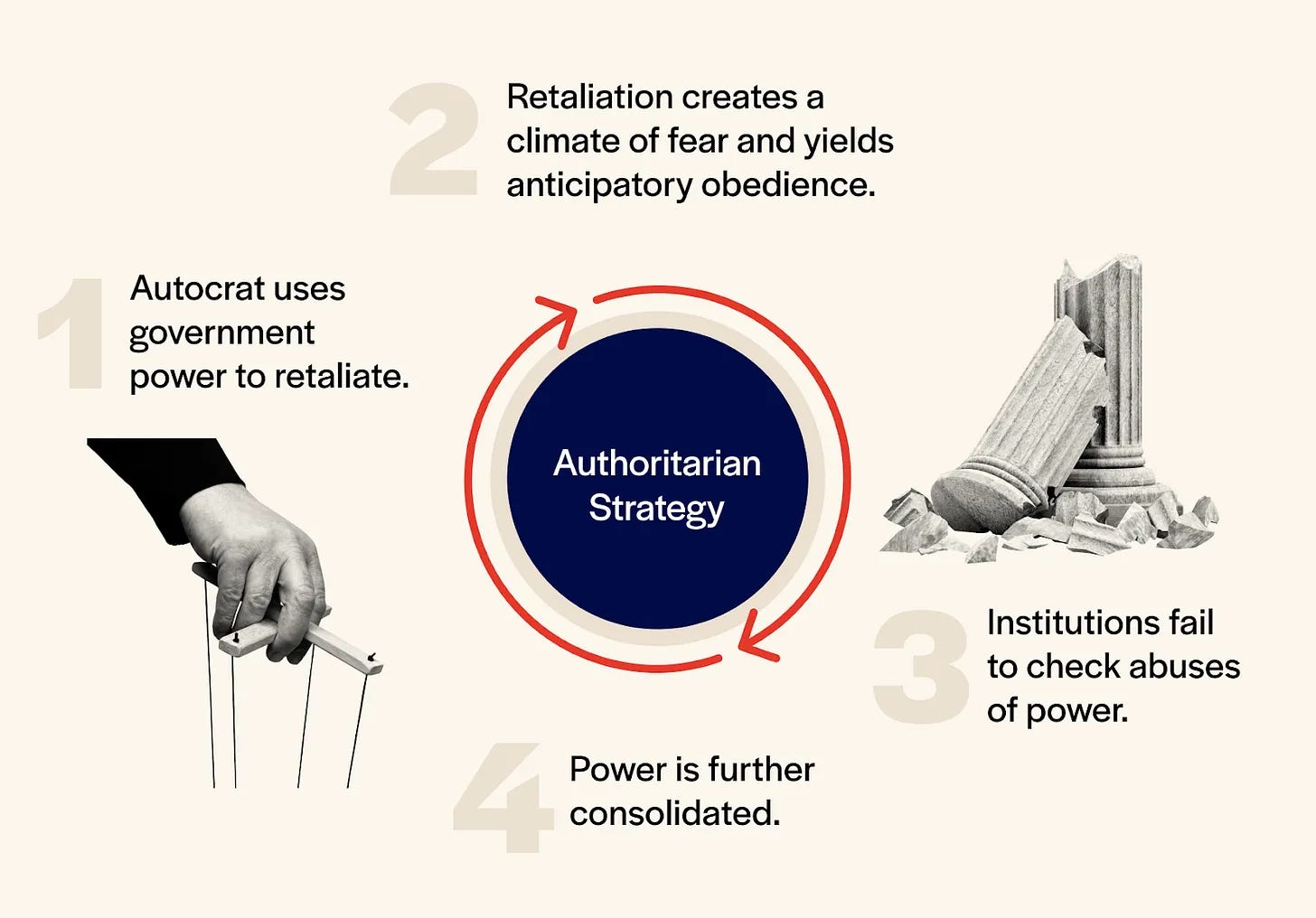
This is a vicious cycle. The more editors, producers, executives, and owners feel threatened by administration officials, the more they will be inclined to check their own coverage.
Brendan Carr doesn’t just want to censor specific outlets or stories. He wants every outlet and every journalist to worry about how the FCC is going to react to every word they write or say. He wants to be in the back of every reporter’s head. To have them temper every headline just to make it “more defensible.” To hold back on controversial stories for more sourcing. To scrap some altogether. To promote pro-administration voices in the name of “balance.”
To think first of politics, not of truth.
The more outlets check their coverage, the more the administration becomes unchecked. And the greater its power to threaten others.
On and on the cycle spins. Over time, as the media drifts from bias to outright capture, eventually the once-free press looks anything but.
As my colleague Rachel Goodman told a congressional spotlight hearing last month:
[The ultimate goal is the] “Hungary model” of media capture, in which a nominally independent media regulator, who in fact is completely aligned with the president or the ruling party, exerts financial and administrative pressure on independent media in an effort to destabilize their business and, ultimately, eliminate the independent media company. In Hungary, when Fidesz achieved its supermajority in 2010, one of the first laws it passed was a media law, justified as a needed “corrective” to left wing bias in the press. Like the FCC, Hungary’s new media authority is authorized to revoke broadcasting licenses and approve or prohibit mergers, and it has used these powers to penalize media critical of the government and encourage the expansion and consolidation of pro-government media. The Hungary model has been deployed in de-democratizing societies around the world; when Poland’s Law and Justice party held the government from 2015 to 2023, it similarly deployed regulatory power to weaken critical media through antitrust investigations, licensing decisions, and retroactive taxation.
We’re already seeing what this looks like at CBS, at the Washington Post, at the Los Angeles Times. CNN may be next if Trump-friendly Paramount succeeds in buying Warner Bros. Discovery. (Note: Carr has openly praised the deal and pledged to swiftly approve it; state regulators have a different view.)
Elections are the target — but remember: Carr’s power is illusory
All of this, like everything else the administration does, should be understood as aimed squarely at future elections.
Importantly, the goal is not just to distort the news that voters are hearing before elections so that they are more inclined to vote for the president’s political allies (although it certainly is that too). The scarier implication is what a captured media could mean if and when the autocratic faction attempts to undermine or overturn future election results.
Instead of headlines like these?
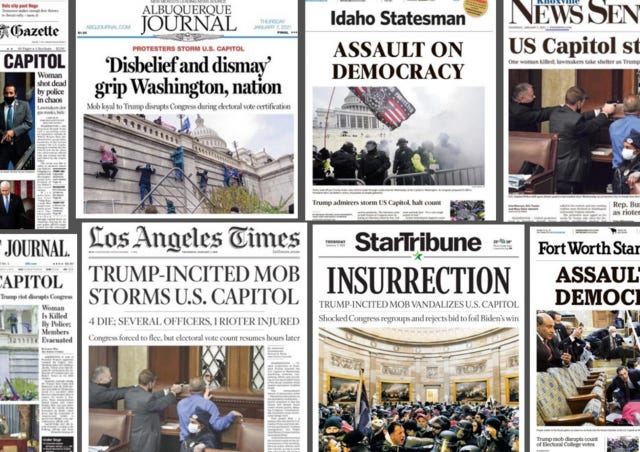
Carr and others in the administration would want you to instead see ones like this.
Here is the good news: The United States is not Hungary. Brendan Carr’s power may be easily abused, but — at least when it comes to censorship — it is also largely illusory. Every single outlet can, indeed they must, respond to Carr’s threats with something that echoes that statement at the top from former FCC leaders:
That the FCC has absolutely no business censoring speech.
That Carr’s abusive threats make him constitutionally unfit for the office he holds.
And that the free press in this country will continue to put facts above politics long after Carr is gone from the FCC.
The SAVE America Act strategy, explained
This week, the Senate has been ensnared by Trump’s efforts to ram through the SAVE America Act, a Frankenstein’s monster of deliberate voter suppression and disenfranchisement measures that would wreak havoc on America’s elections process. It would, among other things, require a passport or birth certificate to register to vote, impose highly restrictive ID requirements on in-person and mail voting, target elections officials with steep criminal penalties, and potentially disenfranchise the 69 million married women who have changed their last names.
The law is and has always been doomed to failure. So what’s the big deal?
The Atlantic’s Russell Berman and Yvonne Wingett Sanchez explain (with an assist from my colleague Alexandra):
The most pressing question about the SAVE America Act is not whether it’s going to pass, but why Trump and his allies are so determined to see the Senate put up a bill that’s doomed to fail…
Voting-rights advocates have a theory. “It’s a pretext for the next authoritarian escalation,” Alexandra Chandler, who oversees the elections team at the advocacy group Protect Democracy, told us. Chandler and others we interviewed see the Senate’s high-profile debate as one episode in a broad, sustained, coordinated effort by the White House to seed doubt in American elections ahead of what Republicans believe could be steep losses this November. This, she said, would follow a pattern that Trump set both before and after his 2020 loss: before the election, manufacture a crisis upon which he can then blame defeat. “When his allies lose elections, it’s a talking point,” Chandler said: “You didn’t pass the legislation that would have solved this fake problem, and therefore the election results are not valid.”
The whole article is a must-read: A serious Senate debate about an unserious bill (gift link)
What else we’re tracking:
“What if we make the House bigger?” Highly recommend this conversation on Highway to Hill with Aubrey Wilson and Anne Meeker of POPVOX Foundation on House expansion and proportional representation in practice.
Sweden’s Varieties of Democracy (V-Dem) Institute, one of the most prestigious academic institutions studying democracy, has an alarming new report on the United States: “Our data on the USA goes back to 1789. What we’re seeing now is the most severe magnitude of democratic backsliding ever in the country.”
Similarly, Freedom House is out with their Freedom in the World 2026 report. Global freedom declined for the 25th straight year (the U.S. is now less free than Poland, Mongolia, and Romania). Still, they write, “even in this especially challenging moment, there are reasons for optimism.”
Appointing JAGs to prosecute regular civilian cases undermines military and violates law — Admiral James McPherson and Protect Democracy’s Zach West explain the troubling new trend for Law.com.
I highly recommend this essay from Protect Democracy advisor Anne Applebaum in The Atlantic on Donald Trump’s increasingly irrational foreign policy: Everyone but Trump understands what he’s done.
For example, as Middle Tennessee State’s Free Speech Center humorously notes, the FCC doesn’t even have authority over most of the outlets he is threatening. “The FCC’s authority applies only to broadcast stations, a quickly shrinking subset of the news universe. CNN, MS NOW (formerly MSNBC) and all other cable networks are beyond his power. He’s like a safety-patrol boy trying to pull over cars; they’re out of his reach. Even CBS, which like other broadcast networks has some owned and operated stations, is immune from the FCC as a network. Any action taken would have to be against individual stations for individual and documented reasons and would take years to resolve.”
Or, as the commission’s lone remaining Democrat Anna Gomez noted: “No licenses are up for renewal until 2028. Early renewal attempts are exceedingly rare, and the process is so demanding that any effort would almost certainly fail.”
Read the ‘Sweden’ article, 2nd bullet point at the end of this article.
Sounds like persuasive explanations for Carr's threat and for Trump pushing for a vote on the so-called "SAVE Act".